

This analysis was updated on September 1, 2026, to take into account details of the text of the agreement and associated documents after they had been transmitted to Congress.
President Donald Trump announced on July 22 that the United States and Saudi Arabia finalized a civil nuclear cooperation agreement. On Aug. 24, the Trump administration transmitted the deal, along with the unclassified Nuclear Proliferation Assessment Statement (NPAS), to Congress for review, as required by the Atomic Energy Act. Without Congressional action to block the nuclear cooperation agreement or modify its terms, the deal will enter into effect after 90 days. Despite the Trump administration's claims that the nuclear cooperation agreement meets the highest standard for nonproliferation, the deal will increase the risk of Saudi proliferation, erode longstanding nonproliferation norms, and set a dangerous precedent for future nuclear cooperation agreements.
In negotiating the Saudi nuclear agreement, the Trump administration rejected key nonproliferation conditions for U.S. nuclear cooperation that have long-standing bipartisan support and are internationally recognized best practices.
Most critically, the deal does not require Saudi Arabia to adhere to the more intrusive International Atomic Energy Agency (IAEA) safeguards agreement, known as the Additional Protocol. As described by the agency, the Additional Protocol provides additional tools for verification and “increases the IAEA’s ability to provide much greater assurance on the absence of undeclared nuclear material and activities.”
The Trump administration argues the proposed bilateral safeguards arrangement negotiated with Saudi Arabia is an adequate substitute, but it appears to only apply to a limited number of sites where cooperative U.S.-Saudi nuclear activities take place and would not provide access to all of the facilities covered by the Additional Protocol.
Furthermore, the proposed U.S.-Saudi agreement includes a pathway for Saudi Arabia to develop a uranium enrichment program, possibly using U.S. technology and permitting enrichment of uranium up to 20 percent. Saudi Arabia claims its interest in enrichment is purely for the production of reactor fuel, but the same technology can be used to produce fissile material for a bomb. This is particularly troubling given that Saudi officials have openly threatened to pursue nuclear weapons to match any Iranian capability and they have refused to adopt the Additional Protocol.
The following are answers to frequently asked questions about the Saudi nuclear program, the U.S-Saudi nuclear agreement, the Additional Protocol, and the requirements of Section 123 of the Atomic Energy Act.
The Arms Control Association has reviewed the text of the nuclear cooperation agreement, the bilateral US-Saudi safeguards agreement, the unclassified NPAS, and the memorandum from the Secretary of State and Secretary of Energy to the President regarding the agreement. Those documents, submitted to Congress Aug. 24, inform the answers to and the analysis in this updated set of FAQs.
The memorandum from Secretary of State Marco Rubio and Secretary of Energy Chris Wright indicated that there are two confidential side letters on implementation of the agreement, which remain classified and are not publicly available. These letters likely include additional details about the terms of possible cooperation on enrichment and should be made public to inform the debate around proliferation risks of this accord.
The FAQs also raise some of the questions about the proliferation risks posed by the nuclear cooperation agreement that Congressional members should explore during the review, including the regional and international implications of the Saudi agreement for nonproliferation efforts.
The following questions are addressed:
- What is the status of Saudi Arabia’s nuclear program?
- What has Saudi Arabia said about nuclear weapons?
- What is the status of the US-Saudi Nuclear Cooperation Agreement?
- How long did it take to negotiate the 123 Agreement?
- Does the nuclear cooperation agreement require Saudi Arabia to adopt the IAEA Additional Protocol?
- What is the Additional Protocol and why is it important?
- Has the United States entered into nuclear cooperation agreements without the Additional Protocol in the past?
- Does the Nuclear Suppliers Group require the Additional Protocol to supply enrichment and reprocessing technologies?
- What is the bilateral safeguards agreement that the United States will pursue instead of the Additional Protocol?
- Will the 123 agreement allow Saudi Arabia to enrich uranium?
- Why does the U.S. generally oppose sharing enrichment technology?
- How would a “black box” enrichment program work? What are the risks?
- What uranium enrichment technology would the United States transfer to Saudi Arabia?
- Will US companies benefit from nuclear commerce with Saudi Arabia if the 123 agreement is in effect?
- If the United States does not provide enrichment technology to Saudi Arabia will Russia or China?
- Does the 123 Agreement require Saudi Arabia to join the Abraham Accords?
- What is section 123 of the Atomic Energy Act?
- What is the Nuclear Proliferation Assessment Statement (NPAS)? What Does Saudi Arabia’s NPAS say?
- What is the Congressional review process?
- What is the Gold Standard?
- Has the United States supported the transfer of enrichment and reprocessing technologies as part of its past nuclear cooperation agreements?
- How might the US-Saudi nuclear agreement affect negotiations with Iran?
- Will other states seek similar 123 agreements with the United States or other supplier states?
These FAQs will be updated when additional information becomes available.
What is the status of Saudi Arabia’s nuclear program?
Saudi Arabia’s current nuclear infrastructure is limited, but Riyadh has outlined ambitious plans for expanding its civil nuclear program, including the construction of nuclear power reactors and capabilities to produce nuclear fuel.
In 2017, Saudi Arabia approved the Saudi National Atomic Energy Plan, which called for the construction of two large nuclear power reactors, investment in small modular reactor development, and exploration of fuel cycle options. Saudi Arabia’s nuclear development entity, known as the Nuclear Holding Company, has solicited bids from four companies, Rosatom (Russia), China National Nuclear Corporation, EDF (France) and KEPCO (South Korea) to build its first two power reactors (1.4GWe each) at the Duwaiheen site near the border with Qatar and the UAE.
In addition to the power reactors, Saudi Arabia’s energy minister Prince Abdulaziz bin Salman stated in 2023 that, consistent with the 2017 plan, Riyadh plans to develop the “entire nuclear fuel cycle,” including “the production of yellowcake, low-enriched uranium and the manufacturing of nuclear fuel both for our national use and of course, for export.”
Saudi Arabia has already conducted some exploration of its domestic uranium resources in cooperation with China National Nuclear Corporation. Although Riyadh appears optimistic about mining the ore, Uranium 2022: Resources, Production, and Demand, a joint publication of the International Atomic Energy Agency and the Nuclear Energy Agency, reported that uranium ore deposits in Saudi Arabia would be “severely uneconomic” to mine and that other deposits are only “inferred.”
Saudi Arabia, as a non-nuclear weapon state party to the nuclear Nonproliferation Treaty (NPT), can legally pursue a civil nuclear program, including uranium enrichment, under the treaty’s required International Atomic Energy Agency (IAEA) safeguards. Riyadh, however, has been slow to cooperate with the IAEA on safeguards issues in the past. Saudi Arabia initially had an outdated safeguards agreement, known as the Small Quantities Protocol, designed for states with little to no nuclear materials. Despite repeated requests from the IAEA, Riyadh was slow to update its Small Quantities Protocol or sign a comprehensive safeguards agreement, even after an Argentinian company began work on a research reactor in Saudi Arabia (now completed but unfueled). In 2024, Riyadh finally negotiated a comprehensive safeguards agreement.
What has Saudi Arabia said about nuclear weapons?
Saudi Arabia is a member of the NPT and legally obligated to refrain from developing or acquiring nuclear weapons. However, in a March 2018 interview with CBS, Saudi Crown Prince Mohammed bin Salman said that “Saudi Arabia does not want to acquire any nuclear bomb, but without a doubt, if Iran developed a nuclear bomb, we will follow suit as soon as possible.”
Saudi Arabia’s Foreign Minister Adel al-Jubeir reiterated the comment in a June 2018 interview with CNN, saying that “if Iran acquires a nuclear capability, we will do everything we can to do the same.” In 2022 at the World Policy Conference in Abu Dhabi, al-Jubeir’s successor, Prince Faisal bin Farhan Al Saud, made a similar remark, saying that “[i]f Iran gets an operational nuclear weapon, all bets are off.”
Saudi Arabia does not currently have fissile material production capabilities (the U.S.-Saudi deal may provide that technology) and there is no evidence that Saudi Arabia has violated its NPT obligations and engaged in illicit nuclear activities. The unclassified Nuclear Proliferation Assessment Statement (NPAS) notes that Saudi Arabia has denied reporting that it cooperated with China on a facility to process uranium ore into yellowcake, a form that can later be turned into gas for enrichment, and declined to comment on reports about “an undeclared nuclear site” near al Uyaynah.
Riyadh does appear to be expanding its ballistic missile capabilities, providing a possible delivery system for a nuclear warhead. Saudi Arabia possesses ballistic missiles, purchased from China, that would be technically capable of delivering a nuclear warhead. Previous U.S. intelligence assessments and open-source imagery analysis also suggest that Saudi Arabia is manufacturing ballistic missiles with Chinese support, according to media reports.
What is the status of the US-Saudi Nuclear Cooperation Agreement?
President Donald Trump announced on July 22 that the United States and Saudi Arabia signed a nuclear cooperation agreement. Subsequent documents submitted to Congress specify that Secretary of Energy Chris Wright signed the deal, known as a 123 agreement, on July 20 and Minister of Energy Abdulaziz Bin Salaman on July 22.
Prior to the two ministers signing the deal, Trump signed a presidential determination on July 16 approving the proposed agreement. The determination concluded that the agreement “will promote, and will not constitute an unreasonable risk to, the common defense and security.”
The Trump administration transmitted the deal to the Speaker of the House of Representatives in a letter dated Aug. 24, along with the unclassified Nuclear Proliferation Assessment Statement (NPAS), which is required by the Atomic Energy Acy, the text of the bilateral U.S.-Saudi safeguards agreement, a joint memorandum on the deal from the Secretaries of State and Energy, and a letter from the chair of the Nuclear Regulatory Commission.
The memorandum from Secretary of State Marco Rubio and Secretary of Energy Chris Wright indicates that there were two confidential side letters on implementation of the agreement that were shared with Congress. As required by the Atomic Energy Act, the administration also submitted a classified Nuclear Proliferation Assessment Statement.
The Congressional Record noted the transmission of the documents on Aug. 27.
The Atomic Energy Act requires Congress to review the deal for 90 days before it enters into force. Congress can do nothing, pass a joint resolution to approve the deal, pass a joint resolution of disapproval to block the deal, or seek to modify its terms. (See below for questions about the review process.)
How long did it take to negotiate the 123 Agreement?
The United States and Saudi Arabia were engaged in talks on nuclear cooperation for more than a decade before Trump announced the deal. Previous efforts to reach an agreement stalled over Saudi Arabia’s refusal to adopt the more intrusive IAEA safeguards arrangement, known as the Additional Protocol, and forgo enrichment and reprocessing, technologies that can be used for producing nuclear fuel as well as the fissile material for a bomb.
The Trump administration dropped these conditions in the final 123 agreement, even though there was broad bipartisan support for including them in any nuclear deal with Saudi Arabia. For instance, while he was in the Senate, Secretary of State Marco Rubio authored a bill with Senator Edward Markey (D-Mass.) that would have required Riyadh to have an Additional Protocol to its comprehensive safeguards agreement with the IAEA in place and agree to forgo enrichment and reprocessing as part of any nuclear deal. That legislation did not pass, but Congress did pass a section in the 2020 National Defense Authorization Act that essentially requires the Additional Protocol for new nuclear cooperation agreements. If the deal does not include the Additional Protocol, the president must issue a report to Congress justifying the decision not to require it. (The Trump administration submitted such a report to Congress in November 2025.)
In addition to Saudi reluctance to agree to the Additional Protocol and to give up domestic enrichment and reprocessing, it appears that the Trump administration wanted to ensure that U.S. companies would benefit from the nuclear cooperation agreement. Eight months before the deal was finalized, Trump and bin Salman announced a framework for nuclear cooperation, which stated that U.S. companies will be Saudi Arabia’s “civil nuclear cooperation partners of choice.” The deal indicates that Saudi Arabia and the United States will agree on a list of qualified suppliers, clearly intended to favor U.S. companies.
Reportedly, one of the confidential side letters includes details on Saudi Arabia’s "partners of choice" arrangement with U.S. nuclear suppliers.
Does the nuclear cooperation agreement require Saudi Arabia to adopt the IAEA Additional Protocol?
No. It has been clear for nearly a year that the Trump administration dropped the long-standing U.S. demand that Saudi Arabia adopt an additional protocol as part of any nuclear cooperation agreement. The Trump administration confirmed in a November 2025 report to Congress that the proposed 123 agreement would not require Saudi Arabia to adhere to the IAEA’s Additional Protocol and instead would require a U.S.-Saudi bilateral safeguards agreement.
According to the text of the bilateral safeguards agreement, which was submitted to Congress Aug. 24, the bilateral safeguards agreement will be implemented by the IAEA and only apply to facilities where cooperative nuclear activities occur. That agreement must be approved by the IAEA Board of Governors and in place prior to any cooperative nuclear activities taking place. (See below for additional details on the bilateral agreement.)
The Additional Protocol, by contrast, is a more intrusive safeguards arrangement that gives IAEA inspectors expanded access to sites and information about a country’s nuclear program and additional tools for following up on allegations of undeclared activities.
The decision to forgo the Additional Protocol reverses long-standing U.S. efforts to universalize the more intrusive safeguards agreement and rejects the longstanding bipartisan support for requiring states to have an Additional Protocol in place as part of any 123 agreement.
What is the Additional Protocol and why is it important?
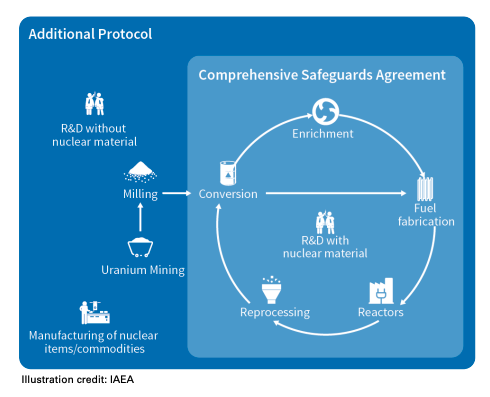
The Additional Protocol is not legally required by the NPT, nor is it a legal requirement for U.S. nuclear cooperation agreements, but it is the internationally accepted best practice for safeguards and specifically designed to provide greater assurance that a country is not engaged in undeclared nuclear activities.
Finalized in 1997, the Additional Protocol was designed to address gaps in the NPT-required comprehensive safeguards agreements. The NPT requires non-nuclear weapon states to implement a safeguards agreement with the IAEA to provide assurance that civilian nuclear materials and technologies are not being diverted for use in a prohibited nuclear weapons program.
However, revelations about the illicit nuclear weapons development efforts of Iraq and North Korea in the early 1990s demonstrated that standard NPT-required safeguards were insufficient, particularly for detecting undeclared nuclear activities.
According to the IAEA, the Additional Protocol “significantly increases the IAEA’s ability to verify the peaceful use of all nuclear material in States with comprehensive safeguards agreements.” The Additional Protocol also “increases the IAEA’s ability to provide much greater assurance on the absence of undeclared nuclear material and activities,” according to the agency.
The Additional Protocol includes several key mechanisms for strengthening IAEA comprehensive safeguards agreements (CSAs), including by:
- Expanding the sites that the IAEA can inspect. Inspections under a CSA apply only to sites where nuclear material is present. The Additional Protocol allows the IAEA to inspect sites that support a nuclear program, but where no material is present. This includes locations such as, research and development facilities, centrifuge production sites, and uranium mines (uranium ore is not considered nuclear material).
- Allowing the IAEA to request short-notice inspections to all facilities at a site.
- Requiring a state to provide additional information about its program to the agency, including research and development activities and relevant imports
- Providing the IAEA with additional tools, such as wide-area environmental sampling, to investigate and assess if a state has conducted illicit nuclear activities.
- Facilitating complementary access to undeclared sites to address inconsistencies or ensure the absence of undeclared nuclear activities.
The United States was instrumental in pushing for the Additional Protocol’s negotiation in the 1990s and advocating for its universalization.
According to the IAEA, 144 states and Euratom have now ratified additional protocols. The United States and the four other NPT-recognized nuclear weapon states have a version of the Additional Protocol in place for their civil nuclear programs. Iran implemented an Additional Protocol as part of the 2015 nuclear deal, but suspended it in 2021, three years after Trump withdrew from the agreement despite Iran’s compliance.
Has the United States entered into nuclear cooperation agreements without the Additional Protocol in the past?
Yes, but it is rare. There is long-standing bipartisan support in Congress for requiring the Additional Protocol as a condition of 123 agreements.
India, a nuclear-armed state that is not a member of the NPT, did not have an Additional Protocol in place when it negotiated a nuclear cooperation agreement with the United States in 2006. India later negotiated and signed an Additional Protocol, but it is criticized as a weak version of the 1997 Model Additional Protocol (as a non-party to the NPT, India was not obligated to adopt the Model Additional Protocol in its entirety). The United States also concluded 123 agreements with Argentina and Brazil that did not require the Additional Protocol. These agreements were concluded shortly after the Additional Protocol was negotiated. Argentina and Brazil also already had an established bilateral accounting regime in addition to their IAEA safeguards agreements. Even so, the United States has continued to encourage both countries—and all other states—to adopt Additional Protocols.
Does the Nuclear Suppliers Group require the Additional Protocol to supply enrichment and reprocessing technologies?
Yes, but the Nuclear Suppliers Group (NSG) guidelines are nonbinding.
The NSG is a multilateral initiative comprised of 48 states (including the United States) that sell nuclear technologies. NSG members adopted the Additional Protocol (or a regional safeguards arrangement) as a condition of supplying enrichment and reprocessing technology in 2011.
Specifically, the updated guidelines say that suppliers should authorize enrichment and reprocessing exports only if the recipient has brought into force a comprehensive safeguards agreement and an additional protocol or, “pending this, [the recipient] is implementing appropriate safeguards agreements in cooperation with the IAEA, including a regional accounting and control arrangement for nuclear materials, as approved by the IAEA Board of Governors.”
The NSG guidelines—which the United States pushed for—underscore that enrichment and reprocessing technology transfers are discouraged and that the Additional Protocol is widely supported as a condition of supplying enrichment and reprocessing technology.
The unclassified Nuclear Proliferation Assessment Statement accompanying the proposed U.S.-Saudi agreement does not address the potential impact of its variance with the NSG's guidelines.
What is the bilateral safeguards agreement that the United States will pursue instead of the Additional Protocol?
The documents the Trump administration sent to Congress Aug. 24 include the text of the bilateral U.S.-Saudi safeguards agreement. Although the bilateral safeguards agreement contains some provisions that go beyond Saudi Arabia’s NPT-required comprehensive safeguards agreement, such as short notice IAEA inspections at covered sites, the bilateral deal is insufficient to provide assurances that Saudi Arabia’s nuclear program will remain peaceful, that there are no undeclared nuclear activities in Saudi Arabia, and that technologies and materials transferred from the United States will not assist Riyadh’s development of nuclear weapons, if the political decision is made to pursue a nuclear deterrent.
According to the text of the bilateral safeguards agreement, the additional measures will be applied by the IAEA only to “covered sites” defined by the nuclear cooperation agreement. The scope of the agreement stipulates that “all uranium conversion, uranium enrichment, fuel fabrication, reprocessing, or any associated research and development activity undertaken pursuant to the Nuclear Cooperation Agreement shall occur at a location on a covered site.”
The agreement requires Saudi Arabia to provide the IAEA with a list of covered sites, a description of each building in Saudi Arabia where cooperative nuclear activities occur, including its “use, contents and activities”, and a description of fuel cycle-related research and development activities that do involve nuclear materials at covered sites.
Saudi Arabia must provide to the IAEA a description of “the scale of operations and manufacture of nuclear-related equipment and non-nuclear material related to the Nuclear Cooperation Agreement,” as well as information about imports of nuclear materials and technologies from the United States and their location and exports of covered materials from Saudi Arabia.
Saudi Arabia must also submit to the IAEA a ten-year plan for nuclear fuel cycle activities.
This information must be submitted within 180 days and updated on a yearly basis.
Regarding IAEA access to the covered sites, the bilateral agreement requires Saudi Arabia to allow the agency to conduct short-notice inspections at covered sites to “verify or to resolve a question related to the correctness and completeness of the information provided by Saudi Arabia.”
The IAEA shall determine the frequency of the access, which will be “kept to the minimum consistent with the objective of the agreement.” The agency must give Saudi Arabia 24 hours notice to access a covered site, or two hours notice if the agency is already on-site. The agreement requires Saudi Arabia to facilitate the IAEA’s ability to conduct “location-specific environmental samples and other objective measures.”
The bilateral safeguards agreement will not give the IAEA access to all sites that would normally be covered by an Additional Protocol. The document suggests that fuel cycle activities, such as uranium mining and milling, would not be covered if conducted solely by Saudi Arabia. The IAEA also may not get information about any previous work conducted by Saudi Arabia on mining and milling. This could create gaps in the agency’s understanding of Saudi stockpiles of uranium ore.
It also does not appear that the agreement will allow the IAEA to request complementary access to undeclared nuclear facilities in Saudi Arabia, a key provision of the Additional Protocol. The agreement stipulates that “in the event that access to a covered site does not resolve an Agency question,” then the United States and Saudi Arabia “agree to immediately consult with the Agency on the appropriate procedures and means to resolve the question under this Agreement without delay.” This suggests that the proposed agreement will not require Saudi Arabia to grant access to sites not covered by the CSA or bilateral safeguards agreement.
If that is the case, this is a particularly crucial difference between the Additional Protocol and the bilateral safeguards agreement required by the Saudi nuclear deal. The Additional Protocol was specifically designed to help the IAEA provide assurance that there are no undeclared nuclear activities—a particularly important assurance given Saudi threats to build nuclear weapons.
The unclassified NPAS supports the assessment that the bilateral safeguards agreement is focused more on diversion than on deterring illicit nuclear activities. It mentions that the bilateral safeguards agreement is intended to provide “added confidence against the possible diversion of material for a nuclear explosive device.”
Preventing diversion is important, but as the case of Iraq demonstrated, it is insufficient for preventing proliferation. The IAEA must have the necessary access and tools to ensure the absence of undeclared nuclear activities.
In summary, the bilateral safeguards agreement text suggests that certain sites relevant to Saudi Arabia’s nuclear program would not be covered by either the bilateral agreement or the CSA, raising concerns about how these locations will be monitored and accessed if/when the IAEA has questions. It is also unclear if the agency will have access to undeclared sites to follow up on evidence of illicit activities.
Will the 123 agreement allow Saudi Arabia to enrich uranium and/or reprocess plutonium?
Yes, the deal could permit uranium enrichment up to 20 percent and the unprecedented transfer of U.S. enrichment technology to Saudi Arabia.
According to the text of the deal, uranium transferred under the agreement or produced by equipment transferred under the agreement “may be enriched if the parties agree in writing, following completion of a Joint Enrichment and Conversion Study.” The two-year study will commence immediately following the implementation of the 123 agreement.
The text states that the Executive Agents designated by the United States and Saudi Arabia “may explore options to support the long-term commercial feasibility of civil uranium enrichment capacity in the United States of America and the Kingdom of Saudi Arabia.” Specifically, as part of the study, the parties will “consult with a view to identifying appropriate options for the enrichment of uranium subject to the agreement and for further development or demonstration in the United States of America of relevant technologies that could be deployed in the Kingdom of Saudi Arabia.” The considerations will take into account the agency’s ability to conduct safeguards and the proliferation risks of such technologies.
After the study is completed the United States and Saudi Arabia will “consult regarding considerations for the transfer of sensitive nuclear facilities or sensitive nuclear technologies and the domestic processes required to authorize such transfers.”
If the deal does lead to an enrichment facility in Saudi Arabia that uses technology transferred from the United States, it does not specify what type of enrichment technology would be transferred. Certain data, such as design information for centrifuges, would not be shared, according to the text of the deal.
The deal does make clear that the initial level of enrichment will be limited to 5 percent uranium-235. The enrichment level can be increased up to 20 percent uranium-235, if the parties complete “an additional Joint High-Assay Low-Enriched Uranium Enrichment Study focused specifically on the considerations relevant to enrichment at that level.”
Enrichment to less than five percent is considered reactor grade. Uranium enriched up to 20 percent is used in some research reactors, but poses a greater proliferation risk because it can be quickly enriched to weapons grade levels (enriching to 20 percent is the significant majority of enrichment work necessary to get to 90 percent). Uranium enriched to 90 percent is considered weapons grade, but a bomb can be made with uranium enriched to less than that level.
The text of the deal omits key details on how the United States might build and operate a uranium enrichment facility in Saudi Arabia. It states the parties shall “develop arrangements and procedures under which any such enrichment may take place.”
According to some reports, if the study supports enrichment, the United States will construct a "black box" enrichment facility in Saudi Arabia that would seek to prevent Riyadh from having direct access to the centrifuge technology used for uranium enrichment, but it is unclear how effective this strategy will be. The Wall Street Journal also reported that if the study does not support a U.S.-constructed enrichment facility, then, after ten years, Saudi Arabia could pursue an indigenous uranium enrichment program or work with another supplier state to develop an enrichment program. Presumably, that program would not be subject to the bilateral U.S.-Saudi safeguards agreement or the Additional Protocol, unless a different foreign supplier insisted upon its inclusion.
Critical details about the black box and 10-year waiting period may be included in one of the confidential side letters and should be made public to verify earlier reports and better assess the proliferation risks of any proposed plan.
Why does the U.S. generally oppose sharing enrichment technology?
The United States has long opposed the spread of enrichment because the same technology that refines uranium for nuclear fuel can also be used to produce fissile material for a bomb by increasing the enrichment level.
Uranium enrichment technology caries unique risks. Unlike reactors that produce plutonium that can be used to fuel nuclear weapons, centrifuges can be hidden at small, illicit sites or buried underground. As the cases of Iran and North Korea demonstrate, it can be challenging to detect covert uranium enrichment facilities.
How would a “black box” enrichment program work? What are the risks?
As described by media reports, the United States could construct and operate an enrichment facility in Saudi Arabia, if the two year study determines such a plan is viable. Arguments in favor of this approach contend that the arrangement will prevent Saudi Arabia from directly accessing the enrichment technology.
Even if Saudi personnel do not have direct access to the facility, the black box approach does not guarantee that the United States can prevent the Saudis from eventually gaining access to or knowledge of the enrichment technology. There is a risk that information will leak during the course of the joint study on the feasibility of enrichment, subsequent cooperative activities (the Saudi nuclear regulator, for instance, may require certain information about the facility), or in the course of providing information necessary for Saudi Arabia’s declaration to the IAEA regarding the enrichment facility.
It is also unclear how the United States would ensure physical security of the facility and protection of its technology in the event of a conflict. In the event of a rupture of the U.S.-Saudi relationship, Saudi Arabia could attempt to seize and/or nationalize the facility. Similarly, instability in Saudi Arabia or conflict in the region could put the facility in jeopardy.
Members of Congress need to press the administration for answers on how it is planning for these contingencies.
What uranium enrichment technology would the United States transfer to Saudi Arabia?
It is unclear what U.S. entity would provide the uranium enrichment technology to Saudi Arabia if the 2-year study supports enrichment. The two-year study includes “identifying appropriate options for the enrichment of uranium” in Saudi Arabia. This could include technologies that need further development in the United States, according to the deal. It could also theoretically include centrifuges that enrich uranium much more efficiently that the machines used by Iran. The deal makes clear that the United States will not transfer certain restricted data, such as design information for centrifuges, to Saudi Arabia.
The United States already has very limited civil uranium enrichment capabilities and faces challenges meeting its own enriched uranium supply needs. Supply challenges may increase in the coming years, as U.S. law will prevent importing Russian nuclear reactor fuel after 2028. The U.S. government has provided grants to several companies to start or increase uranium enrichment production, but diverting some of that capacity to Saudi Arabia could compound uranium supply issues in the United States.
Will US companies benefit from nuclear commerce with Saudi Arabia if the 123 agreement is in effect?
Not necessarily. Trump has tried to sell the deal as beneficial for reinvigorating U.S. nuclear commerce and the cooperation agreement does say that Saudi Arabia "agrees to partnering with Qualified Suppliers for nuclear power reactors, nuclear reactor fuel, and all other aspects of the nuclear fuel cycle." As defined in the text of the nuclear cooperation agreement, "qualified suppliers" can be entities with licenses (or applications for licenses) with the Nuclear Regulatory Commission or funding/operational authorization from the Department of Energy. But the list can also include any entity agreed in writing by both parties, suggesting non-U.S. companies may be included.
It is also unclear if/how the qualified supplier condition might affect the bids already being considered for the two planned reactors or what might happen if there are no qualified suppliers that can meet Saudi Arabia's specifications for its planned nuclear program. Presumably, Saudi Arabia's existing nuclear cooperation with other states would also continue.
Reportedly, one of the confidential side letters includes additional details on an exclusivity arrangement with U.S. suppliers. But the bottom line remains—finalizing the 123 agreement, even with an exclusivity deal, does not guarantee U.S. nuclear trade to Saudi Arabia.
Furthermore, if the nuclear cooperation agreement goes forward with establishing fuel cycle capabilities, such as enrichment and fabrication in Saudi Arabia, U.S. companies could lose the option for lucrative fuel supply contracts on U.S.-designed reactors. Russia, for that reason, builds fuel supply contracts into its reactor bids.
During the debate over the U.S.-India nuclear cooperation agreement, the Bush administration made similar arguments: the agreement would lead to U.S. reactor sales to India. But since that deal was finalized in 2008, no U.S. company has sold a reactor to India.
If the United States does not provide enrichment technology to Saudi Arabia will Russia or China?
A common argument in favor of the U.S.-Saudi nuclear deal suggests that if the United States does not assist Saudi Arabia in developing its nuclear program, Russia or China will, and with fewer safeguards in place. But it is unclear if this scenario would play out.
Russia and China, like the United States, should abide by the Nuclear Suppliers Group (NSG) condition that a state have an Additional Protocol, or other regional mechanism in place, before the transfer of enrichment or reprocessing technology. Neither state has supplied Saudi Arabia with this technology to date, despite preexisting nuclear cooperation arrangements with the Kingdom.
Furthermore, both states may see value in refraining from supporting Saudi Arabia’s fuel production plans, particularly if Saudi Arabia builds Russian or Chinese-supplied reactors. Russia’s state-owned Rosatom, for example, prefers to sign reactor contracts that include lifetime fuel supply because of the economic benefits.
If the United States is seriously concerned about another NSG member supplying enrichment or reprocessing technologies to another state without adequate safeguards, Washington should be seeking to bolster and strengthen conditions of supply and support for those conditions, not weakening the norm. By rejecting the NSG’s guidelines regarding the Additional Protocol without providing a clear, compelling case as to why, the United States sets a precedent that other states may follow.
Does the 123 Agreement require Saudi Arabia to join the Abraham Accords?
No. The text of the U.S.-Saudi nuclear cooperation agreement does not require Saudi Arabia to sign the Abraham Accords, which are a 2020 diplomatic framework that led several countries, including the United Arab Emirates and Bahrain, to recognize Israel. It is unclear if or how the United States will insist on such recognition before fulfilling certain aspects of the bilateral nuclear cooperation agreement.
On July 23, the day after Trump announced the 123 agreement with Saudi Arabia (and a week after he signed a presidential determination on July 16 approving the agreement), he posted on Truth Social that the nuclear cooperation agreement “will be approved, but is totally subject to Saudi Arabia joining the very respected and successful Abraham Accords.”
The proposed agreement does not reference the Abraham Accords, and Saudi Arabia has not publicly responded to Trump’s demand. Israeli Prime Minister Benjamin Netanyahu said that Saudi Arabia joining the accords would be a “historic leap forward for peace in the Middle East.”
What is section 123 of the Atomic Energy Act?
Section 123 of the U.S. Atomic Energy Act (AEA) establishes the conditions and outlines the process for major nuclear cooperation between the United States and other countries. In order for a country to enter into such an agreement with the United States, that country must commit to a set of nine nonproliferation criteria. These criteria state that:
- Nuclear material and equipment transferred to the country must remain under safeguards in perpetuity.
- Non-nuclear-weapon states partners must have full-scope IAEA safeguards.
- Transferred nuclear material, equipment, and technology will not have any role in nuclear weapons development or any other military purpose (except in the case of cooperation with nuclear-weapon states).
- In the event that a non-nuclear-weapon state partner detonates a nuclear device using nuclear material produced or violates an IAEA safeguards agreement, the United States has the right to demand the return of any transfers.
- U.S. consent is required for any re-transfer of material or classified data.
- Nuclear material transferred or produced as a result of the agreement is subject to adequate physical security.
- U.S. prior consent rights to the enrichment or reprocessing of nuclear material obtained or produced as a result of the agreement.
- Prior U.S. approval is required for highly-enriched uranium (HEU) and plutonium obtained or produced as a result of the agreement. An agreement permitting enrichment and reprocessing (ENR) using U.S. provided material requires separate negotiation.
- The above nonproliferation criteria apply to all nuclear material or nuclear facilities produced or constructed as a result of the agreement.
The President may exempt a proposed agreement from any of the above criteria upon determination that maintaining such criterion would be “seriously prejudicial to the achievement of U.S. non-proliferation objectives or otherwise jeopardize the common defense of the United States.” Exempted 123 agreements require a congressional joint resolution approving the agreement for it to become law. The Saudi agreement will be a non-exempt agreement and will not require an affirmative vote of approval.
For the U.S. nuclear cooperation agreement with India, a non-NPT member state without full-scope safeguards, Congress passed the Henry J. Hyde United States-India Peaceful Atomic Energy Cooperation Act in 2006. The Hyde amendment has been criticized for undermining U.S. and international counterproliferation efforts, including the Nuclear Suppliers Group.
What is the Nuclear Proliferation Assessment Statement (NPAS)? What Does Saudi Arabia’s NPAS say?
Under the Atomic Energy Act, the President must submit to Congress a classified and unclassified Nuclear Proliferation Assessment Statement (NPAS), explaining how the nuclear cooperation agreement meets the nine criteria laid out in Section 123. The President must also determine in the NPAS that the agreement "that the performance of the proposed agreement will promote and will not constitute an unreasonable risk to the common defense and security."
The unclassified NPAS on the nuclear cooperation agreement with Saudi Arabia does address the nine criteria in Section 123. It does not, however, adequately address the Saudi threats to develop nuclear weapons. The NPAS acknowledges that Saudi Crown Prince Mohammad bin Salman made “concerning public statements indicating that, if Iran were to develop a nuclear weapon, the Kingdom would quickly follow suit,” but notes that Saudi Arabia “has repeatedly reaffirmed its commitment to the peaceful uses of nuclear energy, the nuclear nonproliferation regime, and the NPT.” The NPAS goes on to say that the proposed agreement “contains strong nonproliferation terms.”
The United States should not be satisfied that Saudi Arabia’s statements supporting the NPT are more credible than its threats to weaponize, particularly when the NPAS does not adequately explain why Saudi Arabia refuses to adopt an additional protocol.
The NPAS report raises additional proliferation concerns. It notes, for instance, that “Saudi Arabia currently lacks comprehensive export control and dual-use regulations.”
What is the Congressional review process?
The Atomic Energy Act requires that nuclear cooperation agreements are submitted to Congress for a review period comprised of 90 days of continuous session. That period is broken up into a 30-day review by the Senate Foreign Relations Committee and House Foreign Affairs Committee, followed by a 60-day review by the entire Congress.
If the 90 days elapse without Congressional action, a "non-exempt" nuclear agreement enters into effect. If Congress passes a joint resolution of disapproval, the agreement cannot enter into effect (unless it is vetoed and the veto is not overridden). A resolution of approval or disapproval is privileged and thus subject to expedited consideration.
A joint resolution of approval can simply support the deal, or it could also include conditions for any export of U.S. technology under the 123 agreement, such as a requirement that Saudi Arabia join the Additional Protocol. Congress could also pass stand-alone legislation conditioning any transfers of nuclear technology or materials to Saudi Arabia. Congress took similar steps in the case of the U.S. nuclear cooperation agreement with China, conditioning export licenses on a certification that China was meeting certain nonproliferation conditions.
In considering the Saudi agreement, Congress should consider pressing the administration to answer questions about the implications of abandoning the Additional Protocol and the risks of providing enrichment technology to a country that has openly threatened to build nuclear weapons. Members of Congress should also consider the broader ramifications of abandoning these key nonproliferation conditions. Questions could include:
- How does the proposed bilateral arrangement compare to the Additional Protocol?
- What are the proliferation risks if the IAEA does not have access to undeclared sites in Saudi Arabia as it would with the Additional Protocol?
- How will the United States continue to support universalization of the Additional Protocol if it abandons this objective vis-a-vis Saudi Arabia?
- How will the proposed Saudi deal make it more challenging to negotiate an effective nuclear nonproliferation deal with Iran?
- What is the makeup of the group that will study the question of enrichment and how will it make its decision and are there conflicts of interest?
- How does the U.S. plan to ensure the physical protection of any enrichment facility/technology transferred to Saudi Arabia?
- Is the United States concerned that Saudi Arabia will leverage its threat to weaponize once there is domestic enrichment in the country for additional U.S. security guarantees?
- Is the United States concerned that other countries will seek similar deals (with the United States or others) giving additional states access to key technologies necessary to produce fissile material for a bomb without more intrusive IAEA safeguards?
The Gold Standard refers to a nuclear cooperation agreement that requires a state to permanently forgo uranium enrichment and plutonium reprocessing. The United Arab Emirates negotiated such an agreement with the United States in 2009.
When members of Congress refer to the Gold Standard, they often reference the prohibition on enrichment and reprocessing as well as a requirement that the state implement an Additional Protocol.
The U.S. push to include the Additional Protocol in all nuclear cooperation agreements, however, predates the Gold Standard, and continued as U.S. policy even after administrations began to move away from the Gold Standard.
After the United States and Saudi Arabia announced a framework for nuclear cooperation in November 2025, Chairman of the Senate Foreign Relations Committee Jim Risch (R-Idaho) and Ranking Member Jeanne Shaheen (D-New Hampshire) both stated that any 123 agreements with Saudi Arabia should adhere to the Gold Standard.
Has the United States supported the transfer of enrichment and reprocessing technologies as part of its past nuclear cooperation agreements?
No. The United States has never directly transferred enrichment or reprocessing technology to a non-nuclear-weapon state or provided it via a ‘black box’ agreement because of the proliferation risks. Transferring uranium enrichment technology to Saudi Arabia would break the long-standing U.S. opposition to the spread of those technologies as part of its nonproliferation strategy.
The United States has, on a limited basis, provided what Section 123 of the Atomic Energy Act refers to as “advanced consent.” This provides pre-approval for a state to alter nuclear materials provided by the United States or produced by technologies provided by the United States. The United States, for example, in its 123 agreement with Japan, provided advanced consent for Japanese reprocessing of spent fuel for its civilian nuclear power program.
The United States has also negotiated 123 agreements that allow states to conduct indigenously designed enrichment and reprocessing activities under certain limits. The 123 agreement with South Korea, for instance, created a pathway to South Korea’s enrichment of uranium to less than 20 percent, if agreed upon by a high-level U.S.-South Korean commission. (Trump reversed long-standing U.S. opposition to South Korea exercising the enrichment option in November 2025 and the United States is now negotiating with South Korea regarding the scope of a uranium enrichment program, but it will not include the transfer of U.S. technology.)
How might the US-Saudi nuclear agreement affect negotiations with Iran?
Given Iran’s history of illicit nuclear activities and expected uncertainties in accounting for Iran’s nuclear material after U.S. and Israeli strikes, the additional protocol should be a key priority in any US-Iran nuclear deal. But Iran has long argued that it does not want to be singled out for restrictions beyond what other non-nuclear weapon states are subject to. If the United States is not requiring Saudi Arabia to implement an Additional Protocol, it will likely be harder to press Iran to accept the Additional Protocol.
Similarly, Trump has suggested he is pushing for a 15-20 year suspension on uranium enrichment in Iran as part of any deal. Iran may be less likely to accept a longer moratorium if Saudi Arabia may have uranium enrichment technology on its soil after two years.
Furthermore, the deal may disincentivize states from pursuing regional solutions to meet fuel cycle needs and reduce proliferation risks. If states pursue bespoke arrangements with different conditions with the United States, there is less incentive and basis for future collaboration.
Will other states seek similar 123 agreements with the United States or other supplier states?
There is a risk that the Saudi deal will incentivize other states to seek agreements that allow them to develop technologies relevant to weapons under the guise of cooperative civil activities and without more intrusive safeguards. This is particularly worrisome now as additional states are debating the merits of acquiring nuclear deterrents and the value of remaining in the NPT.
The UAE, for instance, could renegotiate its Gold Standard agreement with the United States under a clause that allows for revisiting the deal if another state in the region gets more favorable terms.
There is also a risk that other supplier states may provide similar proliferation-risky deals to partners or allies. If the United States makes an exception for Saudi Arabia and provides enrichment technology without an Additional Protocol, other states may similarly seek to flout the Nuclear Suppliers Group guidelines for their partners and allies, increasing the risk that the proliferation-sensitive enrichment and reprocessing technologies are more widely available.—KELSEY DAVENPORT, Director for Nonproliferation Policy