


"[Arms Control Today] has become indispensable! I think it is the combination of the critical period we are in and the quality of the product. I found myself reading the May issue from cover to cover."
NNSA Charts Buildup as Delays Mount
April 2026
By Xiaodon Liang
Los Alamos National Laboratories will produce 60 plutonium pits per year by the end of 2028 if the site can meet new objectives set out by a leading official at the National Nuclear Security Administration (NNSA) in a Feb. 11 memo.
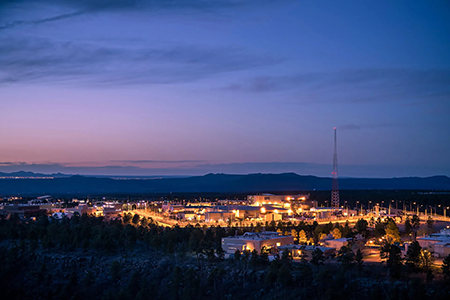
The lab’s plutonium facility also should have the capability to "enable production of 100 pits" by the end of 2028, according to the objective-setting document, which was obtained and published by the Los Alamos Study Group, a locally-based advocacy organization.
The memo, authored by David Beck, the NNSA deputy administrator for defense programs, sets ambitious targets for increasing nuclear weapons production across the agency. The “transformation objectives” represent what Beck’s office “believes are achievable by the end of calendar year 2028.”
The memo instructs the NNSA to also deliver the W80-4 warhead for the Long-Range Standoff Weapon, the new Air Force nuclear cruise missile, “ahead of [Defense Department] required need dates,” accelerate development and delivery of the warhead for the sea-launched cruise missile, and “Demonstrate and transition to Stockpile Management at least two novel Rapid Capability nuclear weapons systems.”
Since 2018, the NNSA has planned to produce 30 plutonium pits per year at Los Alamos, New Mexico, with another 50 to be produced annually at the under-construction Savannah River Plutonium Processing Facility in South Carolina. The Savannah River facility is now expected to be completed by September 2035, at a cost of over $22 billion, according to a Feb. 26 report by the Government Accountability Office (GAO).
The GAO also noted that work to install pit production equipment at Los Alamos to meet the existing 30-pits-per-year target had suffered delays attributable to “prioritizing resources to achieve the first production unit for [the] W87-1 [warhead] through late 2024,” as well as difficulties procuring gloveboxes for handling radioactive items.
The NNSA is shifting its strategy for procuring and installing equipment at Los Alamos through a reprioritization of items and programs. According to the GAO, new estimates for the cost and schedule of the Los Alamos effort will be available in early 2026.
The agency published Mar. 25 its final site-wide environmental impact statement studying alternatives for the future of nuclear weapons work and other activities at the Los Alamos site over the next 15 years. The statement was accompanied by the agency’s decision to choose the most expansive option among the three considered, implying the construction of new facilities for capabilities that currently do not exist at the lab.
The New Mexico Environment Department issued an administrative compliance order Feb. 11 to the U.S. Department of Energy, the NNSA, and the contractors that operate Los Alamos instructing them to take steps to clean up toxic waste at Material Disposal Area C, a legacy unlined dump on laboratory grounds. (See ACT, September 2025.)
The GAO report, based on a review of the Energy Department’s project assessment database through June 2025, indicates that other major NNSA projects are experiencing schedule delays.
Two projects associated with the Uranium Processing Facility being built at the Y-12 National Security Complex in Oak Ridge, Tennessee, will see extended delays. The main process building is roughly six years behind schedule and will cost $7.45 billion dollars, compared with an earlier estimate of $4.73 billion.
The new Lithium Processing Facility at Y-12 will also be completed late by about six years, at a cost of $6 billion. Previous estimates put the cost of the facility at between $871 million and $1.5 billion, the GAO reported.
The Feb. 11 NNSA memo also directs staff to “Execute the President’s directive with respect to the testing of the U.S. nuclear deterrent.” President Donald Trump announced last October that the United States would resume testing on an “equal basis” with nuclear peers. (See ACT, November 2025.)
The administration has yet to elaborate how this order will be implemented by the NNSA, and the memo indicates that next-step activities related to testing remain “TBD”—yet to be decided.
Correction: In the April 2026 issue of Arms Control Today, the story "NNSA Charts Buildup as Delays Mount" on p. 28 misinterpreted a line in a document by David Beck, deputy administrator for defense programs at the National Nuclear Security Administration. The document called for Los Alamos to have the capability to "enable production of 100 pits" by the end of 2028.