


“For half a century, ACA has been providing the world … with advocacy, analysis, and awareness on some of the most critical topics of international peace and security, including on how to achieve our common, shared goal of a world free of nuclear weapons.”
The NPT System Hangs in the Balance
April 2026
By Daryl G. Kimball
For more than five decades, the nuclear Nonproliferation Treaty (NPT) has served as the essential framework and catalyst, albeit an imperfect one, for global efforts to stop the spread of nuclear weapons, end nuclear testing, and advance disarmament diplomacy to help achieve a world free of nuclear weapons.
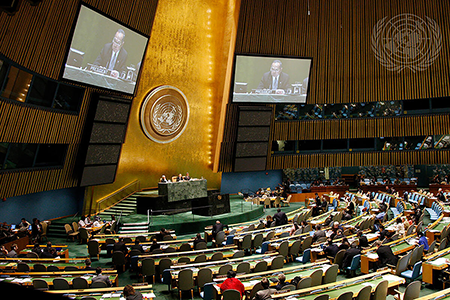
But now, due to years of inattention, inaction, and reckless disregard for international norms of behavior by some NPT nuclear-armed states, the nonproliferation system is facing an uncertain future. States-parties at the past two NPT review conferences, in 2015 and 2022, have failed to overcome differences that have blocked agreement on measures to advance treaty goals.
This makes it essential that diplomats at this month’s 11th NPT Review Conference join together (as they did in 2022 in paragraphs 102-148 of the final draft document) and reaffirm their governments’ support for the treaty, as well as for the principles, objectives, and action steps endorsed by consensus at the 2010 and 2000 review conferences and the pivotal 1995 Review and Extension Conference.
A successful consensus outcome document must also commit key states to concrete action steps that reduce the nuclear danger and advance the NPT’s core goals. As 2026 Conference President Du Hong Viet told Arms Control Today, without such an outcome, “We may lose the credibility of the NPT itself, and the review process.”
This NPT meeting arrives at a time of increasing nuclear danger and serious geopolitical tension. Moreover, key treaties that have served as guardrails against nuclear catastrophe have expired or are under threat.
For the first time since 1972, there are no binding limits on the size of the Russian and U.S. nuclear arsenals, the world’s largest. Both countries might soon begin increasing the number of deployed strategic nuclear weapons for the first time in 35 years. China is expanding the size and diversity of its nuclear arsenal. France just announced that it will increase its arsenal.
Worse yet, there are no active arms control talks between or among the five nuclear-armed NPT states. Each is in violation of the obligation to engage in “negotiations in good faith on effective measures relating to cessation of the nuclear arms race at an early date and to nuclear disarmament” as required by Article VI of the treaty.
The 1996 Comprehensive Test Ban Treaty (CTBT), a core element of the NPT bargain that has 187 signatories and near-universal support, is also under duress. U.S. President Donald Trump has threatened to resume nuclear explosive testing “on an equal basis” and has accused China of conducting a nuclear test in 2020.
However, the seismic data gathered and analyzed by the Comprehensive Test-Ban-Treaty Organization and independent experts is inconclusive, and a retaliatory U.S. nuclear test would not only be technically unnecessary, but it would ignite a chain reaction of nuclear testing by other states that would blow apart the NPT system.
In recent years, threats of nuclear use have also been on the rise, and nuclear-armed states continue to engage in exercises intended to signal their willingness to use these mass terror weapons if provoked.
The illegal attacks against Iran by two nuclear-armed states—NPT nonmember Israel and the United States—have sabotaged active negotiations designed to return International Atomic Energy Agency inspectors to Iran and achieve new limits to block potential pathways to produce bomb-grade material. The ongoing war will certainly revive debate about the goal, as agreed in 1995, of a zone free of weapons of mass destruction in the Middle East.
Despite these strong crosswinds, NPT states must line up together behind a set of core action steps. These include the immediate start of bilateral or multilateral disarmament negotiations. As an interim step, all nuclear-armed NPT states should agree to freeze the number of their strategic nuclear launchers. They should also reaffirm their commitment to the global moratorium on nuclear test explosions and agree to launch technical talks on new, voluntary confidence-building measures to verify compliance before the CTBT enters into force.
Furthermore, the NPT states should pledge to refrain from threatening the use of nuclear weapons, commence negotiations on legally binding negative security assurances for non-nuclear-weapon states in good standing with the NPT, and call upon all nuclear-armed states to promptly ratify the protocols to the South Pacific, African, and Central Asian nuclear-weapon-free-zone treaties. Finally, NPT states should call for universal adoption of the additional protocol to their IAEA safeguards agreements to guard against clandestine nuclear weapons efforts.
Effective leadership from the United States at this conference is, unfortunately, unlikely. For the first time, the U.S. team will not be led by a Senate-confirmed ambassador with prior NPT experience and the diplomatic standing to demonstrate strong presidential commitment to securing a successful review conference outcome.
Other states will need to tip the balance in the right direction. In particular, middle-power countries from all regions will need to band together, as they did in 1995, to push the nuclear-armed powers to respect their solemn NPT commitments and advance the treaty’s objectives. The results of the 2026 NPT Review Conference will likely have profound, long-term effects on our common future.