


"I want to tell you that your fact sheet on the [Missile Technology Control Regime] is very well done and useful for me when I have to speak on MTCR issues."
A Hug Felt Around the World: The Kindness of Hiroshima Hibakusha Shigeaki Mori (1937-2026)
April 2026
By Kathleen Sullivan
On March 14, Shigeaki Mori, a beloved hibakusha, historian, and humanitarian, died at the age of 88. He was 8 years old August 6, 1945, when a U.S. B-29 bomber dropped the first nuclear weapon ever used in war on the city of Hiroshima. Mori was walking to school with a friend at 8:15 on that hot summer morning. A searing bright light blinded the boys, followed by hurricane-force winds from the blast that blew them off a bridge and into the creek below. When Mori regained consciousness, he climbed out of the water and found himself, as he later described the scene, in near-total darkness, inside the mushroom cloud. He eventually found his way to an air-raid shelter and would later be reunited with his family, who also survived. His school companion did not make it out alive.
By the end of September 1945, some 140,000 people, mostly noncombatants, perished from the U.S. atomic bombing. According to Tim Wright in his harrowing report, “The Impact of Nuclear Weapons on Children,” more than 38,000 children perished in Hiroshima and Nagasaki. “According to surveys by the city of Hiroshima, 73,622 children under 10 years of age were exposed to the bombing, of whom 7,907 had died by the end of 1945. Among older children and adolescents, the death toll was thought to be 15,543,” Wright wrote.
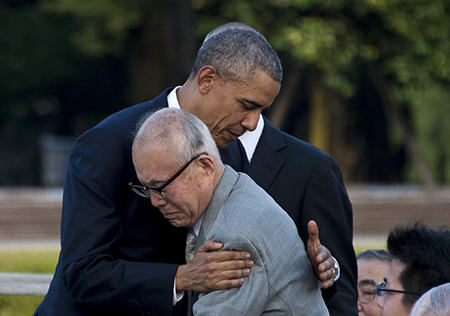
As one of these 70,000-plus children who survived, Mori spent his life, in an extraordinary act of kindness, in the search for U.S. prisoners of war who perished in Hiroshima. He was driven by a desire to inform the loved ones of the fate of these 12 U.S. service members and to help them find closure and healing. After decades of research and reconciliation, Mori’s book was published: The Secret History of the American Soldiers Killed by the Atomic Bomb. His life and research is portrayed in Barry Frechette’s 2016 documentary film, “Paper Lanterns.” Perhaps due to his lifelong pursuit to identify the U.S. POWs, Mori was chosen to be one of the hibakusha who met President Barack Obama, the first sitting U.S. president to visit a city to experience an atomic bombing, in Hiroshima in May 2016. Mori was overcome with emotion by the meeting and in response, Obama embraced him.
This hug that was felt around the world did not please all hibakusha. Many were disturbed by the lesser-known fact of Obama’s visit to the Peace Park in Hiroshima, accompanied as he was by the U.S. nuclear football. Otherwise known as the “presidential emergency satchel,” this 45-pound briefcase contains communication codes and devices needed to initiate a nuclear attack. It is never far from the president’s reach and an additional device is dispatched with the U.S. vice president.
It is terrifying to think of how accessible the nuclear codes are to the current U.S. commander-in-chief, or to any human being who, as with all of us, are fallible and do not always have total control of our faculties. In any case, to bring what is essentially a leather-bound mechanism used to launch nuclear weapons into the Peace Park in Hiroshima was unforgivable to many Japanese people.
Thomas Merton referred to the atomic bomb as the “Original Child Bomb” in his 41-point prose poem, asking: What will happen and speculating that people today are “fatigued by the whole question.” Mori, who spent his adult life identifying U.S. POWs, and in some cases befriending their families, was never fatigued. With gratitude, his memory lives on in those who seek reconciliation and who work for nuclear abolition. As it is written on the cenotaph in Hiroshima: “Let all the souls here rest in peace; for we shall not repeat the evil.”