


"No one can solve this problem alone, but together we can change things for the better."
Pentagon Review to Assess Strategic Numbers
April 2026
By Xiaodon Liang
The U.S. Department of Defense is conducting a “nuclear strategy review” to assess strategic force requirements and potential additional theater nuclear weapons programs in lieu of a full nuclear posture review, a top department official said March 17 at a congressional hearing.
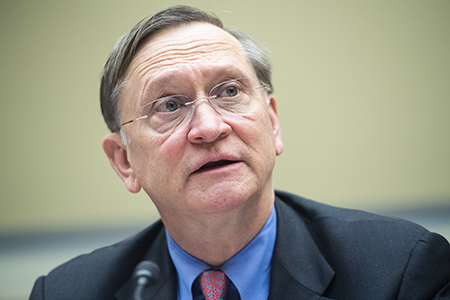
The review will be conducted by the office of the undersecretary of defense for policy and U.S. Strategic Command, according to Robert Kadlec, the assistant secretary of defense for nuclear deterrence, chemical, and biological defense, policy and programs.
Kadlec, speaking before the House Armed Services Committee’s Subcommittee on Strategic Forces, said the review would assess “very specific issues as it relates to the two-peer problem”—as U.S. experts regularly describe China and Russia—and “the pace of modernization and sufficiency of what we have already in the programs of record.”
“People have asked about numbers,” Kadlec said, “and I think this is the first opportunity to really evaluate the threat in a way that is real and tangible.”
In a November 2024 report on the nuclear employment strategy, the Defense Department indicated that it had received guidance from the Biden administration to “continuously evaluate whether adjustments should be made” to the U.S. nuclear force.
Kadlec said that ongoing work to assess additional theater nuclear weapons options would focus on “using the existing stockpile and existing platforms,” in response to a question from the subcommittee chair, Rep. Scott DesJarlais (R-Tenn.), about “tailored supplemental capabilities” to the existing nuclear force.
Elbridge Colby, the undersecretary of defense for policy, previously told the Senate Armed Services Committee March 3 that the Trump administration would not be conducting a formal nuclear posture review. “I think the declaratory policy and so forth from the first Trump term was very good,” Colby said.
The 2018 Nuclear Posture Review produced by the first Trump administration differed from its predecessor, the 2010 review conducted by the Obama administration, in declaring that the “extreme circumstances” under which the United States might contemplate nuclear use could include “significant non-nuclear strategic attacks.” (See ACT, March 2018.)
The Biden administration did not fully reject this change but indicated that this set of contingencies consisted of a “narrow range of other high consequence, strategic-level attacks.”
The Biden review also noted that “a near-simultaneous conflict with two nuclear-armed states would constitute an extreme circumstance.”
In his prepared statement for the March 17 hearing, Kadlec wrote that U.S. nuclear forces must be “robust enough to deter both peers simultaneously, even if we were to be engaged in a major conventional conflict with one.”
“The role of our nuclear arsenal in this context is not to fight and win a nuclear war, but to deter China from escalating to the nuclear level in the first place, or from believing it can use its nuclear arsenal to coerce us into accepting a fait accompli,” Kadlec wrote.
Testifying alongside Kadlec, the head of U.S. Strategic Command, Adm. Richard Correll, expressed concern about the potential vulnerabilities exposed by Ukraine’s successful drone strike against Russian strategic forces last June. Correll indicated in his prepared statement that a Pentagon council had endorsed his command’s new requirements for addressing this threat. (See ACT, July/August 2025.)
Drones controlled by unidentified remote operators were sighted intruding into the airspace of Barksdale Air Force Base, Louisiana, between March 9 and 15, ABC News reported March 20, citing a confidential internal briefing document on the incidents.
Barksdale is home to three squadrons of B-52H strategic bombers. A nuclear weapons storage site is under construction at the base, according to satellite imagery analysis by the Federation of American Scientists.
Multiple waves of drones flew over sensitive portions of the base for more than a week. The aircraft displayed “non-commercial signal characteristics, long-range control links and resistance to jamming,” according to the document cited by ABC News.
Correll also said that, as part of the Pentagon’s Golden Dome missile defense program, his command was “assessing strategic missile threats and prioritizing locations for defense against attacks by nuclear-armed adversaries.”
The admiral’s statement included an estimate of total Russian nuclear forces that counted 2,600 strategic warheads and up to 2,000 warheads for theater nuclear weapons.
This marks the first disclosure by Strategic Command of an internal estimate of the size of Russia’s nuclear force, according to Hans Kristensen, director of the Nuclear Information Project at the Federation of American Scientists, in a social media post.