


“It will take all of us working together – government officials, and diplomats, academic experts, and scientists, activists, and organizers – to come up with new and innovative approaches to strengthen transparency and predictability, reduce risk, and forge the next generation of arms control agreements.”
U.S. Congress Funds Nuclear Bunker-Buster Prototype
March 2026
By Xiaodon Liang
Congress authorized $57 million this year for a prototype of a new nuclear weapon delivery system that the U.S. Air Force is considering acquiring to destroy hard and deeply buried targets, according to budget documents.
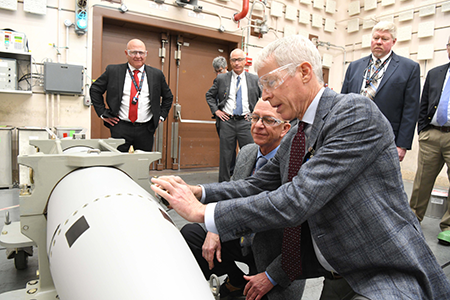
This is the second fiscal year in which the service has asked for and received funding for its work on the program after Congress provided an initial $39 million last year. The Biden administration’s last budget request estimated that the Air Force’s portion of the program would cost $353 million over its lifetime.
In parallel, the National Nuclear Security Administration (NNSA)—the agency responsible for designing and producing U.S. nuclear weapons—is conducting a multi-year Phase 1 concept assessment of options to defeat hard and deeply buried targets. (See ACT, July/August 2025.)
The new weapon, provisionally called the air-delivered nuclear delivery system, would address the requirement for “an enduring capability for improved defeat of [hard and deeply buried] targets” identified in the 2022 Nuclear Posture Review, according to Air Force budget justification documents.
The documents note that the program also responds to the findings of a Pentagon study of options for hard and deeply buried targets mandated by the fiscal year 2023 National Defense Authorization Act.
In the course of designing the new weapon, the Air Force Research Laboratory is initially planning for integration with F-15E strike aircraft and B-2 bombers.
According to the budget documents, in fiscal year 2026, the Air Force intends to continue modeling and simulation analysis of design options, designing and procuring components for building prototypes, and conducting ground tests of prototypes, among other activities.
When the Biden administration unveiled in October 2023 a higher-yield variant of the B61-12 life-extended gravity bomb, the B61-13, it said that weapon would provide an additional option for “harder and large-area military targets.” This would pave the way for retirement of the older megaton-yield B83-1. (See ACT, December 2023.)
At the same time, the administration did not decide to retire the B61-11, a dedicated earth-penetrating variant of the B61 bomb. Although several older variants of the B61 have been consolidated through a recently completed life-extension program into the B61-12 design, the B61-11 was not.
The budget documents are unlikely to refer to the B61-13. That weapon is already in production and will only be delivered by strategic bombers, not fighter jets such as the F-15E, NNSA said in a May 19 press release.
“The B61-13 represents an intermediate answer” to the problem of destroying hard and deeply buried targets, wrote David Hoagland, the NNSA’s acting deputy administrator for defense programs, May 20 in War on the Rocks.
The George W. Bush administration also pursued a nuclear bunker-buster under the Robust Nuclear Earth Penetrator program. Congressional opposition led to cancellation of the program by 2005.
Unlike the proposed air-delivered nuclear delivery system, the Bush-era program did not advance as far as prototyping work within the Air Force before it was canceled, even though the NNSA bomb design work had proceeded beyond concept studies to the next stage, known as a Phase 6.2/6.2A feasibility and design, definition, and cost study.