


“It will take all of us working together – government officials, and diplomats, academic experts, and scientists, activists, and organizers – to come up with new and innovative approaches to strengthen transparency and predictability, reduce risk, and forge the next generation of arms control agreements.”
Trump Strikes Iran Amid Nuclear Talks
March 2026
By Kelsey Davenport
The United States and Israel launched military strikes on Iran, killing Supreme Leader Ayatollah Ali Khamenei and prompting Iranian counterstrikes against Israel, U.S. military bases in the region, and Persian Gulf states. The strikes occurred two days after U.S. and Iranian negotiators met in Geneva for what Omani mediators described as productive negotiations on a nuclear deal.
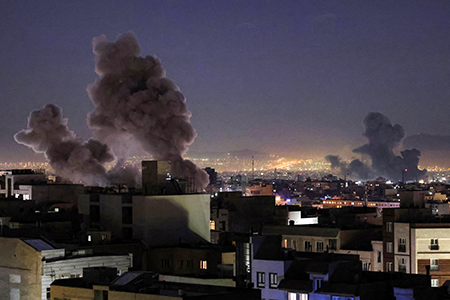
U.S. President Donald Trump and top administration officials have offered different justifications for why the strikes, which began Feb. 28 as Operation Epic Fury, were necessary. Trump did not obtain an authorization for the use of military force from Congress prior to the strikes.
In a video on his social media site after the strikes commenced, Trump said that Iran “can never have a nuclear weapon” and suggested its leaders had “attempted to rebuild their nuclear program” and develop long-range ballistic missiles that “could soon reach the American homeland.”
Trump, however, presented no evidence that Iran was engaged in a nuclear weapons development effort or was taking any specific steps to rebuild its program. Recent satellite imagery of key nuclear sites suggests that Iran conducted some cleanup activities at locations struck by the United States and Israel in June and continued activities at facilities that were not attacked, but there was no indication that Iran restarted proliferation sensitive nuclear activities.
In a March 2 press conference, International Atomic Energy Agency (IAEA), Director-General Rafael Mariano Grossi said that “we don’t see a structured program to manufacture nuclear weapons” in Iran. The IAEA said in a March 3 social media post that based on satellite imagery it could confirm some recent damage to entrance buildings of Iran’s underground Natanz fuel enrichment plant.
Grossi noted in a March 2 statement to the agency’s Board of Governors that in addition to Iran’s nuclear reactors, other states in the region have operating nuclear power and research reactors. He urged “utmost restraint in all military operations” to prevent a nuclear accident and called for a return to diplomacy as “quickly as possible.”
Trump suggested in the Feb. 28 video that the U.S. strikes offered an opportunity for regime change in Iran and urged the Iranian people to “seize control of your destiny.” Shortly afterward, reports emerged that Khamenei and key military advisors were killed during a strike, which Iranian media outlets later confirmed.
Trump said March 1 that the new leadership wants to talk and he “agreed to talk” to them. But it is not clear to whom Trump was referring. Iranian Foreign Minister Abbas Araghchi said a new supreme leader would be chosen in the coming days.
Iranian officials also offered contradictory assessments of their counterstrike objectives. Iranian Parliamentary Speaker Mohammad Bagher Qalibaf said Iran would continue to “deliver such devastating blows” that the United States will be “driven to beg” for a ceasefire. Araghchi, however, said he urged Gulf states to press the United States and Iran to end the conflict.
In addition to targeting U.S. military bases in Gulf states, Iran also struck non-military targets, including energy production infrastructure.
Prior to the strikes, the United States and Iran held three rounds of nuclear negotiations mediated by Oman. During that time, Trump sent additional U.S. military assets to the Persian Gulf and suggested that he was considering a limited strike to pressure Tehran to “negotiate a fair deal.”
After the third round of talks on Feb. 26, Omani Foreign Minister Badr bin Hamad Al Busaidi told CBS News that the United States and Iran made “substantial progress” toward a nuclear deal and an agreement is “within our reach.” Araghchi was similarly optimistic, but Trump said Feb. 27 that he was “not happy” with the progress or the “way they’re negotiating.”
Iran did not publicly release its proposal, but an official familiar with the negotiations told Arms Control Today that Iran was offering to pause uranium enrichment and then scale its future enrichment for fueling nuclear reactors. Iran also would agree to monitoring and would not accumulate enriched uranium gas. Uranium stored in gas form poses more of a risk because it can be fed back into centrifuges and enriched to weapons-grade levels.
In a Feb. 28 press call, unnamed U.S. officials said that there was “no seriousness to achieve a real deal.” The officials suggested that Washington offered “free nuclear fuel forever,” but Tehran rejected that offer, saying it needed uranium enrichment. The official said it “makes absolutely no sense” for Iran to enrich uranium. It is not clear if the negotiators discussed the technical and legal complexities of fuel supply, or the assurances the United States would offer Iran that fuel supplies would not be disrupted.
The U.S. official said that Iran refused to talk about its ballistic missile program and that “we cannot continue to live in a world where these people not only possess missiles but the ability to make 100 of them a month.”
Israeli Prime Minister Benjamin Netanyahu also pushed for any U.S-Iran deal to include missiles and zero uranium enrichment. In a Feb. 15 address to the Conference of Presidents of Major American Jewish Organizations, he said he told Trump that any deal must require Iran to dismantle its uranium enrichment program, ship its enriched uranium out of the country, and include “no-lead time inspections.”
Iran’s stockpiles of enriched uranium, including about 440 kilograms of uranium enriched to 60 percent uranium-235, just shy of the 90 percent U-235 considered weapons grade, are likely intact but currently inaccessible due to the military strikes in June.
Netanyahu also said a deal must address Iran’s ballistic missiles and suggested that Iran must adhere to a range of 300 kilometers, as set by the Missile Technology Control Regime for defining nuclear-capable systems. A deal also must end Iran’s support for proxy militias in the region, he said.