


“What's really strikes me about ACA is the potential to shape the next generation of leaders on arms control and nuclear policy. This is something I witnessed firsthand as someone who was introduced to the field through ACA.”
U.S. Accuses China of Nuclear Test, Preparations
March 2026
By Xiaodon Liang
A top U.S. State Department official has accused China of conducting a nuclear explosive test June 22, 2020, and says the U.S. government believes Beijing also is preparing for nuclear tests with yields in the range of hundreds of tons.
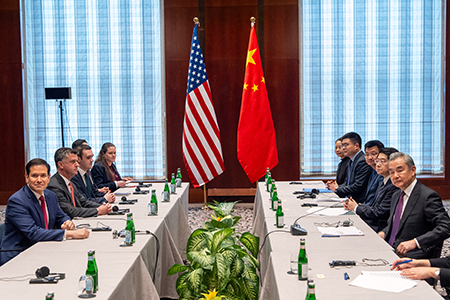
Thomas DiNanno, the undersecretary of state for arms control and international security, made the allegation in a speech at a Feb. 6 meeting of the Conference on Disarmament in Geneva.
It is the first direct accusation by the United States of a violation of China’s obligations as a signatory to the 1996 Comprehensive Test Ban Treaty (CTBT).
The United States “is aware that China has conducted nuclear explosive tests, including preparing for tests with designated yields in the hundreds of tons,” DiNanno said.
China is widely known to have conducted 45 nuclear-test explosions between 1964 and 1996.
The State Department previously expressed “concerns” in an August 2019 compliance report about Chinese testing-related activities, including at a former test site at Lop Nur. At the time, the United States said China “probably carried out multiple nuclear weapon-related tests or experiments in 2018,” but fell short of concluding that China had violated the CTBT.
In the Feb. 6 speech, DiNanno alleged that China “sought to conceal testing by obfuscating the nuclear explosions [through decoupling] because it recognized these tests violate test ban commitments.” Decoupling involves conducting a nuclear explosion in a large underground cavity to mask its observable yield.
Although China, like the United States, is a CTBT signatory, it has not ratified the agreement, thus delaying the treaty’s formal entry into force.
The treaty prohibits all nuclear explosions, which the negotiating parties all understand are nuclear explosions that produce a self-sustaining, supercritical chain reaction of any kind whether for weapons or peaceful purposes.
“The U.S. accusation of Chinese nuclear explosive tests is completely groundless,” Chinese foreign ministry spokesman Lin Jian said Feb. 11 at a regular press briefing. The U.S. statement is a “fabrication of pretexts for its own resumption of nuclear tests,” he said.
U.S. President Donald Trump said Oct. 30 that the United States, which has honored a voluntary testing moratorium since 1992, would resume testing of nuclear weapons “on an equal basis” as other countries. (See ACT, November 2025.) DiNanno noted the president’s announcement in his Feb. 6 statement immediately before discussing the alleged Chinese tests.
“China urges the U.S. to renew the commitment of the five nuclear-weapons states to a moratorium on nuclear testing” and “uphold the global consensus on the ban on nuclear testing,” Lin said in his Feb. 11 statement.
The Chinese test occurred at 9:18 Greenwich Mean Time on the specified date and had an approximate magnitude of 2.75, Assistant Secretary of State Christopher Yeaw said Feb. 17 in a talk at the Hudson Institute.
The International Monitoring System operated by the Comprehensive Nuclear-Test-Ban Treaty Organization “detected two very small seismic events, twelve seconds apart” on June 22, 2020, said Robert Floyd, head of the organization in a Feb. 17 statement.
In the statement, Floyd said that the monitoring system “is capable of detecting nuclear test explosions with a yield equivalent to or greater than approximately 500 [tons] of TNT. These two events were far below that level. As a result, with this data alone, it is not possible to assess the cause of these events with confidence.”
“Mechanisms which could address smaller explosions are provided by the Treaty but can only be used once the Comprehensive Nuclear-Test-Ban Treaty enters into force. That is why it is important that the nuclear arms control framework includes the entry into force of the CTBT. The need is more urgent now than ever,” Floyd wrote. “Any nuclear test explosion, by any state, is of deepest concern.”
International and national seismic networks can detect events that produce shockwaves at much lower levels in certain areas of particular concern, such as former nuclear test sites. For example, the existence of seismic templates—comparable data on past seismic events—from known nuclear test sites may “enable the detection of new explosions today by [the monitoring system] down to a few tons of TNT yield or less for an underground explosion,” according to a 2020 report by Anna Péczeli and Bruce Goodwin, two experts with the Center for Global Security Research at Lawrence Livermore National Laboratory.
NORSAR, the Norwegian seismology foundation, independently identified a small signal at 9:18 GMT from the region of Lop Nur but cautioned that “the precise epicentral location cannot be tightly constrained,” in a Feb. 19 press release.
NORSAR said the event displayed “strong compressional waves compared to shear waves, a feature that can be consistent with explosive sources.” However, “[n]atural earthquakes can produce similar patterns, particularly when observations are limited to a single high-quality station.”
The foundation “cannot confirm or refute the allegation that a nuclear test took place.”
According to a 2012 National Academies of Sciences (NAS) report on technical issues related to the test ban treaty, the maximum effectiveness of decoupling on record—in a salt dome—was a reduction in the measured yield of a nuclear test by a factor of 70.
This would reduce the observed yield of a test from several hundred tons to a single-digit ton of TNT equivalent.
But the NAS report noted that decoupled underground tests in rock would have a much lower effectiveness than in salt, reducing the observed yield by a factor of 20 to 40. China’s tests at its former Lop Nur test site were conducted in granite or other types of rock.
The 2012 NAS report concluded that “the uncertainty in the actual amount of decoupling would present a difficult technical challenge.”
If China were able to conduct an undetected test, the 2012 NAS report noted that explosions with yields under 100 tons could be useful for safety tests and developing low-yield, unboosted fission devices.
Tests between 100 tons TNT equivalent and 1 kiloton TNT equivalent could be used to “pursue improved implosion weapon designs,” “validate some untested implosion weapon designs,” and proof-test compact weapons.
If the alleged Chinese test was a hydronuclear experiment just above the criticality threshold, however, the usefulness of the test would be limited to safety tests, addressing some design code issues, and “validation of some unboosted fission weapon designs.”
China in recent years has resumed visible, above-ground drilling and infrastructure work at its Lop Nur test site, The New York Times reported in December 2023, citing imagery analysis by analyst Renny Babiarz.