


“It will take all of us working together – government officials, and diplomats, academic experts, and scientists, activists, and organizers – to come up with new and innovative approaches to strengthen transparency and predictability, reduce risk, and forge the next generation of arms control agreements.”
New START Expires As U.S. Urges ‘Modernized’ Treaty
March 2026
By Xiaodon Liang
The New Strategic Arms Reduction Treaty (New START) expired Feb. 5 without a U.S. response to a Russian offer to continue informally abiding by the central limits of the agreement, leaving the two nuclear superpowers with no legally binding curbs on deploying their strategic weapon.
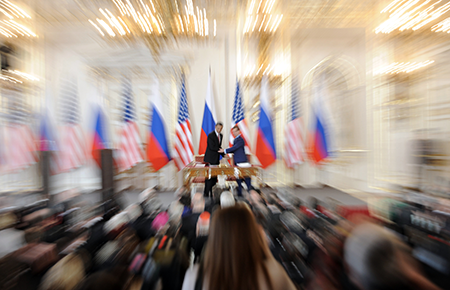
The United States will instead seek a “new, improved, and modernized Treaty that can last long into the future,” U.S. President Donald Trump said in a Feb. 5 social media post.
Meanwhile, Russian Foreign Minister Sergey Lavrov informed the Russian parliament Feb. 11 that “For now, Russia complies with its moratorium on respecting the central quantitative limitations as per this treaty. We have reasons to believe that the United States is not in a hurry to reject these indicators and will abide by them in the foreseeable future.”
Lavrov stressed, however, that Russia will maintain its moratorium “only as long as the United States does not exceed the above limits.”
Russian President Vladimir Putin proposed Sept. 22 that the two sides continue abiding by the treaty’s central limits informally for one year. Although Trump initially said the proposal was a “good idea,” the Russian foreign ministry confirmed Feb. 4 that the United States had not formally responded to Putin’s initiative.
Representatives of the two sides reportedly discussed a potential six-month informal understanding to abide by the treaty and the resumption of arms control negotiations during talks in Abu Dhabi, Axios reported Feb. 5. The discussions were confirmed by Russian presidential spokesman Dmitry Peskov, but not by U.S. officials.
“President Trump wants to find a better agreement,” the U.S. undersecretary of state for arms control and international security, Thomas DiNanno, said in a speech to the Conference on Disarmament in Geneva Feb. 6.
That same day, the U.S. Department of State briefed officials from the embassies of China, Russia, and certain U.S. allies on the main points of DiNanno’s address, according to diplomatic sources who spoke with Arms Control Today on the condition of anonymity.
In his address, DiNanno described Russia’s numerical superiority in tactical nuclear weapons as an “intolerable disadvantage” to the United States and criticized New START for not including that category of weapons within its scope.
DiNanno emphasized two priorities for U.S. arms control diplomacy in his statement: “taking into account all Russian nuclear weapons, both novel and existing strategic systems, and addressing the breakout growth of Chinese nuclear weapons stockpiles.”
DiNanno also suggested that the United States could, following the expiration of New START, increase the size and diversity of its nuclear arsenal. “The United States also retains non-deployed nuclear capacity that can be used to address the emerging security environment, if directed by the president,” he said.
“China will not take part in nuclear disarmament negotiations at this stage,” Shen Jian, China’s ambassador for disarmament affairs, said Feb. 6 in response to Di Nanno. He reiterated the long-standing Chinese position that Russia and the United States have “special and primary responsibilities” to make cuts to their arsenals first.
Shen called on the United States to “respond positively” to the Russian freeze proposal, while also labeling Washington the “culprit for the aggravation of [the] arms race.”
A previous attempt by the first Trump administration to include China in nuclear arms control talks foundered in 2020. (See ACT, September 2020.)
In November 2023, senior U.S. and Chinese officials held talks on nuclear weapons matters in Washington but the dialogue was not sustained. (See ACT, December 2023.)
Trump said in a Jan. 7 interview with The New York Times that “I think it would be appropriate for the Chinese [to be part of a new arms control treaty], but I would do a deal with Russia without the Chinese.” U.S. Assistant Secretary of State for Arms Control and Nonproliferation Christopher Yeaw indicated, however, that the administration may be prioritizing a multilateral strategy.
“Following the expiration of [New START] the United States proposed multilateral strategic stability talks as a means to achieving future nuclear arms control,” Yeaw said at a Feb. 17 Hudson Institute event.
Trump spoke with his Chinese counterpart, Xi Jinping, by telephone Feb. 4, but neither the U.S. nor Chinese readouts of the conversation mentioned nuclear arms control. Trump and Xi aim to hold a summit in early April.
“[M]any important subjects were discussed, including Trade, Military, [and] the April trip that I will be making to China,” Trump said in a Feb. 4 social media post. Beijing has warned Washington privately that approval of a potential $20 billion arms sale to Taiwan in the coming weeks could derail the trip, the Financial Times reported Feb. 6.
On the eve of New START’s expiry, Russian Deputy Foreign Minister Sergey Ryabkov and Chinese Assistant Foreign Minister Liu Bin met in Beijing Feb. 3 in the latest in a series of bilateral consultations. According to a Chinese statement, the two officials “had an in-depth exchange of views on the current global strategic stability situation and multilateral arms control issues.”
The Pentagon released Jan. 23 a National Defense Strategy that shed little light on U.S. plans for nuclear forces after the expiration of New START.
The document eschews a formal Nuclear Posture Review or equivalent section, opting instead for a brief passage.
“We will modernize and adapt our nuclear forces accordingly with focused attention on deterrence and escalation management amidst the changing global nuclear landscape,” the strategy document says.
The language contains a key departure from an otherwise identical statement on nuclear forces by Secretary of Defense Pete Hegseth Dec. 6 at the Reagan Defense Forum, in which he said that the United States “will develop additional options to support deterrence and escalation management.”
With the expiration of New START, Congress has taken a keener interest in nuclear weapons and arms control in the absence of negotiated limits.
The Senate Foreign Relations and Armed Services committees held expert hearings on the issue Dec. 10 and Feb. 3, respectively.
Speaking before the Armed Services Committee, Rose Gottemoeller, the former lead U.S. negotiator on New START, cautioned that Russia could sprint ahead in a race to upload new warheads on missiles if the United States ignores the Russian proposal to continue to respect the treaty’s central limits and decides instead to begin expanding the number of U.S. deployed strategic nuclear warheads.
Democrats in the House and the Senate have introduced resolutions calling on the president to engage with Russia on a follow-on agreement to New START, to engage with China in nuclear risk reduction talks, and to forgo increasing the size of the deployed U.S. strategic arsenal.
In a Jan. 13 letter to the State Department, House Foreign Affairs Committee chair Brian Mast (R-Fla.) and Rep. Keith Self (R-Texas), the chair of the Europe subcommittee, wrote that “The Committee stands ready to work with the Trump administration and its efforts to modernize arms-control approaches.”