


“For half a century, ACA has been providing the world … with advocacy, analysis, and awareness on some of the most critical topics of international peace and security, including on how to achieve our common, shared goal of a world free of nuclear weapons.”
Beijing Fills Missile Silos, Claims Continuity
January/February 2026
By Xiaodon Liang
China will maintain its nuclear capabilities “at the minimum level required for national security” while continuing a policy of no first use of nuclear weapons, a new policy statement claims, even as U.S. intelligence alleges the deployment of intercontinental ballistic missiles (ICBMs) in a third of the silos at China’s new missile bases.
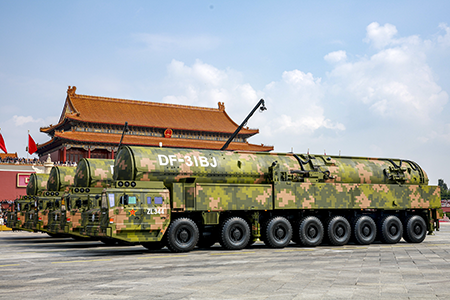
The restatement of Chinese policy came Nov. 27 in an official government white paper on arms control, disarmament, and nonproliferation. The paper is Beijing’s first comprehensive statement on these topics since open-source intelligence analysis identified a large-scale expansion of Chinese nuclear forces in 2021. (See ACT, September 2021).
But the document will disappoint those seeking an official acknowledgement by Beijing of its buildup or an explicit explanation of the logic behind its evolving force posture.
The paper comes close when blaming the United States for “reinforcing its nuclear deterrence and war-fighting capabilities” and “blurring the line between missile defense and strategic offense on purpose,” which constitute “severe threats” to strategic stability.
In response, China is improving “strategic early warning, command and control, missile penetration, and rapid response, as well as [nuclear forces’] survivability,” the document says.
This falls short of confirming a Pentagon claim, reiterated in this year’s edition of an annual report on China’s military, released Dec. 23, that China is making “progress on its attempts to achieve” an “early warning counterstrike” capability “where warning of a missile strike enables a counterstrike launch before an enemy first strike can detonate.”
The report reveals a previously unreported test launch by China of several ICBMs in “quick succession” in December 2024, “indicating the ability to rapidly launch multiple silo-based” missiles. The Pentagon previously noted a similar test in September 2023.
U.S. intelligence continues to assess that China may acquire a force of 1,000 operational nuclear warheads by 2030, the new report says. Although the Chinese white paper does not discuss quantitative requirements, it states that China “never has and never will engage in any nuclear arms race.”
The Pentagon report indicates that China’s strategic forces have deployed DF-31 solid-fueled ICBMs at some 100 silos in new missile fields in the northwest of China. The new missile fields, along with 30 new silos at older fields, add a total of 350 launchers to the land-based leg of China’s strategic arsenal, which also includes around 140 siloed liquid-fueled and road-mobile solid-fueled ICBMs, according to research by the Federation of American Scientists.
The U.S. report estimates that China’s total number of warheads remains in the low 600s, a similar finding to last year. (See ACT, January/February 2025.) U.S. intelligence assesses “a slower rate of [warhead] production when compared to previous years.”
China has renovated and expanded a pit production and warhead assembly site at Pingtong, Sichuan province, over the last few years, the Washington Post reported Dec. 28, citing imagery analysis by the Open Nuclear Network and the Verification Research, Training and Information Center.
The Pentagon report repeats allegations that China is seeking low-yield warheads, for “counterstrikes against military targets” and to “control nuclear escalation” which would enable China to “deter non-nuclear military actions with its nuclear forces.”
The Pentagon also assesses that “Beijing continues to demonstrate no appetite” for arms control talks.
Although the Chinese white paper endorses the “complete prohibition and thorough destruction” of nuclear weapons, it falls back on the traditional Chinese policy that countries possessing the largest nuclear arsenals—Russia and the United States—have a “special and primary” responsibility to reduce their forces first. Beijing has long relied on this formulation to justify avoiding substantive nuclear arms control efforts.
The paper also criticizes extended deterrence and nuclear sharing arrangements, drawing attention once again to China’s proposal for a no-first-use agreement among the five officially recognized nuclear powers (China, France, Russia, the United Kingdom, and the United States).
Of note in the document’s discussion of nonproliferation is the absence of a restatement of China’s support for the goal of denuclearizing the Korean peninsula. Chinese leader Xi Jinping also did not mention denuclearization during a meeting with his North Korean counterpart, Kim Jong Un, in September. (See ACT, October 2025.)
The white paper repeats previous criticism by Chinese officials of the agreement between Australia, the UK, and the United States (AUKUS) to transfer naval nuclear reactors and highly enriched uranium to Australia as part of a nuclear-powered submarine arms sale.
The AUKUS agreement “apparently runs counter to the object and purpose of the [nuclear Nonproliferation Treaty],” the new policy document says.