


“For half a century, ACA has been providing the world … with advocacy, analysis, and awareness on some of the most critical topics of international peace and security, including on how to achieve our common, shared goal of a world free of nuclear weapons.”
On Nuclear Disarmament: Acta non Verba
January/February 2026
By Daryl G. Kimball
For more than five decades, the United States and Russia have observed mutual limits on their deadly long-range nuclear arsenals to mitigate the dangers of nuclear arms racing and nuclear war, but this essential pillar of nuclear strategy is at risk. On Feb. 5, the last remaining treaty limiting the two largest nuclear arsenals—the 2010 New Strategic Arms Reduction Treaty (New START)—will expire. It restricted each side to no more than 1,550 deployed warheads on no more than 700 deployed long-range missiles and bombers.
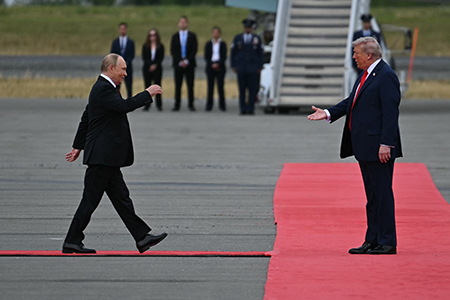
Seven U.S. presidents from Nixon to Obama concluded major nuclear arms control and nonproliferation agreements. Gerald Ford advanced negotiations on the second Strategic Arms Limitation Treaty and Joe Biden extended New START by five years.
After six years in the White House, however, President Donald Trump has failed to make any progress despite talking often about his desire for “denuclearization” with Russia and China, complaining about the high costs of nuclear weapons, and noting the devastating effects of nuclear conflict.
Worse yet, Trump has raised tensions by issuing nuclear threats, expanding costly plans to modernize and upgrade the U.S. arsenal, suggesting he might resume nuclear explosive testing, and announcing plans for an unworkable national missile defense scheme that will encourage adversaries to build up their offensive nuclear systems.
Nevertheless, in August after his summit with Russian President Vladimir Putin, Trump claimed that “we would like to denuclearize. It’s too much power, and we talked about that.” Questioned about the expiration of New START, Trump said in July, “We are starting to work on that … That is a big problem for the world, when you take off nuclear restrictions.” Yes, it is, but so far, he apparently has not done anything about it.
On Sept. 22, Putin offered a modest way forward, announcing that “Russia is ready to continue to adhere to the central quantitative restrictions under the [New] START Treaty for one year after February 5, 2026” if the United States reciprocates. When asked Oct. 5 about Putin’s proposal, Trump said, “Sounds like a good idea to me.”
Unfortunately, the White House has not yet formally replied to the Kremlin offer. And although the Pentagon recently claimed, incorrectly, that “China has not demonstrated a willingness to advance discussions on nuclear risk reduction measures, bilaterally or multilaterally,” there is no indication that Trump or his team have proposed risk reduction or arms control talks with China.
Trump can still help halt a dangerous arms race that no one can win. But to do so, now is the time to turn his vague “denuclearization” talk into tangible arms control action.
The stakes are high. If Trump fails to respond positively to Russia’s proposal for an interim deal to maintain the New START limits, each side likely will begin increasing the size of its deployed nuclear arsenal for the first time in more than 35 years by uploading additional warheads on existing long-range missiles. Many members of the nuclear-weapons establishment are lobbying for such a buildup.
More nuclear weapons will not make anyone safer. The United States already has a massive, devastating, and largely invulnerable nuclear force that is more than sufficient to deter nuclear attack by China, Russia, and any other nuclear-armed state. Contrary to hype, deploying additional U.S. nuclear weapons would not change Chinese President Xi Jinping’s or Putin’s fundamental deterrence calculus in a future war. Increases in Russian and U.S. strategic forces would further destabilize the mutual balance of nuclear terror; strain the costly, behind-schedule U.S. nuclear modernization program; and push China to accelerate its nuclear buildup.
The continued failure of Beijing, Moscow, and Washington to engage in good-faith arms control and disarmament negotiations also violates their obligations under Article VI of the nuclear Nonproliferation Treaty (NPT) and undermines its long-term viability.
However, if Trump and Putin pledge to maintain mutual restraints on their strategic nuclear arsenals and resume bilateral talks on further nuclear reductions, they could prevent unconstrained competition and provide leverage to press China (as well as France and the United Kingdom) to freeze their forces at the current number of strategic launchers. Undoubtedly, this would bolster the beleaguered NPT regime ahead of the treaty’s 2026 review conference.
Russia and the United States each have fewer than 800 total strategic launchers; China has an estimated 550; and France and the United Kingdom have a combined total of about 100. A mutual freeze on strategic nuclear launchers at these levels would not adversely affect any one country’s ability to deter nuclear attack.
These joint restraint measures would create a more positive environment for talks on further strategic reductions, new restrictions on intermediate-range missiles and tactical nuclear weapons, limits on strategic missile defenses, and other nuclear risk reduction measures, including joint steps to mitigate the risks of AI integration in nuclear command and control.
With the end of New START, Trump and Putin can put the world on a safer path by taking commonsense actions to build down the nuclear danger.