


“For half a century, ACA has been providing the world … with advocacy, analysis, and awareness on some of the most critical topics of international peace and security, including on how to achieve our common, shared goal of a world free of nuclear weapons.”
New START on the Brink
January/February 2026
By Xiaodon Liang and Daryl G. Kimball
The United States and Russia have dramatically reduced their nuclear stockpiles since the end of the Cold War, thanks to a series of bilateral arms control agreements that have won the support of Republicans and Democrats alike. But with the expiration of the New Strategic Arms Reduction Treaty (New START) set for Feb. 5, and no bilateral talks on further follow-on agreements to contain or cut U.S. and Russian nuclear arsenals on the horizon, a new era of unconstrained global nuclear competition looms.
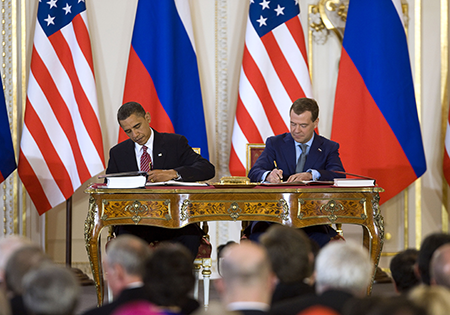
After nearly a year of negotiations, New START was signed by presidents Barack Obama and Dmitry Medvedev April 8, 2010. It capped accountable deployed strategic nuclear warheads and bombs at 1,550 and counted each heavy bomber as one warhead. These limits were approximately 30 percent below the 2,200-warhead limit set by the 2002 Strategic Offensive Reductions Treaty (SORT), which did not include any new verification provisions.
New START also limited the two sides to no more than 700 deployed intercontinental ballistic missiles (ICBMs), submarine-launched ballistic missiles (SLBMs), and heavy bombers assigned to nuclear missions. Deployed and nondeployed ICBM launchers, SLBM launchers, and bombers were limited to 800. This additional cap restricted the ability for a “break out” of the treaty by preventing either side from retaining large numbers of non-deployed launchers and bombers.
New START was the first treaty to include provisions for directly counting the number of warheads on a missile. Inspectors were permitted, during short-notice inspections, to require the host country to allow for the counting of re-entry vehicles on an ICBM or SLBM.
The treaty did not constrain missile defense programs although its preamble acknowledges the “interrelationship between strategic offensive arms and strategic defensive arms” and that “current strategic defensive arms do not undermine the viability and effectiveness of the strategic offensive arms of the Parties.”
Given that the 1991 START treaty and its verification provisions expired Dec. 5, 2009, Russia and the United States were interested in re-establishing treaty-mandated verification mechanisms for New START. As General Kevin Chilton, commander of U.S. Strategic Command, testified to Congress in June 2010, “If we don’t get the treaty, [the Russians] are not constrained in their development of force structure and... we have no insight into what they’re doing. So, it’s the worst of both possible worlds.”
Upon signing New START, Obama said: “While the New START treaty is an important first step forward, it is just one step on a longer journey.” It was a prescient statement.
Senate ratification of the treaty was a struggle largely due to opposition from a bloc of senators led by Jon Kyl (R-Ariz.), who demanded a long-term plan and budget for modernizing the U.S. nuclear delivery systems and life-extending warheads. In November 2010, the Obama administration delivered revised estimates for funding National Nuclear Security Administration nuclear weapons complex programs totaling $85 billion for fiscal years 2012-2016, an average of $8.5 billion per year. Today, the NNSA weapons budget consumes $20 billion annually.
On December 22, 2010, following an eight-month-long process and eight days of often intense floor debate, a bipartisan Senate supermajority voted 71-26 in favor of ratification. Kyl still voted "no." The Russian State Duma and Federation Council completed the ratification process Jan. 26, 2011. The treaty entered into force Feb. 5, 2011, and both parties met the treaty’s central limits by the implementation deadline, Feb. 5, 2018.
Although New START modestly cut the U.S. and Russian strategic arsenals, it still left both with extraordinary firepower and further disarmament diplomacy to pursue. As Senator Lamar Alexander (R-Tenn.) noted in December 2010, New START “leaves our country [and Russia] with enough nuclear warheads to blow any attacker to Kingdom Come.”
However, since New START entered into force, Moscow and Washington have misfired on their on-again, off-again discussions on further nuclear reductions. In 2013, Russian President Vladimir Putin rebuffed an Obama initiative to engage in talks designed to achieve a further one-third reduction, and in 2020, U.S. and Russian negotiators resumed wide-ranging arms control talks but failed to reach any agreement.
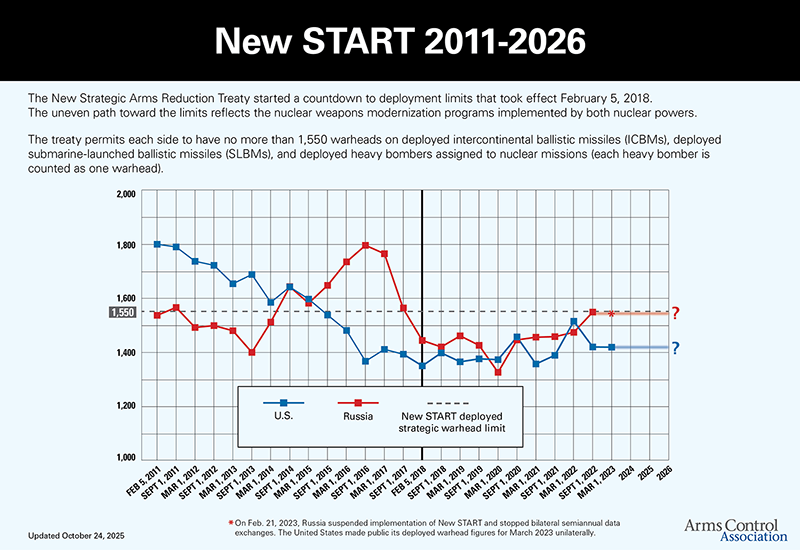
With the original 10-year lifespan of the treaty about to expire, President Joe Biden and Putin agreed at the 11th hour, Feb. 3, 2021, to exercise the one-time, five-year extension allowed by Article XIV of the treaty. The move came after the first administration of President Donald Trump balked at extending New START with Russia, while seeking to engage China in a three-way arms control negotiation in 2020.
Following Russia's full-scale invasion of Ukraine in 2022, Russia formally notified the United States Feb. 28, 2023, that it would suspend implementation of key New START provisions, including stockpile data exchanges and on-site inspections, which already were suspended temporarily in 2020 by mutual agreement due to the COVID-19 pandemic. Putin said Russia would not resume implementation unless the United States ended support for Ukraine and brought France and the United Kingdom into arms control talks. He later clarified that Russia would continue abiding by the treaty’s central limits.
In January 2025, the U.S. State Department said that, although “Russia [was] probably close to the deployed warhead limit during much of [2024] and may have exceeded the deployed warhead limit by a small number during portions of 2024,” the United States nonetheless “assesses with high confidence that Russia did not engage in any large-scale activity above the Treaty limits.”
With the final New START expiration date now approaching, Putin announced Sept. 22 that Russia is “prepared to continue observing the … central quantitative restrictions” of the treaty for one year after its expiration if the United States “acts in a similar spirit.” The proposal came in the context of talks on ending the conflict in Ukraine and vague statements by Trump that he wanted to maintain limits on nuclear arsenals.
In the absence of such an arrangement, each side will be free to upload additional warheads on existing land- and sea-based missiles, thus increasing their total strategic arsenals for the first time in decades. How the next chapter in the long-history of U.S.-Russian nuclear relations will unfold is yet to be determined.