


“For half a century, ACA has been providing the world … with advocacy, analysis, and awareness on some of the most critical topics of international peace and security, including on how to achieve our common, shared goal of a world free of nuclear weapons.”
Trump Threatens New Military Action Against Iran
January/February 2026
By Kelsey Davenport
President Donald Trump said the United States will support new Israeli strikes against Iran’s missile program and threatened to take military action “immediately” if Tehran takes steps to rebuild its nuclear program.
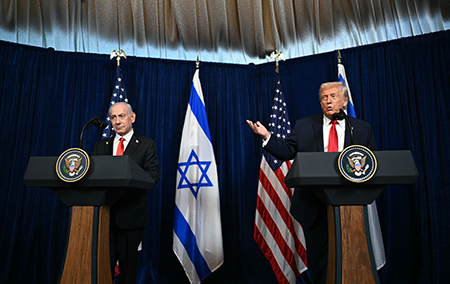
Trump told reporters Dec. 29 that if Iran “will continue with the missiles,” the United States will support Israeli strikes and suggested that Tehran should make a deal with Washington to avoid further attacks.
Trump’s threats came during Israeli Prime Minister Benjamin Netanyahu’s Dec. 29 trip to visit the president at Mar-a-Lago. Before the trip, Israeli officials emphasized that Israel is ready to strike Iran again and suggested that Netanyahu would seek U.S. support for further military action during his visit.
Israel targeted the missile program during its 12-day air campaign against Iran in June, but Tehran was still able to conduct counterstrikes against Israel and the U.S. airbase in Qatar. (See ACT, July/August 2025.)
Since the conflict ended, Iran has announced steps to rebuild and expand its missile program, including equipping its missiles with new technologies. The commander of the Islamic Revolutionary Guard Corps, Major General Mohammad Pakpour, said Dec. 7 that Iran will incorporate stealth technologies into its systems so that they can better evade missile defenses, according to Iran’s state-run Press TV.
Trump’s Dec. 29 comments did not make clear what type of support his administration would provide if Israel strikes Iran’s missile program again, but he suggested that the United States would strike Iran directly if the country took certain steps to reconstitute nuclear activities.
Trump said that he heard that Iran is “trying to build up [its nuclear program] again.” If true, the United States will have “no choice but [to] very quickly eradicate that buildup,” he said.
Although it does not appear that Iran is restarting nuclear activities impacted by the U.S. and Israeli strikes in June, such as uranium enrichment, it is more challenging to assess the status of the country’s nuclear program while Tehran continues to prohibit International Atomic Energy Agency (IAEA) inspectors from accessing bombed sites.
Iran is legally obligated under the nuclear Nonproliferation Treaty (NPT) to implement safeguards on its nuclear program, but it suspended cooperation with the agency following the June attacks. Iran later allowed inspectors to return to sites that were not targeted, such as the Bushehr nuclear power plant, but has yet to provide the agency with reports about its nuclear materials or allow inspectors to access bombed facilities, arguing that safety and security concerns preclude cooperation. (See ACT, October 2025.)
In addition to suspending cooperation, Iran called for the IAEA to revise its safeguards approach to take into account the realities of armed conflict, as the agency continues to press Tehran to allow inspectors to visit nuclear facilities damaged by Israeli and U.S. military strikes.
Behrouz Kamalvandi, a spokesman for the Atomic Energy Organization of Iran (AEOI), said Dec. 9 that after an attack, a country “cannot be expected to immediately allow inspectors into damaged sites, because that could mean handing sensitive information to its enemies.”
Iran has accused the IAEA of providing information used by Israel and the United States in the June strikes but presented no evidence to support those accusations.
IAEA Director-General Rafael Mariano Grossi said in a Dec. 20 interview with RIA Novosti, a Russian state news service, that the agency must assess for itself if Iran’s nuclear sites are unsafe or inaccessible due to the strikes. He reiterated Iran’s legal obligation to allow the IAEA access and said talks with Tehran are ongoing.
In November, the IAEA Board of Governors censured Iran for failing to implement its safeguards obligations and urged Tehran to cooperate with the agency. (See ACT, December 2025.)
Kamalvandi did not provide details about the changes Iran wants the IAEA to make, but he noted that the NPT and its safeguards provisions were drafted for “peaceful conditions,” and said that procedures and processes need to be revised to function under “wartime pressures” when there are unique security interests.
Despite suspending cooperation with the IAEA, Kamalvandi said that Iran remains committed to the NPT and its safeguards agreement.
Esmaeil Baghaei, the Iranian foreign ministry spokesman, reiterated Iran’s commitment to the NPT and said Dec. 22, at his weekly press briefing, that the issues raised by the IAEA require answers from the “parties responsible” for the current situation. Baghaei said that the “perpetrators of illegal and criminal attacks on these facilities” caused the interruption of monitoring.