


"The Arms Control Association’s work is an important resource to legislators and policymakers when contemplating a new policy direction or decision."
U.S. to Analyze Options for New Bomber
June 2026
By Xiaodon Liang
Budget documents indicate the U.S. Air Force plans to assess options for a new heavy bomber that could replace the B-52H.
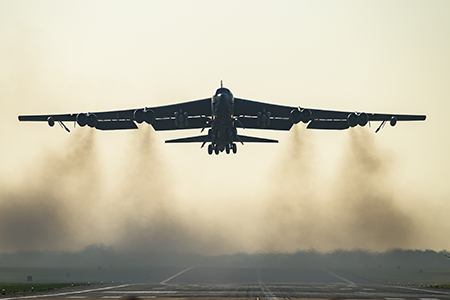
The service is requesting $1 million from Congress to begin a heavy bomber analysis of alternatives in fiscal year 2027, according to Air Force research and development funding documents.
The study would “determine future B-52 requirements and costs and/or a new heavy bomber aircraft configuration and costs.” The analysis of alternatives was first reported May 6 by Aviation Week.
In fiscal 2027, the study would begin by conducting “initial planning activities to develop key performance parameters, key system attributes, and additional performance attributes for a follow-on heavy bomber.”
The Air Force is already procuring a new stealth bomber, the B-21 Raider. In 2021, Bloomberg News reported that the originally planned fleet of 100 B-21s would cost $89 billion in constant 2019 dollars to acquire. The Pentagon is separately weighing whether to buy more B-21s. (See ACT, May 2026.)
The B-52H first entered service in 1961. The Air Force is currently executing several sustainment and capability improvement programs to extend the lifespan of the venerable fleet.
Notably, these programs include a $3 billion radar modernization and a $19 billion engine replacement. The Air Force announced May 4 that the new engine had recently passed a critical design review and that the first bombers would be upgraded this year.
The fiscal 2027 budget documents also indicate that the Air Force is requesting $30 million from Congress this year to begin development of a new weapon pylon for the B-52H that would be capable of carrying heavier and a larger number of missiles or bombs.
The request specifically mentions the Joint Air-to-Surface Standoff Missile, a tactical cruise missile, as an example.
Seventy-six B-52Hs remain operational, according to the Air Force. Approximately 42 of these bombers are certified for nuclear roles, according to the Federation of American Scientists, and roughly three-quarters of those planes were typically reported by the United States as deployed strategic bombers under the New Strategic Arms Reduction Treaty.
In the fiscal year 2025 National Defense Authorization Act, Congress permitted the secretary of defense to recertify all B-52Hs in the fleet for nuclear missions.