


"No one can solve this problem alone, but together we can change things for the better."
2026 NPT Review Conference Stymied by Disputes
June 2026
By Libby Flatoff and Daryl G. Kimball reporting from New York
After four weeks of intense debate and discussion, diplomats from 130 states at the 2026 nuclear Nonproliferation Treaty (NPT) Review Conference failed to agree on ways to address rising nuclear weapons dangers.
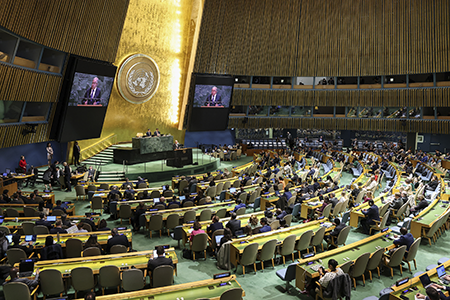
With delegates unable to overcome an array of disputes among a handful of states, including Iran and the United States, conference President Do Hung Viet announced May 22 that consensus on the eight-page draft outcome document was not possible.
“No one [state] blocked consensus because I realized there was not consensus, and so I did not put the document forward,” Viet, Vietnam’s UN ambassador, told a news conference. “I had options. I decided I had to make the difficult decision to pursue this path [because] I wanted to maintain my neutrality and maintain my commitment to a balanced approach.”
Viet said there were “difficulties” reaching consensus on more than one section of the final draft text, but “a very important reason” for the impasse was the country-specific language in paragraph 15 of the final draft, which said “Iran can never seek, develop or acquire any nuclear weapons.”
According to diplomats who spoke with Arms Control Today on condition of anonymity, the U.S. delegation insisted that language faulting Iran must remain in the document; Iran refused to accept the reference and objected to the omission of language in an earlier version of the document condemning U.S.-Israeli military attacks on its safeguarded nuclear facilities.
This marks the third-straight NPT review conference at which states-parties failed to agree on a final conference outcome document. At the 2022 conference, held shortly after Russia’s illegal invasion of Ukraine, Russia objected to references to its occupation of Ukraine’s Zaporizhzhia Nuclear Power Plant. At the 2015 conference, the United States blocked consensus over a proposal for a conference to discuss the Middle Eastern weapons-of-mass-destruction (WMD) free zone. (See ACT, September 2022; ACT, June 2015.)
The April 28-May 22 review conference at UN headquarters in New York was the 11th such meeting to review implementation and compliance with 1968 treaty obligations, to reaffirm support for the treaty and decisions taken by consensus at previous review conferences, and to identify further steps to advance NPT goals and objectives.
In an interview with Arms Control Today before the 2026 review conference, Viet warned that if there was another failure, “We may lose the credibility of the NPT itself.” (See ACT, April 2026.) In his post-conference remarks May 22, he said, “A third failure to reach a consensus outcome is disastrous for this regime.”
Throughout the conference, states-parties underscored their general support for the treaty and its three main pillars on preventing the spread of nuclear weapons, preventing a nuclear arms race, and advancing the peaceful use of nuclear technology under safeguards. But members sparred on several key issues in the final conference document, including the conflict in the Middle East and Iran’s nuclear program. On day one, the United States led a lengthy objection to Iran’s nomination by the Non-Aligned Movement to serve as one of 35 largely ceremonial conference vice presidents, making it clear that the U.S. priority was to insist that Iran “can never be allowed to have a nuclear weapon.”
Many other states, including in the Western Group, also wanted the conference to “express concerns over the finding of the [International Atomic Energy Agency] Board of Governors of Iran’s non-compliance with its obligations under its Safeguards Agreement with IAEA.”
Iran and some other states emphasized that two nuclear-armed states, the United States and Israel, had attacked the safeguarded nuclear facilities of a non-nuclear-weapon state—Iran—in violation of key nuclear safety principles and international law. This prompted a number of sharply worded “right of reply” statements among the United States, Gulf Arab states, and Iran. Other states noted that the regional conflict underscored the urgent need for further progress on the negotiation of a WMD-free zone.
As was the case at the 2022 conference, Russia’s war on Ukraine and the risks to the safety and security of Ukraine’s nuclear power plants were the target of sharp criticism, mainly from European states. This prompted right-of-reply statements from the Russian delegation, which opposed any language referring to the Zaporizhzhia nuclear facility.
In response to criticism from several states about the forward deployment of U.S. nuclear weapons in certain allied states and potential new nuclear sharing arrangements, several Western European states worked hard to defend their nuclear sharing and deterrence policies as being compatible with the letter of the NPT.
Significant Interventions
Among the most significant interventions were those of the United States, China, and Russia on their concerns about one another’s nuclear arsenals and their stance on nuclear testing and the 1996 Comprehensive Test Ban Treaty (CTBT). Many non-nuclear-weapon states pressed for stronger commitments on disarmament and nuclear risk reduction from the five nuclear-weapon states recognized under the NPT.
The opening U.S. statement by Assistant Secretary of State Christopher Yeaw focused on U.S. criticisms of Chinese nuclear policies, including its buildup of nuclear forces and U.S. allegations that China conducted a prohibited nuclear test in 2020. He noted that all five NPT nuclear-armed states have Article VI responsibilities and said that is why “we have proposed multilateral strategic stability and arms control” talks.
Russia and China expressed regret that the United States had failed to take up opportunities to negotiate a follow-on to the now expired New Strategic Arms Reduction Treaty (New START). They urged Washington to actively consider Moscow’s proposal to respect the New START limits for one more year and explore a follow-on agreement “in a responsible manner.”
On April 29, China’s director-general for disarmament, Sun Xiaobo, clearly referenced the United States in his statement, arguing that “One certain country exaggerates so-called nuclear threats from others as a pretext for investing trillions of dollars in nuclear modernization. The so-called ‘multilateral nuclear arms control and strategic stability dialogue’ proposed by certain country is in essence an attempt to shift its special and primary responsibilities as the country with the largest nuclear arsenal onto others. Attempts to shift the responsibility for nuclear disarmament to other countries will lead nowhere. China has no interest in them,” he said.
Sun’s statement continued: “China supports the purposes and objectives of the Comprehensive Nuclear-Test-Ban Treaty and honors its commitment on moratorium on nuclear testing, and urges those concerned to recognize the grave consequences of resuming nuclear testing against the trend of history.”
The U.S., French and UK delegations issued a joint statement May 21 to “strongly encourage all nuclear weapon States under the NPT to engage in multilateral strategic stability talks to promote mutual transparency and adopt concrete risk reduction measures.”
Notably, their statement also endorsed the pursuit of “confidence-building measures regarding nuclear explosive test monitoring, including increasing the ability to detect tests of any yield towards ensuring nuclear weapons states adhere to a zero-yield standard,” which was established by the CTBT.
Despite differences on whether and how to advance their joint Article VI obligations, the nuclear five worked together to methodically eliminate more specific elements from the draft outcome document that would have committed them to more specific actions designed to reduce the salience and number of their nuclear weapons.
CTBT Language Saved
However, due to the efforts of the vast majority of states that support the CTBT, U.S. attempts to eliminate language in support of the treaty were rebuffed. The final draft outcome document “underscore[d] the need for nuclear-weapon States to ratify the CTBT, and to uphold and adhere to national moratoriums against all nuclear test explosions and commend[ed] the provisional operationalization of the International Monitoring System and of the International Data Centre” (emphasis as received).
To try to find solutions to these and other differences, Viet presented the first version of the draft outcome document earlier in the conference to allow for more time to negotiate. Each successive draft document was written in an economical style that sought to focus on key principles and objectives without extraneous language that might prompt time consuming negotiation. The first version was 13 pages; the fifth and final draft was only eight pages.
In the final round, two paragraphs were dropped from the document, apparently due to Russian objections, in an attempt to find consensus. One paragraph mentioned North Korea’s illicit nuclear weapons program; the other mentioned the IAEA’s five nuclear safety principles relating to the Zaporizhzhia Nuclear Power Plant. These omissions made certain European states, as well as Japan and South Korea, very unhappy.
Many non-nuclear-weapon states were also displeased that the document failed to commit the nuclear-weapon states to urgently resume bilateral or multilateral arms control and disarmament negotiations. The final draft of the outcome document only called for “constructive dialogue on the basis of mutual respect and acknowledgement of each other’s security interests and concerns, to ease international tension, promote international peace and stability, enhance confidence and reduce strategic risks, and note that such engagement could facilitate future arms control discussions, and help progress towards nuclear disarmament.”
After the conference failure, Ireland published a statement on behalf of its fellow New Agenda Coalition members, Brazil, Egypt, Mexico, New Zealand, and South Africa: “Against a backdrop of elevated nuclear risks, we would have expected to see more flexibility from the nuclear-weapon States over the course of this Conference, particularly given that many non-nuclear weapon States demonstrated considerable flexibility throughout these negotiations. Collective, constructive and bold leadership is required, especially from all nuclear-weapon States.”
If the draft outcome document had been approved, it would have decided that at the next NPT review conference, there would be “structured, in-person discussions and exchanges of views on the national reports by the nuclear-weapon States,” something many states have argued would improve accountability in the NPT review process.
Viet noted at his May 22 press conference that he tried to “appeal to states to come to an agreement that would have contributed to reducing tension and risk and nuclear dangers.” In the end, however, it was not enough, as there was no middle ground between the United States and Iran.
States-parties agreed that the next NPT review conference will be held in 2031 with the next preparatory meeting in 2028.