


“For half a century, ACA has been providing the world … with advocacy, analysis, and awareness on some of the most critical topics of international peace and security, including on how to achieve our common, shared goal of a world free of nuclear weapons.”
Trump Claims to Discuss Arms Control in China
June 2026
By Xiaodon Liang
U.S. President Donald Trump presented a “denuclearization” proposal to his Chinese counterpart, Xi Jinping, during a May 14-15 state visit, Trump told journalists on his way back from Beijing.
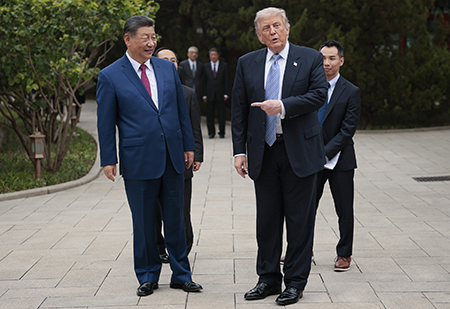 “I talk about it all the time with Russia and with China, and it did come up. We did discuss” denuclearization, Trump said May 15 on Air Force One in response to a question from the press pool about his previous statement in January that he would seek arms control negotiations with Xi and Russian President Vladimir Putin. (See ACT, March 2026.)
“I got a very positive response,” the president said.
“I don’t want to say anybody committed, but we have a very good understanding, you know, the concept of denuclearization,” he said.
In a May 15 press statement on the state visit, however, Chinese Foreign Minister Wang Yi did not mention nuclear arms control but said that the two presidents had reached an understanding on “a constructive China-U.S. relationship of strategic stability.”
That new descriptor, repeated prominently in Chinese press releases regarding the state visit and in state-controlled media reports, marks a fresh attempt by China to frame the complex, multi-dimensional bilateral relationship, and speaks as much to politics and economics as it does to the military balance of power.
In a May 17 fact sheet, the White House echoed the Chinese formulation, confirming that the two presidents had agreed to “build a constructive relationship of strategic stability.”
The U.S. fact sheet claimed that Trump and Xi had agreed that “Iran cannot have a nuclear weapon,” and that they had “confirmed their shared goal to denuclearize North Korea,” but Chinese statements did not affirm either of these. (See ACT, June 2026.)
While the White House account of the meeting focused primarily on economic ties between the two countries, the Chinese counterpart, as attributed to Wang, chose to foreground the broader strategic understanding purportedly reached between the two presidents.
Trump indicated in his comments on Air Force One that he sees the conversation on nuclear arms control between the United States and China as just the beginning.
“We’re going to be together four times, potentially, this year,” he pointed out.
At a May 14 state banquet in Beijing, Trump invited Xi to visit the White House Sept. 24. Wang’s statement confirmed that “Xi will pay a state visit to the United States this fall.”
The two leaders might also meet again at the Asia-Pacific Economic Cooperation summit in Shenzhen, China, in November, as well as the Group of 20 summit in Miami in December.
Although details of the U.S. denuclearization concept remain scant, Trump rejected, in his Air Force One comments, a reporter’s suggestion that the proposal was an extension of the New Strategic Arms Reduction Treaty, with China somehow involved. That treaty, which expired Feb. 5, bound only U.S. and Russian nuclear forces.
Earlier this year, the United States “provided detailed proposals to Russia and China, and among the P5, on possible initial steps, including on transparency, risk reduction, and nuclear testing,” according to an April 29 statement by Assistant Secretary of State for Arms Control and Nonproliferation Christopher Yeaw, referring to the five nuclear-weapon states recognized under the nuclear Nonproliferation Treaty (NPT).
Yeaw delivered the statement April 29 at the NPT Review Conference in New York, where states-parties gathered from April 27 to May 22 to discuss implementation of the foundational treaty. (See ACT, June 2026.)
Diplomatic sources told Arms Control Today that they could not confirm that a written proposal had been delivered.
Trump also discussed arms sales to Taiwan with Xi, the U.S. president said in his Air Force One interview, despite a long-standing assurance made by President Ronald Reagan to Taiwan’s leaders that Washington would not discuss arms sales to Taipei with Beijing.
Xi “brought that up. He talked about that obviously. So, what am I going to do, say I don’t want to talk to you about it because I have an agreement that was signed in 1982?” Trump said.
Speaking to NBC News May 14, Secretary of State Marco Rubio insisted that “U.S. policy on the issue of Taiwan is unchanged as of today.”
An arms deal worth $14 billion—primarily consisting of air- and missile-defense interceptors—is awaiting Trump’s signature, Reuters reported May 13.
“I’m holding that in abeyance, and it depends on China. It’s a very good negotiating chip for us, frankly,” Trump said in a May 15 interview with Fox News. Trump said the value of the deal was smaller, at around $12 billion.
In July 2024, China cited U.S. arms sales to Taiwan as justification for discontinuing bilateral nuclear risk reduction talks. (See ACT, September 2024.)
Taiwan’s opposition-controlled parliament approved a special additional defense budget May 8, allocating $25 billion to pay for U.S. weapons.
The move was a partial setback to the government of President Lai Ching-te, which had sought a larger special budget of nearly $40 billion that would cover additional domestic procurement.