


“For half a century, ACA has been providing the world … with advocacy, analysis, and awareness on some of the most critical topics of international peace and security, including on how to achieve our common, shared goal of a world free of nuclear weapons.”
Trump Says U.S., Iran Close to Deal
June 2026
By Kelsey Davenport & Shaghayegh Chris Rostampour
U.S. President Donald Trump announced that the United States and Iran are close to reaching a peace agreement, but Iranian officials cautioned that a deal is not imminent. Even if an agreement is reached, Washington and Tehran said it will not address nuclear issues in detail and that more negotiations will be necessary.
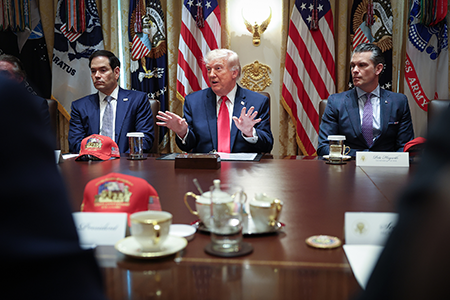
In a May 23 post on Truth Social, Trump wrote that “An Agreement has been largely negotiated,” and that “Final aspects and details of the Deal are currently being discussed, and will be announced shortly.”
The previous week, Trump threatened to resume strikes but said he would hold off at the behest of states in the region. The leaders of Qatar, Saudi Arabia, and the United Arab Emirates asked the United States “to hold off on our planned Military attack” against Iran set for the next day because “serious negotiations are now taking place,” Trump wrote May 18 on Truth Social.
Iranian Foreign Ministry spokesman Esmail Baghaei concurred that progress was made, but disputed Trump’s assertion that a deal would be announced soon. “We have reached conclusions on a large portion of the issues, but no one can claim that the signing of an agreement is imminent,” he told Iranian state media May 25.
Both Baghaei and U.S. Secretary of State Marco Rubio suggested that the agreement will not address key nuclear concerns in detail and that subsequent negotiations will focus on those issues. Baghaei said in a May 25 press conference that the “focus of the negotiations is on ending the war” and “at this stage, we are not discussing the details of the nuclear issue.”
Rubio told The New York Times during a trip to New Delhi May 24 that “the straits [sic] have to be immediately reopened, and then we will enter, under agreed-to parameters, into very serious talks about enrichment, about the highly enriched uranium, and about [Iran’s] pledge to never have nuclear weapons.”
The future of the Strait of Hormuz emerged as a key issue after the United States and Israel attacked Iran Feb. 28. The subsequent war and Iran’s focus on asserting military control over the strait largely halted maritime traffic through the waterway, a critical route for commodities such as oil and fertilizer. Iran now wants to charge ships for transit, while the United States maintains that the waterway should be open.
Iran is also seeking sanctions relief as part of the initial agreement. Iranian media reported that the head of Iran’s central bank, Abdolnasser Hemmati, accompanied Iranian Parliament Speaker Mohammad Bagher Qalibaf and Foreign Minister Abbas Araghchi to Qatar May 25 for talks on sanctions relief.
Even if an agreement to formalize the April 7 ceasefire and reopen the Strait of Hormuz were reached, Iranian and U.S. statements suggest that the two sides remain far apart on the future of Iran’s nuclear program and the disposition of its stockpile of highly enriched uranium-235 (HEU), particularly the 440 kilograms of uranium enriched to near-weapons-grade levels. Baghaei suggested a 30-to-60-day window to negotiate a nuclear agreement after Washington and Tehran reached a deal to end the war.
Before announcing that a deal was imminent, Trump maintained that Iran must hand over the HEU to the United States and threatened to send U.S. troops into Iran to retrieve the material.
In a May 25 Truth Social post, however, Trump suggested that he might be relaxing his demand that the United States take possession of the material. He said, “The Enriched Uranium (Nuclear Dust!) will either be immediately turned over to the United States to be brought home and destroyed or, preferably, in conjunction and coordination with the Islamic Republic of Iran, destroyed in place or, at another acceptable location.”
Iranian officials have emphasized that the HEU must remain in Iran. Iran’s supreme leader, Mojtaba Khamenei, reportedly supports that position, saying that transferring the material abroad could increase Iran’s vulnerability to future military pressure or attacks, according to senior Iranian sources quoted May 21 by Reuters.
Araghchi has suggested that Iran offered to blend down the HEU to lower levels, which poses less of a proliferation risk, during negotiations with the Trump administration before the U.S. and Israeli decision to bomb Iran Feb. 28. (See ACT, April 2026.) Down-blending could be what Trump referred to when he said the HEU must be destroyed.
Speaking May 15 at the BRICS foreign ministers’ meeting in New Delhi, Araghchi said that the two sides were deadlocked over the future of the HEU, “but we will come to that subject in later stages.”
Trump also may be demonstrating more flexibility on the future of Iran’s nuclear program. He recently suggested that the United States may be willing to relax its demand that Iran forgo uranium enrichment in perpetuity and accept instead a 20-year suspension of enrichment. “Twenty years is enough, but the level of guarantee from them is not enough. In other words, it’s got to be a real 20 years,” he told reporters May 15 on Air Force One.
Iran has repeatedly rejected a permanent ban on uranium enrichment, which it views as a sovereign right under the nuclear Nonproliferation Treaty. Senior Iranian officials have said Tehran is willing to suspend enrichment but rejected doing so for 20 years.
It is unclear if Israeli Prime Minister Benjamin Netanyahu would accept a deal allowing Iran to enrich uranium in the future or retain any enriched uranium.
In a May 24 statement, Netanyahu said he discussed the negotiations with Trump the previous day and that the two leaders “agreed that any final agreement with Iran must eliminate the nuclear danger. This means dismantling Iran’s uranium enrichment sites and removing enriched nuclear material from its territory.”
A re-eruption of hostilities also threatens progress. Two days after Trump announced an agreement was imminent, the United States bombed Iran, in what U.S. Central Command described as “self-defense strikes.”
In a May 25 statement, Central Command spokesman Capt. Tim Hawkins said the United States acted with “restraint” and targeted “missile launch sites and Iranian boats attempting to emplace mines” that threatened U.S. forces.
In a May 26 statement, Iran’s Foreign Ministry said that the United States “committed a grave violation of the ceasefire.” These “acts of aggression, coinciding with the ongoing diplomatic process mediated by Pakistan, once again exposes the ill intent and bad faith of the U.S. ruling establishment,” the statement said. “Iran will not leave any act of hostility unanswered.”
If Iran does retaliate, The New York Times reported May 12 that it may be better positioned militarily than previously assessed. Unnamed U.S. officials quoted in the article said that U.S. intelligence assessed that Iran retained about 70 percent of the stockpile of missiles it possessed before the war and roughly the same amount of missile launchers.