


“For half a century, ACA has been providing the world … with advocacy, analysis, and awareness on some of the most critical topics of international peace and security, including on how to achieve our common, shared goal of a world free of nuclear weapons.”
The U.S. Has Been Central to the NPT Since the Beginning. What Will It Do in 2026?
April 2026
By Matthew Sharp
When states-parties to the nuclear Nonproliferation Treaty (NPT) meet in New York this month to discuss the implementation and future direction of the treaty at the 2026 NPT Review Conference, there will be as many perspectives and objectives as there are delegations. Conference President Do Hung Viet, Vietnam’s UN ambassador, will use the allotted four-week schedule to navigate that diversity of opinion and seek common ground among the states-parties.
One thing they can agree on is that Viet will have his work cut out for him. Issues that have blocked past conferences from success, such as the Middle East in 20151 and Ukraine in 2022,2 remain outstanding. New developments are largely negative, including U.S. accusations of Chinese nuclear testing and U.S. threats to resume nuclear testing “on an equal basis,” the expiration without replacement of the New Strategic Arms Reduction Treaty (New START), and the ongoing war against Iran. An additional factor to consider as participating delegations prepare for the conference is the role that will be played by the United States, traditionally one of the most significant drivers of how such conferences unfold.
Assistant Secretary of State for Arms Control and Nonproliferation Christopher Yeaw said February 17 that the review conference is a “high priority for the administration, and we certainly have some things that we want to see advocated and advanced there.”3 The full scope of those things is not yet clear. U.S. objectives are doubtlessly still being finalized, and these positions will be communicated publicly at the appropriate time by U.S. diplomats. Yet clues are emerging that suggest the U.S. approach may look different from the past in important ways. Review conference delegations should consider those hints carefully in light of what they suggest for how the conference may play out.
Clues to U.S. Positions
First, a number of U.S. policy positions were made clear in October at the UN First Committee meeting, including opposition to language endorsing the Comprehensive Test Ban Treaty (CTBT) or a UN role in AI-nuclear issues.4 References to the Sustainable Development Goals, a set of 17 objectives to end poverty, protect the planet, and ensure prosperity adopted by the UN in 2015, are also in disfavor with the Trump administration, presaging division with those who have pushed at past conferences for references to the benefits of NPT implementation toward realizing those development goals. Delegations should anticipate that these positions will also hold true at this year’s review conference.
A second point that the United States made clear at last year’s First Committee meeting was its comfort with diplomatic isolation. In 2025, Washington voted against a dozen resolutions it had previously supported on topics that ranged from the CTBT to the Arms Trade Treaty to the UN Disarmament Commission. On seven of these, the United States was the only “no” vote. As countries prepare for the 2026 NPT Review Conference, they should not overestimate the value of consensus in U.S. eyes.
Third, U.S. State Department officials Undersecretary for Arms Control and International Security Tom DiNanno
and Assistant Secretary for Arms Control and Nonproliferation Christopher Yeaw spoke on NPT-relevant topics three times in February.5
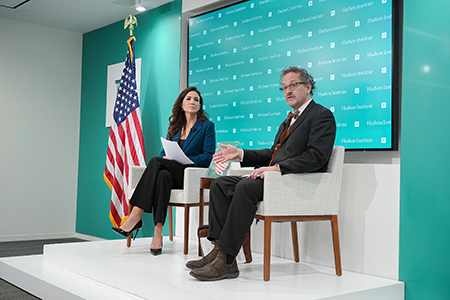
In February 23 remarks at the Conference on Disarmament focused on China’s nuclear activities, Yeaw said that “every NPT state-party has an obligation to negotiate in good faith on effective measures relating to nuclear disarmament. Article VI [of the treaty] does not say that only those states with the largest arsenals have that responsibility—all five nuclear-weapon states to the NPT share the same obligation.” On February 17 at the Hudson Institute, Yeaw said of the U.S. offer of arms control talks with China, “as we head into the NPT Review Conference in April, I sincerely hope that China takes up the president’s offer.” He also made clear that getting “the countries of the world to continue to press that all nuclear-weapon states need to be involved in this” would be a U.S. priority.
Yeaw’s framing of China’s nuclear buildup and refusal to engage in arms control in terms of its Article VI obligations is noteworthy, in particular as his bureau prepares its 2025 report on compliance with arms control agreements, anticipated in mid-April. A U.S. administration skeptical of multilateral institutions may well judge the conference largely by the degree to which it calls out China’s perceived nonperformance of its obligations, thereby building multilateral pressure for China to engage.
Finally, the ongoing U.S.-Israeli war in Iran will be discussed among conference delegations, as airstrikes on nuclear facilities—based, in part, on accusations about Iran’s NPT compliance—are of direct relevance to the treaty’s implementation. Delegations should anticipate that the United States will similarly seek multilateral pressure on and accountability for Iran at the conference, pushing back on any criticism of U.S. and Israeli attacks on Iran’s nuclear facilities.
In July 2025, the State Department dismissed a number of NPT-focused staff and abolished the ambassador-level position that previously led U.S. NPT delegations, but it would be a grave mistake to assume that U.S. participation in the 2026 Review Conference will therefore be unfocused or ineffective. The U.S. head of delegation will be supported by a dedicated and experienced team of experts who remain in place, and they will articulate and implement administration positions professionally and adaptively over the course of the conference. Other delegations should thus consider carefully what these updated U.S. positions mean for their own objectives and tactics in different scenarios for the conference.
Possibilities for the Review Conference
Past review conferences have worked toward consensus on detailed documents that comment extensively on various aspects of treaty implementation and, in some instances, endorse future actions. Barriers to this outcome will be high in 2026, with well-known disagreements on such topics as Ukraine, the Middle East, the CTBT, and NATO. Past conferences have been able to negotiate diligently to close gaps, even when final agreement proved impossible. This approach may be less viable if the United States places a high value on calling out individual states—such as China and Iran, who will be present and must also join any consensus—for their inadequate compliance, and if it places a low value on consensus. In such a case, deliberations could become stalemated at the beginning of the process, rather than at the end, building frustration that could impede compromise on any outcome.

Anticipating lack of consensus on a detailed final document, commentators frequently mention a fallback solution in the form of a higher-level conference document, or a joint statement among a number of states-parties, that sidesteps disagreement on specifics and instead affirms, for example, general support for the treaty. Again, papering over unbridgeable differences—on the issue of China’s arms control obligations, for instance—could have little value for a U.S. delegation that sees calling out China as a primary goal and does not place a high value on consensus.
An approach that seeks a consensus report and then falls back in the endgame to a higher-level statement may therefore fail. For those concerned about demonstrating support for the NPT among its parties, trying and failing to secure agreement on such a high-level statement of support may be more damaging in these terms than no outcome at all. A variation on this scenario could switch the order by tabling a high-level statement at the beginning of the conference to set the stage for parallel discussion on a more detailed final document. To the extent that this variation would provide a common basis for discussing points of disagreement rather than papering over them, it might prove more broadly appealing.
Past review conferences have operated by consensus, but nothing prevents a state-party from forcing a vote on a draft final document to overcome points of unbridgeable disagreement. Whose interests would be furthered in such a case depends on the text; for example, a document adopted by vote that called out China could advance potential U.S. objectives, while a document condemning NATO would not. In this scenario, it is even more important that all delegates exercise vigilance over how drafts are being shaped by the conference president; if the protection of consensus is removed, it matters a great deal whose positions are included in the current draft.
Some anticipated U.S. positions, for example its lack of support for the CTBT, are unlikely to prevail in a vote of the conference. However, clear U.S. comfort with political isolation means there is little leverage to be gained by calling such votes. Any state considering this course should first reflect on the value of an outcome if the first NPT vote in 50 years does not include the support of the United States, a treaty originator and depositary.
Perhaps the most pessimistic outcome for a deeply divided review conference would be the failure to agree even on administrative matters. Adoption of a conference agenda is typically a pro forma exercise, but in 2005, for three of the meeting’s four weeks, states-parties were unable to agree to get past the agenda phase, paralyzing the conference before it even began. A technical impasse this year would not help a U.S. objective of holding Iran or China to account because it would deny Washington the opportunity to lay out its arguments on both issues. Similarly, this outcome would undermine the ability of any delegation to achieve its substantive goals; it would seem to be an appealing option only for those who seek chaos.
The most dramatic outcome for the review conference might be if Iran decides to follow through on its 2025 threats to withdraw from the NPT in response to the decision by France, Germany, and the United Kingdom to snap back international sanctions under UN Security Council Resolution 2231. Although damaging to the NPT, such a major development might advance U.S. objectives if it focuses NPT states-parties on the Iran issue and unites them in criticism of Iran’s actions. Conversely, a conference that fails to rally parties around such a significant event as NPT withdrawal cannot offer much help for any state-party’s objectives, whatever they are.
Less dramatic would be death by boredom, which is to say if the conference devolves into endless, unproductive cycles of accusations and counteraccusations: Iranian-U.S. exchanges on U.S. and Israeli attacks; U.S.-Chinese accusations of irresponsible arms buildups; EU-Russian divisions over Ukraine; China’s criticism of UK and U.S. plans to provide Australia with nuclear-powered submarines; or the NATO nuclear weapons-sharing debate. The large majority of participants without a direct stake in such specific exchanges could at best tune out, and at worst decide the conference has become a bad use of their time.
A U.S. delegation motivated to build pressure on China to engage in arms control may find it beneficial to take every opportunity to make this case and encourage others to do the same. In the extreme, however, a scenario in which delegations tune out would hurt U.S. priorities if it drowned them out or deprived U.S. arguments of an audience. This scenario is most unhelpful to those who prioritize unity and engagement as a barometer of support for the NPT.
A final scenario for the review conference is if parties conclude early on that consensus is not feasible on details and not valuable at the level of generalities and instead focus their attention on review process practicalities. The stage is set for this, as extensive work was done over the past years on a mechanism for treaty parties to define and contribute national reports on their actions to implement the NPT’s obligations and then engage in an interactive debate regarding the substance of those reports at NPT meetings. Such a dialogue could benefit U.S. objectives, given the enormous gap in transparency between China and the United States.
There is a distinction between building pressure on China to be more transparent and building pressure on China to engage in arms control, but progress on the first supports the second. If China has less appetite for isolation than the United States, this could be an issue on which China would block agreement, as it did during a 2023 NPT preparatory meeting. However, China has its own transparency priorities, pushing hard in a 2025 preparatory meeting for greater transparency from NATO allies into their nuclear policies. Moreover, non-nuclear-weapon states have long sought accountability for all states possessing nuclear weapons, so spending review conference time on this issue may be something in which all sides could find value.
Whichever path this month’s conference takes, it is the NPT’s legally binding obligations, written in black and white more than 50 years ago, that make it the cornerstone of the global nonproliferation and disarmament regime. A review conference can neither take that status away nor resolve the real challenges that face implementation of those obligations.
As with all treaties, however, the NPT depends on a durable sense among its parties that they benefit from its continued implementation, and that the other parties remain equally committed. It is, in this way, and following 16 years in which they have been unable to reach common ground, that the proceedings of this review conference are important. As delegations try again this month, they should take note of changes in the positions of key participants, especially the United States, and consider carefully how those positions will play out over the course of the conference.
Finding common ground, even if on technical aspects of the NPT review process, would demonstrate a shared view of the continued international importance of the treaty. The NPT, currently under strain, would be left stronger than it is today. If NPT parties instead misread the priorities and positions of key players such as the United States and talk past each other, however, an issue as fundamental to the treaty as the viability of its disarmament obligations could be at the core of another fractured conference, leaving the NPT significantly weakened.
ENDNOTES
1. Andrey Baklitsky, “The 2015 NPT Review Conference and the Future of the Nonproliferation Regime,” Arms Control Today, July/August 2015; Thomas Countryman, “Learning from the 2015 NPT Review Conference,” Arms Control Today, May 2020.
2. Gaukhar Mukhatzhanova, “10th NPT Review Conference: Why It Was Doomed and How
It Almost Succeeded,” Arms Control Today, October 2022.
3. Christopher Yeaw, “Hard Truths: Towards Verifiable and Enforceable Arms Control,” remarks delivered at the Hudson Institute, U.S. Department of State, February 17, 2026.
4. Shizuka Kuramitsu, “States Gather at UN Security Meeting Amid Pressure, Reforms,” Arms Control Today, November 2025.
5. Thomas G. DiNanno, “Statement to the Conference on Disarmament,” U.S. Department of State, February 6, 2026; Yeaw remarks on the end of the New START Treaty at the Hudson Institute, February 17, 2026; Yeaw, “Statement to the Conference on Disarmament,” U.S. Department of State, February 23, 2026.
Matthew Sharp worked on nuclear nonproliferation and arms control issues in several roles at the U.S. Department of State and National Security Council from 2009 to 2025. He is a senior fellow at the Center for Nuclear Security Policy at the Massachusetts Institute of Technology.