


"I want to tell you that your fact sheet on the [Missile Technology Control Regime] is very well done and useful for me when I have to speak on MTCR issues."
Coercing Syria on Chemical Weapons: A Case Study of Deterrence and Coercive Diplomacy
April 2026
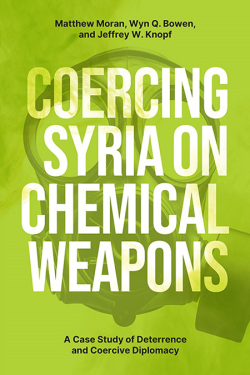
Coercing Syria on Chemical Weapons: A Case Study of Deterrence and Coercive Diplomacy
By Matthew Moran, Wyn Q. Bowen, and Jeffrey W. Knopf
Oxford University Press
2025
Reviewed by Chris Quillen
Syria’s CW Challenge to the Nonproliferation Regime
The Syrian government’s extensive use of chemical weapons (CW) during the 2011-2024 civil war is the most significant challenge to the international nonproliferation regime in the 21st century. This history presents a rich case study, given that it involves dozens of CW attacks with chlorine and the nerve agent sarin, stretches across the administrations of U.S. presidents Barack Obama and Donald Trump, and involves disparate efforts to deter Syrian CW use and to compel Syrian President Bashar al-Assad to surrender his arsenal.
Matthew Moran, Wyn Q. Bowen, and Jeffrey W. Knopf use this era in their book Coercing Syria on Chemical Weapons to assess theories of deterrence and coercive diplomacy by focusing on three phases of the conflict. The first covers the beginning of the civil war through Obama’s “redline” statement on CW use in 2012 to the deadly 2013 sarin attack at Ghouta, in which deterrence largely failed. In the next phase, efforts to compel Assad to surrender his chemical weapons and sign the Chemical Weapons Convention (CWC) largely succeeded with Russia’s help. Finally, deterrence failed again when Assad returned to using chemical weapons despite the previous success of dismantling most of his arsenal, resulting in retaliatory strikes during Trump’s first term in an effort to restore deterrence.
This thoroughly researched and well-written book offers a timely and important contribution to the existing literature with several significant insights for policymakers. The authors demonstrate a number of weaknesses in the seemingly standard fallback position of threats of retaliation combined with occasional airstrikes—referred to as the “resolve plus bombs” formula—in efforts to deter CW use and compel CW renunciation. They correctly point out that deterrence efforts tend to overemphasize establishing the credibility of the coercer, which is important but not decisive. Instead, they argue for greater attention to the motivations of the coerced to determine their vulnerability to pressure, as well as the need to offer assurances of not being attacked if the target of coercion cooperates.
On the importance of motivations, the authors reason that the target of coercion might simply be more motivated than the coercer and thus willing to endure the threatened punishment. As a result, the credibility of the coercer matters little. In the Syria case, Assad was singularly focused on remaining in power and was willing to use CW, thus risking airstrikes by the United States in order to maintain his regime. This fact alone goes a long way to explaining many of the deterrence failures in the Assad case. According to the authors, the coercer should focus specifically on threatening the issue that motivates the target. In the Syrian case, that suggests that the United States would have had more success deterring Assad if it had threatened his hold on power.
The authors admit that this was a challenging policy to enact, given Obama’s unwillingness to directly intervene in Syria and fears of an Islamic extremist takeover in Damascus if Assad fell. Obama essentially was trapped between his political aversion to military intervention—which included U.S. involvement in Iraq and Afghanistan—and his perceived moral obligation to respond to CW use. Nevertheless, the overall argument that focusing more on the motivations of the coerced rather than the credibility of the coercer is likely to improve coercive strategies. Policymakers, however, tend to focus on enhancing their credibility, which is largely within their control, rather than determining the other side’s motivations, which are outside of their control and often inscrutable.
Regarding assurances, the authors argue for the need to reassure the coerced that adhering to the coercer’s demands will prevent any future punishment. Such a strategy will likely enhance the chances of success but is difficult to enact while balancing the need to offer credible threats. In Assad’s case, assurance meant that if he did not use CW then he would not suffer threatened airstrikes. Obama, however, was either unable or unwilling to offer Assad the assurance of staying in power—the guarantee that Assad most valued—after calling for regime change in Damascus. This failure to offer credible assurances led Assad to use CW to maintain control. He simply feared a rebel advance on Damascus more than a U.S. airstrike.
Trump, on the other hand, may have offered too much assurance by focusing on the threat from the Islamic State militant group rather than on Assad. Believing that the U.S. threat of a military response to CW use had diminished after Obama left office, Assad returned to such use until Trump established his willingness to strike. The authors argue that the only successful assurance that Assad could remain in power was due to Russian diplomacy after the sarin gas attack in Ghouta. With Russia’s backing, Assad was sufficiently confident that he could surrender his CW stocks and sign the CWC without losing power. (Although this was a significant victory for nonproliferation, it was a qualified success, given that Assad maintained some of his chemical arsenal and eventually returned to using it against his own people.) The success in compelling Assad to give up some of his chemical arsenal is a significant puzzle because compellence is generally expected to be more difficult than deterrence, but proved the more successful strategy in this case.
This inclusion of motivations and assurances alongside credibility is an important contribution from the authors but sometimes enables them to pick and choose which factor was paramount to explain any particular outcome. As a result, the real strength of this book lies in its descriptive power of the Syrian CW case more than its prescriptive power for future cases. For example, the authors point out that credibility and assurance are both on a spectrum rather than all-or-nothing propositions and can even counteract each other. The greater the credibility of the threat to attack by the coercer, the less likely the coerced will accept any assurances to avoid an attack. Thus, too much assurance can undercut deterrent threats. Although a useful conclusion, this line of argument enables seemingly credible deterrence to be dismissed due to the lack of sufficient assurance and complicates a clear understanding of which factor truly led to the failure. Undoubtedly, policymakers will continue to struggle with striking the right balance between threats and assurances to achieve their desired outcome despite the numerous insights in this analysis.
Similarly, the authors argue for a greater focus on the motivations of the target of coercion, but determining the motivations of others is notoriously difficult and it is especially challenging at the specific moment when the target of coercion feels their primary concern is under threat. In the Syria case, the authors argue persuasively that Assad’s primary motivation was maintaining his grip on power and thus anytime he felt his regime sufficiently threatened, he was willing to cross the line and use chemical weapons, including sarin, in mass-casualty attacks despite deterrent threats. Their argument sometimes appears to rest on the assumption that if Assad used sarin, then he must have felt threatened. This conclusion may be useful in explaining the times Assad crossed that line, but does not help in determining when such incidents may recur and will not enable policymakers to pre-empt such use through assurances. By analyzing three competing factors—credibility of deterrence, assurances, and motivations—the authors sometimes equivocate on which factor was most relevant to explain the outcome. Although the world is a complex place, this approach offers little in helping to understand future cases other than to remember to take all such factors into account.
To be fair, these limitations of the book reflect the challenges inherent generally in deterrence and coercive diplomacy in a dynamic situation. Multiple U.S. administrations were unclear in their approach to similar challenges due to competing demands. The United States could not ignore the use of chemical weapons on moral and nonproliferation grounds, but was unwilling to threaten invasion and feared an Islamic extremist government takeover in Damascus. Assad, meanwhile, was left wondering where the supposed redline was after his repeated use of chlorine sparked little international response. Only his use of sarin ran a serious risk of military strikes until he suffered his most significant strike from the United States, France, and the United Kingdom after his use of chlorine in Douma in 2018 killed dozens of people. These shifting international priorities seriously complicated any efforts at deterrence, coercion, or acquiescence.
Another powerful insight the authors offer involves the role of recent comparable experiences in the calculations of the key players in Russia, Syria and the United States throughout this time period. NATO’s decision to facilitate the fall of leader Muammar Qaddafi in Libya, even after he surrendered his weapons of mass destruction, raised serious questions in Assad’s mind about his future if he turned over his chemical weapons and limited the U.S. ability to offer any assurances. Russia similarly recalled regime-change experiences in Afghanistan, Iraq, and Libya—all of which resulted in considerable chaos—and feared a similar fate for its ally in Damascus. Although Assad and Russian President Vladimir Putin feared this track record meant that the United States was serious about possible regime change in Syria, Obama and Trump appeared to take the opposite approach. Instead, both presidents tried to avoid repeating those same mistakes and did not wish to risk the fall of Assad for fear of a humanitarian crisis or even an Islamic State takeover. Thus, Libya provided a cautionary tale for all of the key players, even if they drew somewhat different lessons.
The authors conclude their analysis in 2020, as Assad appeared to have won the civil war and, not coincidentally, stopped using his chemical weapons. Subsequent events inspired them to add a brief epilogue, however, to address Assad’s unexpected fall from power in late 2024 and his equally unexpected nonuse of CW in the end. The authors correctly argue that deterrence was probably not the cause of this CW nonuse, given the lack of deterrent threats from the United States at the time. Instead, they focus on Assad’s inability to respond due to the speed of his ouster and the weakness of his military.
Yet, this nonuse of chemical weapons fundamentally challenges the authors’ argument focusing on Assad’s commitment to regime survival as the primary reason for his CW use. If their hypothesis is true that Assad was more likely to use CW, especially sarin, when he felt most threatened, why did the Syrian leader not at least attempt to use CW again as enemy troops closed on his capital? Although beyond the scope of this book, this is an important question worthy of additional research. Hopefully, the authors will address this question in future work.
Overall, this book offers an excellent contribution to the literature with numerous insights worthy of further consideration, especially because the challenges of deterrence and coercive diplomacy will continue to bedevil policymakers in the future.