


“It will take all of us working together – government officials, and diplomats, academic experts, and scientists, activists, and organizers – to come up with new and innovative approaches to strengthen transparency and predictability, reduce risk, and forge the next generation of arms control agreements.”
North Korea Seeks Nuclear Recognition for U.S. Talks
April 2026
By Kelsey Davenport
North Korea is ready for peace or war with the United States, leader Kim Jong Un said, but he emphasized that any bilateral talks would require that the United States recognizes North Korea as a nuclear-armed state.
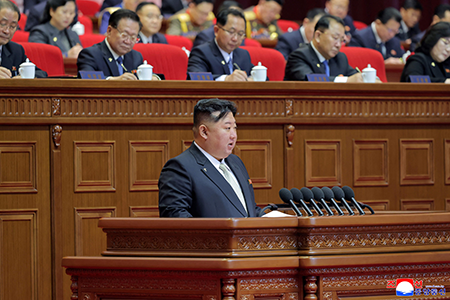
Kim’s Feb. 26 remarks were made on the last day of the week-long Ninth Party Congress, which is held every five years and sets national priorities. His remarks and the proceedings were covered extensively by the state-run Korean Central News Agency and Rodong Sinmun, the official paper of the Workers’ Party. Kim was re-elected as general secretary during the congress.
In his speech, Kim ruled out any negotiations with South Korea. He emphasized that ties with Seoul are “completely eliminated” and “nothing remains” in the relationship. He ordered North Korea to further fortify its border with South Korea.
Kim said North Korea’s relationship with the United States “depends entirely on the attitude of the U.S. side” and that Pyongyang is prepared for “peaceful coexistence or eternal confrontation.”
Although Kim suggested that North Korea is open to diplomacy with the United States, he made clear that any change in the relationship is dependent on a change in U.S. policy, which Washington has suggested it is not ready to make.
Kim said that “there is no reason why we cannot get on well with the U.S.” if Washington “respects the present position of our state specified in the constitution” and “withdraws its hostile policy.” North Korea modified its constitution in 2023 to refer to its nuclear weapons status.
Kim said that North Korea’s position as a nuclear-weapon state is “permanently fixed” and that its “enemies clearly realize that the dismantlement of [North Korea’s] nukes can never happen unless the whole world changes.”
Kim also laid out new priorities to “further expand and strengthen” the country’s nuclear weapons program. He described nuclear weapons as the “backbone” of North Korea’s deterrence and war strategies.
Specifically, he said that North Korea will deploy more advanced intercontinental ballistic missiles (ICBMs) and suggested the country will launch more advanced satellites. Rodong Shimbun said in a Feb. 26 report that the party congress has a “long-term plan” to strengthen the nuclear program and will concentrate on “increasing the number of nuclear weapons and expanding the means and space for nuclear operation.”
The report said that North Korea will continue to conduct drills “to have confidence in the effectiveness of the operation” of the nuclear arsenal. The report also mentioned that North Korea will activate and do a test run of its integrated nuclear crisis response system.
It said that the “nuclear weaponization of naval surface and underwater forces” will be a main component of North Korea’s plans to upgrade its navy. The emphasis on nuclear-capable systems at sea is a continuation of previous plans for expanding the nuclear weapons program.
During the previous party congress in 2021, Kim set several specific goals for nuclear-capable systems, including development of tactical nuclear weapons, a solid-fueled ICBM, a nuclear-powered submarine, and sea-based ICBMs and strategic weapons. North Korea has made progress on most of those goals, including testing a solid-fueled ICBM and likely deploying tactical nuclear weapons, while others, such as the sea-based strategic systems, were revealed or tested but are unlikely to be deployed. North Korea also revealed what is likely a nuclear-powered submarine under construction.
The International Atomic Energy Agency (IAEA) Director-General Rafael Mariano Grossi said in a March 2 statement to the agency’s Board of Governors that North Korea’s 5-megawatt reactor at Yongbyon, which produces plutonium for nuclear warheads, “likely continues to operate” and that activity at the radiochemical laboratory suggests North Korea reprocessed spent fuel from the reactor’s previous cycle. Grossi also said the IAEA is monitoring a new building at Yongbyon, which is of similar size to a known enrichment facility at Kangson. Grossi said the building is “externally complete and internal fitting is likely underway.”
In its 2026 unclassified worldwide threat assessment, the U.S. intelligence community said North Korea is investing “in nuclear-capable systems to deter the U.S., challenge regional missile defenses, and hold targets in South Korea at risk.” It noted that North Korea is likely to deploy missiles with longer ranges and increased accuracy.
The 2025 report suggested that the United States may not be willing to accept North Korea as a nuclear-armed state. It noted that Kim “seeks to intimidate the United States and its allies into abandoning opposition to North Korea’s nuclear weapons.” That language was not included in the 2026 report.
The 2026 threat assessment did note that, despite North Korea’s military advances and the knowledge gained from supporting Russia’s invasion of Ukraine, “North Korea is likely to remain deterred by U.S. and allied forces.”
The United States held air and missile defense drills in South Korea following the North Korea party congress. The March 11 exercises included responding to incursions that include missiles and drones.
Three days later, North Korea launched a volley of short-range ballistic missiles at an island between the Korean peninsula and Japan. The Korean Central News Agency said the missiles “battered the island target” with “100-percent accuracy.”