

“For half a century, ACA has been providing the world … with advocacy, analysis, and awareness on some of the most critical topics of international peace and security, including on how to achieve our common, shared goal of a world free of nuclear weapons.”
Syria Pursues Plan to Complete CW Elimination
April 2026
By Daryl G. Kimball
The Syrian government, with technical support from the Organisation for the Prohibition of Chemical Weapons (OPCW) and financial support from seven partner states, has launched an initiative to assess and demilitarize residual elements of the chemical weapons program developed by the deposed government of Bashar al-Assad.
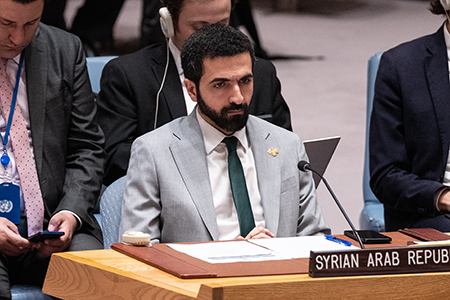
Syria’s UN ambassador, Ibrahim Olabi, announced the effort following a March 10 UN Security Council meeting on the Syrian political and humanitarian situation.
Assad was overthrown in December 2024 after nearly 15 years of civil war. The new government led by Ahmad al-Sharaa has begun to allow international inspectors access to key sites and documents to help eradicate the remainder of Syria’s once-formidable chemical arsenal. Since 2025, the new Syrian government has facilitated access to additional suspected chemical weapons sites and provided more than 10,0000 documents on the former chemical weapons program for OPCW review.
In 2013, following a sarin gas attack by Assad’s military against anti-regime forces and civilians outside Damascus that killed more than 1,400 people, a U.S.-and-Russia-brokered plan was imposed by the UN Security Council that required Syria to join the Chemical Weapons Convention, provide a full declaration of its stockpile, and allow for the demilitarization its chemical weapons stockpile.
This led to a complex, international effort to remove and safely dispose of the vast majority of the chemical arsenal, including 1,308 metric tons of chemical agents, as well as associated production equipment. Subsequent OPCW and UN investigations revealed, however, that the Assad regime still retained and used the nerve agent sarin, chlorine, and sulfur mustard gas through the course of the civil war and failed to reveal the full extent of its clandestine program.
Adedeji Ebo, director and deputy to the UN high representative for disarmament affairs, told the Security Council March 10 that the OPCW Technical Secretariat reports that in addition to 26 newly revealed former chemical weapons-related sites in Syria, “information made available to the OPCW suggests that there are more than 100 other sites that may have been involved in the previous government’s chemical-weapons-related activities.”
Ebo said the OPCW also has conducted interviews with former chemical weapons experts, collected 19 samples, and more than 6,000 documents from the visited locations. He added that “the new Syrian government handed over 34 sealed cardboard boxes containing documents to the OPCW Technical Secretariat, which have been documented and scanned, and will be processed for translation and analysis.”
The OPCW Technical Secretariat continues to conduct interviews and review documents, and it plans to visit all these locations when the security situation in the region improves, he added.
Tammy Bruce, the deputy U.S. ambassador to the UN, said in a statement to the Security Council that, “Finding, securing, declaring, and verifiably destroying any remnants of the Assad regime’s chemical weapons program is no easy task and is therefore costly.” The United States “echoes the calls by the OPCW director-general and the Technical Secretariat for voluntary monetary and in-kind contributions to its Syria mission,” she added.
Bruce said: “The United States is proud to be working alongside Syria, and six other partner nations, in the Syria-led Destruction Planning Group. This group was established to support Syria’s chemical weapons destruction effort, strengthen Syrian national capacities, and mobilize technical and operational support for this mission.” The six other states are Canada, France, Germany, Turkey, Qatar, and the United Kingdom.