


"Though we have achieved progress, our work is not over. That is why I support the mission of the Arms Control Association. It is, quite simply, the most effective and important organization working in the field today."
South Africa and the 1995 NPT Review Conference
March 2026
By Jean du Preez
Many nonproliferation pundits predict that the 2026 nuclear Nonproliferation Treaty (NPT) Review Conference, scheduled for April 27-May 22 in New York, will again fail to reach consensus, following the failures of the last two review cycles. Some say that another failure would render the treaty irrelevant, consigning the centerpiece of the international nonproliferation regime to the ever-increasing list of relics of Cold War agreements.

The divides among delegations on issues central to the NPT since its inception are as wide, if not wider, today than they were in 1995, when solemn promises were made to secure an indefinite extension of the treaty, without which it was argued the treaty would face a rather unstable future. As it turns out, 26 years later, the future of the treaty still looks rather bleak.
The 1995 NPT Review and Extension Conference is one of the most significant moments in treaty history, and possibly most controversial. Its outcome was crucial for subsequent review conferences, including the successful meetings in 2000 and 2010. Yet key agreements achieved at these conferences have been long forgotten, if not shredded. Despite major differences among delegations before the 1995 Review and Extension Conference and the failed NPT preparatory committee meeting in 1999, the goals of the 1995 and 2000 conferences were to secure the NPT’s relevance and future. These outcomes were not easily achieved. They required strong commitment from states-parties to seek visionary solutions and creative leadership from key diplomatic participants.
As a South African delegate involved in his country’s preparations for the conferences in 1995 and 2000 and the agreements reached there, I have unique insights into how those events evolved and into the contributions of the late ambassador Peter Goosen, the visionary behind South Africa’s influential role. They could be useful lessons for delegates to this year’s upcoming review conference.
South Africa’s Role
Volumes have been published about South Africa’s role at the 1995 and 2000 review conferences, and the motivations and decision-making behind the outcomes produced there. Very few, if any, of these articles offered insight into the real story from the perspective of a delegation member.
South Africa was widely heralded as one of the saviors of the 1995 NPT Review and Extension conference. The conference president, Jayantha Dhanapala, acknowledged afterward that the second-most important factor leading to the indefinite extension of the NPT (the most important being unanimous resolve among states-parties to extend the treaty in some form) was that “South Africa came up with the very imaginative proposal of having a statement of principles and a strengthening of the review process. This enabled us to have the seed of an idea that led to the other two parallel decisions that were taken together with the indefinite extension.”1
As South Africa acceded to the NPT in 1991 after dismantling its small nuclear weapons arsenal, the runup to 1995 Review and Extension Conference was the first exposure to NPT diplomacy for South African diplomats. Goosen, the principal foreign ministry official tasked with nuclear matters, participated in all but the first preparatory committee meeting. He was also the first South African to be invited to informal meetings of the former Programme for Promoting Nuclear Non-proliferation. Goosen was in listening mode at these events, in particular to understand the positions of members of the Organisation of African Unity (OAU) and the Non-Aligned Movement (NAM). At the time, there was very little, if any, high-level South African political interest in the NPT review process.
At the time of the third preparatory committee meeting held in September 1994, two alternative proposals emerged from the NAM: a 25-year rollover of the NPT with or without a vote of the states-parties. The meeting chair2 tasked South Africa with preparing and submitting to the fourth session a legal analysis of the various extension options.3 Goosen presented the legal opinion at the January 1995 preparatory committee and identified a third, rolling option of successive periods, which would extend the treaty in perpetuity based on a positive vote of the states-parties between each of the succeeding periods.
This third option was quickly, but incorrectly, interpreted as South Africa’s position, which had not yet been considered. Analyses by the Disarmament Times and the Acronym Institute for Disarmament Diplomacy further fueled this interpretation.4 Since this option addressed the core elements of all sides, it began to gain traction among several delegations. By proposing to extend the NPT in perpetuity, it added leverage for those seeking a mechanism to pressure the nuclear-weapon states to fulfill their commitments to disarmament under the treaty’s Article VI.
Early Strategy
A February 1995 memorandum to South African Foreign Minister Alfred Nzo recommended that the government adopt the third option as its formal position at the conference.5 It was noted that South Africa joined the NPT to ensure national and regional security, and that not extending the treaty in perpetuity would significantly undermine this objective. To “gain maximum political mileage” from this option, the memo recommended that “care should be taken not to expose South Africa’s tactics and position at too early a stage” because this would undermine opportunities for Pretoria to play the role of mediator between states that favor indefinite extension and the majority that did not.
The memo recommended that the legal opinion be shared with a few states, including members of the Southern African Development Community (SADC), African members of the International Atomic Energy Agency (IAEA), Brazil, and Indonesia, as well as Iran, India, and Pakistan, even though the latter two are not NPT parties. The memo proposed a conference strategy that would support extension of the NPT in perpetuity through rolling fixed periods with a positive vote; oppose any extension option less than in perpetuity because it would weaken the treaty; and seek support from delegations that opposed indefinite extension. It is notable that at that time, various states-parties supported periods ranging from a 5-year fixed period to 25-year long rollover periods. The memo suggested that each rollover period would last 15 years.
As is often the case in bureaucracies, especially one in which political leaders were not yet aware of the finer legal and political ramifications of the NPT, the February 27 memorandum was never officially approved by the foreign minister. Yet speculation emerged that South Africa was leaning toward supporting indefinite extension.
One factor contributing to this misconception was the use of the term, “in perpetuity,” which some delegates interpreted as meaning indefinite. As set out in the legal opinion, the third option would extend the treaty in perpetuity, with successive periods requiring a positive vote at each stage. The phrase “in perpetuity” was specifically used to differentiate this option from the flat-out indefinite extension. A second, more concise memorandum was subsequently submitted to the foreign minister to clarify that the prior recommendation did not propose indefinite extension or any of the other proposals floated by the NAM at the time.6
The U.S.-South Africa Binational Commission—or the Gore-Mbeki Commission, named after the two vice chairs, U.S. Vice President Al Gore and South African Deputy President Thabo Mbeki—was established in 1994 to foster cooperation in areas such as health, education, and economic development. Although arms control and nonproliferation were not key features of the commission, several meetings of a sub-working group on these matters were held to discuss, inter alia, South Africa’s membership in the Nuclear Suppliers Group, the Missile Technology Control Regime, and other related issues. The NPT extensions were never a focus of these discussions.
In the context of seeking to enhance relations between the two countries, two letters were sent to South African President Nelson Mandela in February 1995, one from the recently retired Chairman of the Joint Chiefs of Staff Gen. Colin Powell, and one from President Bill Clinton, seeking South Africa’s support for an indefinite NPT extension. Apparently, Thomas Graham, a senior State Department official who led the U.S. delegation to the 1995 Review and Extension Conference, suggested that Powell write a letter to Mandela addressing the importance of an indefinite extension of the treaty in the context of U.S.-Russian bilateral arms control. It stated that, “We can improve the NPT, but history will not be kind to us if we fail to make the treaty permanent at the 1995 NPT Conference.”7
The letter from Clinton to Mandela on February 13 contextualized U.S. support for an indefinite extension in relation to several South African priorities: completion of the Comprehensive Test Ban Treaty (CTBT) negotiations, the commencement of negotiations on a treaty banning fissile material for nuclear weapons, and further reductions in Russian and U.S. nuclear stockpiles. Both letters were referred to Mbeki’s office, which, in turn, referred them to the author, who was then the foreign ministry desk officer for the NPT. The letters had no direct influence on South Africa’s eventual position, but they prompted a high-level meeting with the deputy president, the foreign minister, and selected senior foreign ministry officials.
High-Level Briefing
The high-level meeting with Mbeki April 1 and 2, 1995, at the Diplomatic Guest House in Pretoria, was aimed to brief Mbeki on the review and extension conference and to discuss South Africa’s position. In addition to Mbeki and his legal adviser, the meeting was attended by Foreign Minister Alfred Nzo and his adviser, Abdul S. Minty. The meeting was chaired by the head of the foreign ministry, Rusty Evans, with several ministry officials, including Goosen and Du Preez, in attendance. Goosen led the briefing and presented a chart outlining five possible options for NPT extension, the likely proponents of each, and the implications for South Africa, other countries, and the future of the treaty. The five possible options were: indefinite; fixed period (treaty will terminate after one single period); fixed periods automatic (fixed period with automatic rollover unless otherwise decided by a review conference); fixed periods with a positive vote of the NPT conference (leading to the next period); and fixed periods conditional (each review conference to set and review specific conditions, e.g., progress toward disarmament. The third option, a variant of fixed periods with a positive vote, was also explained. The chart below is a scan of the original viewgraph Goosen presented at the meeting.8
Chart Showing Options, Supporters for Extending NPT 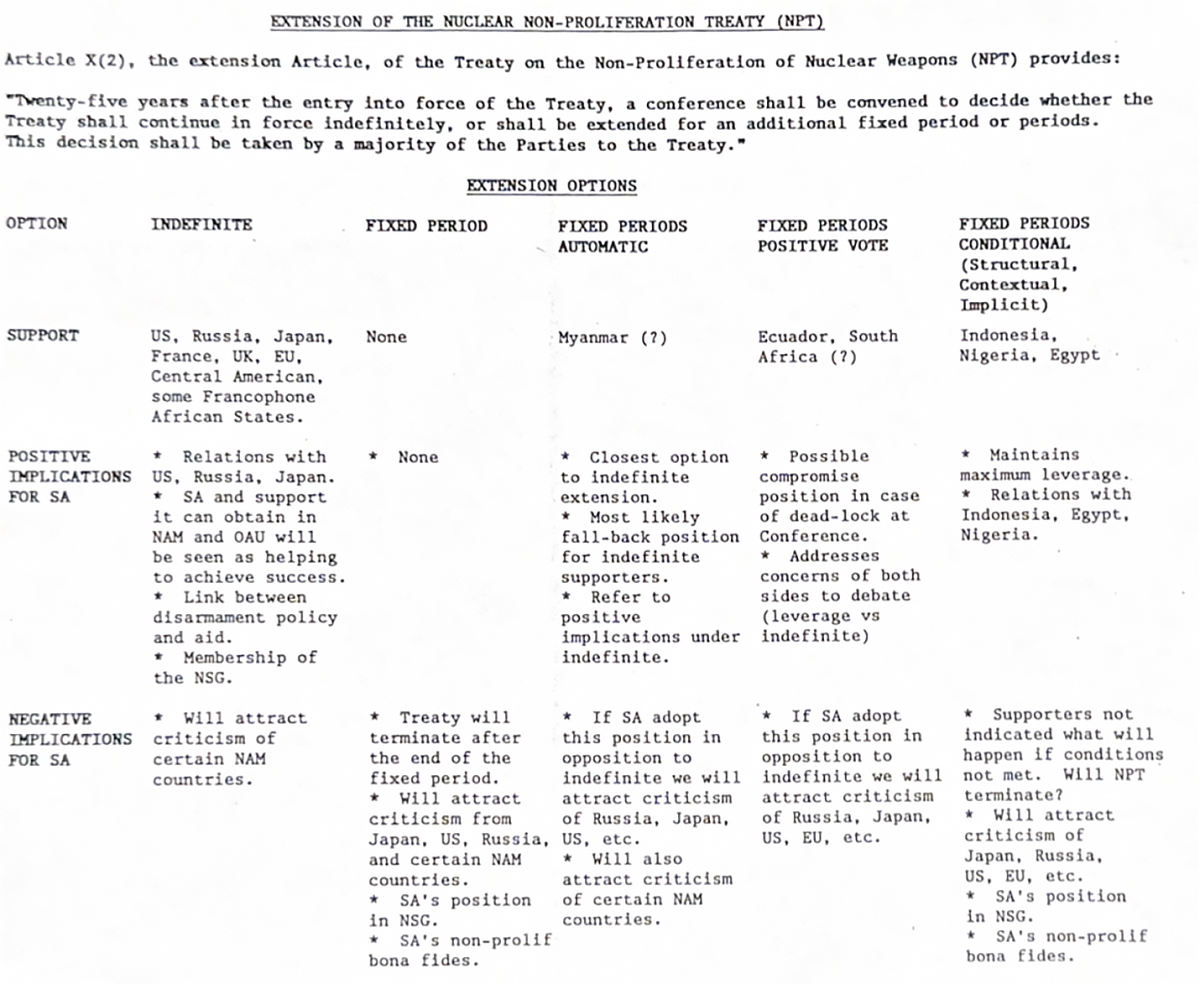 |
Following a discussion, Mbeki sought input from his colleagues. Nzo preferred a limited extension, a position he advocated during consultations in Cairo at the end of March 1995. Minty, who accompanied Nzo to Cairo, argued for a single, fixed-period extension, believing that South Africa should support the NAM position. To the foreign ministry group’s surprise, Mbeki adamantly maintained that the treaty was too important to be jeopardized by a limited or one-time extension. He emphasized that the right of all people to not be threatened by nuclear annihilation could be equated to a basic human right, and that South Africa would therefore have no choice but to support indefinite extension without conditions. Given this principled position, Mbeki proposed that South Africa’s support for an indefinite extension be grounded in a set of “principles” that would have moral weight and could be regarded as binding without jeopardizing the NPT’s existence.9
Goosen and Du Preez were tasked with developing, overnight, a set of nuclear disarmament and nonproliferation principles as well as measures to strengthen the NPT review process. After carefully reviewing the treaty and bearing in mind important additional related issues, Goosen prepared a concept paper on “Issues to Be Taken into Account When Considering the Proposal for Principles for Nuclear Non-Proliferation and Disarmament,” with a framework proposal on how to potentially strengthen the review process, was presented to Mbeki and other high-level officials.
The set of principles was relatively simple and largely embedded in the treaty itself, including commitments to strengthen and adhere to IAEA safeguards agreements; provide access to nuclear energy for peaceful purposes; make progress on a fissile material ban convention, reducing nuclear arsenals and concluding the CTBT. Other commitments covered establishing regional nuclear-weapon-free zones and enforcing negative security assurances for non-nuclear-weapon-states.
The paper also recommended that South Africa propose the establishment of a committee to examine the existing NPT review process and recommend concrete ways to improve and strengthen it. The committee was to report to the third preparatory committee meeting for the 2000 NPT Review Conference.
In addition, the high-level meeting agreed on an implementation strategy that included a letter—from Mbeki to Gore, and drafted by Goosen—in which South Africa’s position was explained. The letter effectively responded to those sent to President Nelson Mandela by U.S. officials in February 1995. In the letter, Mbeki emphasized that “South Africa sees its nonproliferation and arms control policy as being integral to its commitment to democracy, human rights, sustainable development, social justice and environmental protection.”10 This line drew a linkage between the new democracy’s belief in fundamental human rights and values, with the freedom from nuclear weapons and other weapons of mass destruction integral to individual rights.
The strategy also included regional discussions within SADC, the OAU, and NAM, but South Africa kept its options open and held its position close to its chest. For instance, letters to SADC foreign ministers and outreach to European Union member state ambassadors were only sent on the day the conference began.
Meanwhile, Goosen and Du Preez were dispatched to attend the NAM senior officials meeting in New York just before the start of the 1995 conference to “convince” the NAM of South Africa’s position. The NAM ministerial meeting held months earlier in Bandung, Indonesia, was supposed to adopt a common position in support of a 25-year rollover NPT extension with either a red light (rollover agreed to by majority vote) or green light (automatic rollover unless majority decides to block) approach. Having joined the NAM only in 1994, South Africa did not yet have the political gravitas to influence decisions on important issues such as international security. Despite its best diplomatic efforts to promote South Africa’s newly minted position, the delegation could at best prevent a common NAM position in support of a 25-year rollover.
Hence, there was no common NAM position going into the review and extension conference April 17, 1995. This deep divide between South African and key NAM members did not bode well for building bridges within the context of the NPT review process. In addition, senior leaders at the South Africa’s UN Mission, supported by a key adviser to the foreign minister, put significant pressure on the delegation to change Pretoria’s position and support the emerging consensus within NAM.
Nzo’s Speech and Conference Negotiations
The first draft of Nzo’s general statement to the conference was prepared by Goosen and stayed mostly intact despite efforts by a senior delegation member to change its main thrust: South Africa’s support for indefinite extension of the NPT based on a set of principles for nuclear disarmament and nonproliferation. Last-ditch efforts to reach Mbeki in Pretoria, to revise the position before delivery of the statement on the second day of the conference (April 19, 1995), failed.
The statement emphasized that “South Africa took the decision to destroy its nuclear weapons and to join the NPT because it saw its security being guaranteed by its provision.”11 It stressed that the NPT remains the only nuclear disarmament instrument to which all five recognized nuclear-weapon states are bound, and that although criticism of the inequities inherent in the treaty is valid, the “security that the NPT provides” should not be undermined. Then came the announcement that many delegates in the room feared and others welcomed loudly: “South Africa therefore in principle supports the view that the NPT should be extended indefinitely. The termination of the treaty—whether this comes about by placing conditions on its future existence or by extending it only for a fixed period—is not an acceptable option,” Ngo said.
The statement also clearly emphasized South Africa’s opposition to voting since a simple majority would weaken the treaty. Ngo proposed identifying a mechanism to address concerns about treaty implementation, which could be achieved by adopting a set of principles, including those agreed at the Pretoria meeting. He emphasized that these principles would not amend the treaty, but they would rather be a “lodestar which would focus attention on the importance of these goals.” Ngo proposed that these principles be reviewed at every review conference and be used as the “yardstick by which all [states-parties] can measure their nonproliferation and disarmament achievements.” He also announced South Africa’s proposal to strengthen the review process as laid out at the Pretoria meeting a few weeks earlier.
The statement created a visible stir in the UN Assembly Hall, with many delegations expressing support for South Africa’s approach. The delegation was invited to the office of the conference president, where Dhanapala requested that the proposal be used as the basis for his consultations. As he put it, the proposals “offered a new, achievable approach to secure agreement on the existence of the treaty.”12 Dhanapala tasked the delegation with preparing a first draft of what would later become Decision 2, Principles and Objectives for Nuclear Non-proliferation and Disarmament, adopted by the conference. From this point onward, the dynamics within the South African delegation shifted from adversarial among some members to more collaborative. Goosen and Minty were instrumental in advancing achievable common positions that ultimately enabled Dhanapala to secure agreement on the NPT’s indefinite extension.
The purpose of this reflection is not to analyze the conference’s working methods and outcomes. Suffice it to say that the review part of the conference, especially in Main Committee I, failed, with the result being that by the end of the second week, the focus shifted to the parallel negotiations in the presidential group of “friends.” This group of roughly 25 delegations began negotiating based on a draft provided by South Africa, on nuclear nonproliferation and disarmament principles and “strengthening the review process of the Treaty.” Main Committee I, as a result, became orphaned because key delegations pulled their most senior diplomats into the president’s consultations.
Negotiating the draft Declaration on Principles for Nuclear Non-proliferation and Disarmament went through 11 versions, including the original proposal that the South African delegation drafted for Dhanapala. The original eight principles agreed to in Pretoria and proposed in Nzo’s speech remained intact (with the need for a CTBT, a fissile material cutoff treaty, and bilateral arms control included under “disarmament”), and a new “universality” principle added. The final version was agreed to by the informal group May 3, 1995.13 The title was changed to include “objectives” after the declaration was submitted to the conference drafting committee as a whole. Dhanapala was well on his way toward reaching an agreement on indefinite extension.
The process leading to the strengthened review process (Decision I) was more transparent and evolved from the concept originally proposed in the Nzo statement. As Goosen said in a later interview with the Nonproliferation Review, “Originally, we thought that [it] would not be possible to accomplish this at the conference fully. However, we began work in Pretoria on the concept of a mechanism to strengthen the review process. We further refined the concept in New York before presenting the document to more fully incorporate the views of other states. Thus, the ideas in the original South African draft of the review mechanism were not South Africa’s alone, as was the case with the draft on principles. It made good sense for us to work with others in developing the draft on the review process, because, after all, this was South Africa’s first NPT review conference.”14
Despite widely held views that indefinite extension would have been approved if there had been a vote, this was by no means a given. The Canadian delegation claimed to have secured 103 signatures out of the 175 delegations at the conference on an indefinite-extension sponsorship list. Because the Canadian list was not made public, many of those who signed, especially from NAM states, likely would have voted against indefinite extension in a public vote. Most NAM delegations likely would have voted for either a 25-year extension with rollover options, or the original South African third option. In private discussions, many of these delegations acknowledged that they signed the list but had not received instructions from their capitals about what official position to take.15
The Campaign for the NPT and the Nuclear Age Foundation, two advocacy groups, surveyed individual statements of all delegations at the conference, as well as statements by the NAM, and their estimates showed that between 63 and 73 delegations were in favor of unconditional, indefinite extension, with about 92 favoring alternative proposals or undecided.16 The South African delegation did not sign onto the Canadian list despite the urging of Ottawa’s representatives. Although the delegation did not actively lobby against the list, it publicly maintained the position, as expressed in Nzo’s opening statement, that a simple majority vote would weaken the treaty. Observers may have concluded that there was an adversarial relationship between the South African and Canadian delegations, but the cloak-and-dagger diplomacy between Peter Goosen and Sven Jurschewsky from Canada17 on the margins of conference served to keep both delegations informed of developments in their respective political groups and to coordinate their shared goals for the conference outcome.
It has often been speculated that Mbeki’s decision to move South Africa’s position to support the NPT extension resulted from his meetings with Clinton and Gore in the context of the U.S.-South Africa Binational Commission just a few weeks before the high-level briefing in Pretoria. Discussions at the time (and in subsequent years) with colleagues at the South African foreign ministry, the South African Embassy in Washington, D.C, and the U.S. Department of State show no evidence that Mbeki’s decision was influenced by U.S. pressure. Instead, his belief that the human rights of all people of the world are threatened by nuclear annihilation was the driving factor behind his decision. This linkage was also established in the Mandela government’s 1994 policy on the nonproliferation of weapons of mass destruction.18
The New Agenda Coalition and the 2000 Review Conference
The success of South Africa’s conference diplomacy brought the country into the spotlight in the international disarmament and nonproliferation arena. As reported by The New York Times, South Africa became the germ of the compromise plan and emerged as a new leader in the developing world.19 Goosen’s visionary approach enabled South Africa, from this time onward, to play a significant role, punching well above its weight in an arena dominated by big powers and nuclear-weapon states.
Driven by the successes at the 1995 conference and based on close collaborations with a few key individuals from middle-power delegations, including Goosen, the New Agenda Coalition (NAC) was established in 1998 at the foreign-minster level to achieve a nuclear-weapon-free world through the pursuit of mutually reinforcing measures at the bilateral and multilateral levels.20 The coalition played a decisive role in the runup to and at the 2000 review conference by securing historic agreements from the nuclear-weapon states on 13 “practical steps” for nuclear disarmament, including an “unequivocal undertaking” by the nuclear-weapon states to eliminate their nuclear arsenals. Agreement between the coalition and the nuclear-weapon states on these steps directly contributed to the conference’s successful outcome.
Although the coalition is often lauded for providing the basis for the 2000 conference success, there are four other important factors that are mostly ignored. First was the role of the nuclear-weapon states, specifically the leaders of the U.S. delegation, to actively engage with the NAC states to seek achievable nuclear disarmament related goals. Second was the impact of broad NAM support for the NAC proposals. For instance, the voting results of the UN First Committee resolution sponsored by the NAC in October 199921 showed that other than Ireland, New Zealand, and Sweden, all the positive votes came from NAM members and observers. Third, although Conference President Abdulla Bali had no role in initiating or participating in the negotiations between the NAC and the nuclear-weapon states, he realized that the outcome of this collaboration could provide the basis for a successful outcome. He ensured that these negotiations were held in private. The fourth important factor was the key role of Norwegian moderator Steffen Kongstadt,22 who guided the negotiations with diplomatic tact while also quietly pushing his own delegation’s disarmament agenda.
The 2000 experience showed that cooperation between non-nuclear-weapon states and nuclear-weapon states is possible, and that such cooperation not only solidified the controversial indefinite extension decision, but gave new hope about the future of the treaty and its review process. Unfortunately, that hope no longer exists. Instead of collaboration between key middle-power countries and the nuclear-weapon states, the relationship between these groups has become poisonous. The nuclear-weapon states have long lost their ability to give clear direction to review conferences. Instead, their relationship is at its all-time worst. The NAM is also no longer the strong anti force that it has traditionally been. It lacks leadership, and geopolitical influences, including the impact of the war in Ukraine, and new alliances such as BRICS, have seriously undermined NAM’s strength as a cohesive force in the NPT review process. Although the NAC still represents a credible middle-powers group, the key role it played in past conferences has been diminished. As with the NAM, individual NAC members are influenced by geopolitical relationships, and the group seems to have lost its vision.
Lessons for 2026 and Beyond
Was the decision to indefinitely extend the treaty a mistake? It is true that by adopting the indefinite extension option, the treaty was made permanent, and as such eroded the leverage built into Article X of the NPT. However, if one makes an honest assessment of the lack of commitment to past agreements, coupled with a general apathy toward lasting solutions to serious nuclear threats that undermine basic human rights, one might rightfully conclude that no matter whether extended indefinitely or for specific periods, the treaty’s future relies on the manner in which states remain committed to it.
If South Africa pursued its third option to extend the treaty in perpetuity, linked to succeeding rollover periods, or if the NAM position of a 25-year rollover prevailed, states-parties would have been confronted with the challenge of agreeing to another fixed period at the 10th NPT Review Conference in 2022. The legacy of that conference and the deteriorating international security environment in which it was held suggest that such a rollover decision may have been impossible.
One can only speculate about the consequences of such failure. The reality is that the treaty is permanent, but it is equally important to recall the statement made by 1995 conference president after adopting the indefinite decision that “permanence of the treaty does not represent a permanence of unbalanced obligations, nor does it represent the permanence of nuclear apartheid between nuclear haves and have-nots.”23
As states-parties and the conference president-designate make final preparations for the 2026 review conference, it is hoped that the legacy of the 1995 and 2000 conferences, the solemn undertakings given at those milestone events, and the memory of the many diplomats who made such agreements possible will guide them in their quest to defy the odds and achieve a successful outcome.
It is understandable that every review conference president is ambitious. However, the bar for the 2026 conference should be set low. What is needed more than new undertakings or ways to further strengthen the review process is a reset by all parties of their obligations under the NPT and the core undertakings given during past conferences, especially in 1995.
Instead of seeking consensus (in what likely will be a highly divisive atmosphere) on how to record implementation of the treaty, the 2026 conference should consolidate around the treaty’s basic principles, while recognizing the threats posed by changes in the geopolitical security environment.
Rather than tinkering with the strengthened review process adopted in 1995 and further enhanced at the 2000 conference, participants should focus on the core challenges facing the treaty. The 1995 review process was never meant to be a focus on how the treaty is implemented or reviewed. It was simply a mechanism to strengthen and advance agreements in 1995 and beyond. The reasons the last two review conferences (2015 and 2022) failed to reach consensus have nothing to do with process but with the lack of commitment among states-parties to seek meaningful outcomes, even modest ones.
Another failed conference may not directly impact the existence of the NPT, but it would most certainly further undermine, if not erode, its efficacy and relevance as the cornerstone of the nonproliferation regime. The cracks in the foundation are more visible than ever. The solemn undertakings given in 1995 and 2000 have been relegated to history books.
Potentially, two wars24 will directly impact many NPT parties. Aggressive nuclear postures backed by a new arms race, no bilateral arms control agreements, and a doctrinal shift in French nuclear posture,25 are of serious concern. And even more threatening is the possibility of resumed nuclear testing by a number of states, potentially including India and Pakistan.
NPT members should be seriously alarmed about the treaty’s future. They need to wake up from apathetic sleepwalking and find ways to deal with these and other threats. If not, the treaty’s relevance for many non-nuclear-weapon states, especially from the global majority, may be lost forever. There may also be a real danger that some states will consider exercising their sovereign rights protected under Article X by withdrawing from a treaty that is no longer in their supreme national interests.
ENDNOTES
1. Susan B. Welsh, “Delegate Perspectives on the 1995 NPT Review and Extension Conference,” a series of interviews, Nonproliferation Review, Spring-Summer 1995.
2. Ambassador Isaac Ayewah of Nigeria.
3. In addition to the indefinite extension option outlined in ArtX(2), the Treaty also envisaged one fixed or multiple fixed-period extensions.
4. Disarmament Times, Vol. XVIII, No. 1, February 1995; “Extending the Non-proliferation Treaty: The Endgame,” a report on the fourth preparatory committee meeting of the NPT Review and Extension Conference, New York, January 23-27, 1995, ACRONYM, No. 5, February 1995.
5. Internal memorandum from Jean du Preez to Foreign Minister Alfred Nzo based on consultations with Ambassador Peter Goosen in Geneva, February 27, 1995, from the author’s personal files.
6. Internal memorandum from Jean du Preez to Foreign Minister Alfred Nzo, March 2, 1995, from the author’s personal files.
7. Letter from Gen. Colin Powell dated February 8, 1995, from the author’s personal files.
8. From Peter Goosen’s personal files.
9. From the author’s personal notes.
10. Thabo Mbeki, “Letter to Vice-President Al Gore,” dated April 10, 1995, from the author’s personal files.
11. Statement by H.E. Alfred Nzo, South African Foreign Minister on 19 April 1995.
12. From the author’s personal notes.
13. Peter Goosen, drafts and annotated notes in his personal files.
14. Delegate Perspectives on the 1995 NPT Review and Extension Conference” a series of interviews by Susan B. Welsh, Nonproliferation Review, Spring-Summer 1995.
15. Personal experience by the author and members of the South African delegation.
16. Since all but 11 of the 175 parties to the treaty were represented at the 1995 Review and Extension Conference, a simple majority would have required 89 votes in support of indefinite extension.
17. Sven Jurschewsky was a central member of the Canadian delegation and the senior advisor for nonproliferation and deputy director for nonproliferation arms control and disarmament in the Canadian foreign ministry.
18. The South African cabinet adopted South Africa’s Policy on the Non-proliferation of Weapons of Mass Destruction on August 31, 1994, in response to a proposal by Foreign Minister Nzo.
19. The New York Times, May 9, 1995.
20. New Agenda Coalition was established in June 1998 by means of a joint declaration by the foreign ministers of Brazil, Egypt, Ireland, Mexico, Slovenia (withdrew from the group soon after it was established), South Africa, and Sweden (withdrew in 2013).
21. “Towards a nuclear-weapons-free world: the need for a new agenda, U.N. General Assembly resolution 54/54 G of 1 December 1999, adopted by 114 in favor, 13 against, and 39 abstentions
22. Steffen Kongstadt was a key member of the Norwegian delegation and served as minister in the Permanent Mission in Geneva at the time. He has since retired.
23. Statement by Jayantha Dhanapala, president of the 1995 Review and Extension Conference at the conclusion of the conference, May 12, 1995.
24. The ongoing war in Ukraine and the second round of U.S. and Israeli attacks on Iran, including against its leadership and nuclear facilities.
25. Michele Rose, Reuters, “France to boost nuclear arsenal, involve European allies in deterrence,” March 2, 2026.
Jean du Preez was a South African diplomat for nearly 20 years before joining the Center for Nonproliferation Studies in 2002. He has also served as a senior official at the Comprehensive-Test-Ban-Treaty-Organisation, representing it at the 2010 review conference and participating as a delegate at the 1995 and 2000 review conferences.