


"I greatly appreciate your very swift response, and your organization's work in general. It's a terrific source of authoritative information."
IAEA Board Discusses Nuclear Safety in Ukraine
March 2026
By Kelsey Davenport
The International Atomic Energy Agency (IAEA) Board of Governors held an extraordinary meeting in January to discuss nuclear security and safety risks in Ukraine after repeated Russian strikes on Ukraine’s energy infrastructure.
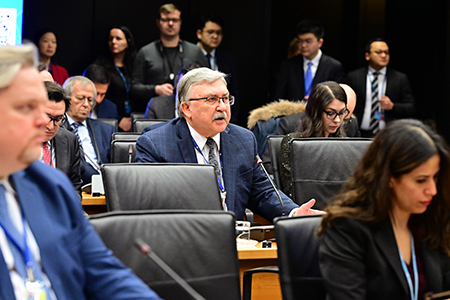
The Netherlands requested the Jan. 30 meeting. In a statement to the IAEA’s 35-member board, Dutch Ambassador Peter Potman expressed “grave concerns” about Russia’s attacks on Ukrainian electrical substations, noting that the strikes bring the “prospect of a nuclear accident to the very precipice of becoming a reality.”
Potman said that attacking Ukraine’s electric grid is a direct violation of IAEA Director-General Rafael Mariano Grossi’s seven indispensable pillars for ensuring nuclear safety. Grossi announced the seven pillars in 2022, shortly after Russia’s illegal, full-scale invasion of Ukraine and occupation of the Zaporizhzhia Nuclear Power Plant. Pillar 4 says “there must be a secure off-site power supply from the grid for all nuclear sites.”
The Netherlands, along with 11 other board members, requested that Grossi share a written assessment of the “increased nuclear safety risks in Ukraine” ahead of the board’s quarterly meeting in March. The assessment will help members “assess the extent to which a nuclear accident is imminent,” Potman said.
Grossi told the board Jan. 30 that nuclear power plants cannot operate safely without off-site power and noted a clear deterioration in Ukraine’s energy grid since the agency began monitoring it in 2024. He said IAEA teams will continue to visit substations in Ukraine to assess impacts on nuclear safety and security.
Russia’s ambassador to the IAEA, Mikhail Ulyanov, objected to the extraordinary meeting, saying the topic falls outside of the board’s purview. He accused members of using the meeting to “try to put pressure on Russia.” In a Jan. 30 statement, he said that Russia’s attacks on Ukraine’s energy infrastructure are a direct response to Ukrainian strikes on Russian civilian infrastructure.
Ukraine’s foreign ministry, in a statement the same day, said that the “deliberate and systemic” Russian attacks on Ukraine’s energy infrastructure create “direct nuclear risks.” Ukraine said it would propose an amendment to the IAEA statute “aimed at limiting the rights of the aggressor state within Agency bodies.”
Howard Solomon, the interim chargé d’affaires at the U.S. Mission to International Organizations in Vienna, called for all strikes against Ukraine’s energy infrastructure to cease. He said the current situation is “unacceptable and extremely dangerous.”
Russian attacks on Ukraine’s energy infrastructure continued after the meeting despite Grossi’s warnings.
In a subsequent Feb. 6 statement, Grossi said attacks on electrical infrastructure caused a reactor unit at an unspecified, operating nuclear power plant in Ukraine to automatically disconnect from the grid and shut down.
He said the “latest grid event is a stark reminder of the ever-present risks to nuclear safety and security arising from deteriorating grid conditions,” and called for restraint from further attacks. Attacks continued despite Grossi’s warnings.