


June 16, 2026
The April 28-May 22 nuclear Nonproliferation Treaty (NPT) Review Conference failed to adopt a final consensus document on May 22 after conference president Ambassador Do Hung Viet withheld the final document for debate due to unresolvable disagreements over how to address Iran’s nuclear program and the U.S.-Israeli war on Iran. This marks the third straight failure of the NPT review process.
The conference, which takes place every five years, involved some 130 states-parties. The review conferences aim to review NPT commitments, reaffirm support for the treaty, and create a concrete action plan for the next five years.
The conference took place during a time when each of the three pillars of the NPT – nonproliferation, disarmament, and the peaceful use of nuclear energy – are under severe strain.
Viet said at a news conference May 22 that, “No one [state] blocked consensus because I realized there was not consensus, and so I did not put the document forward.”
The exchanges at the conference also revealed the discord among the nuclear five on how and whether to reduce nuclear risks and nuclear arsenals.
The U.S. delegation sought to focus attention on China’s nuclear buildup and said it had proposed “multilateral strategic stability talks” on “transparency, risk reduction, and nuclear testing.”
China and Russia expressed regret that the United States had failed to take up opportunities to negotiate a follow-on to the New Strategic Arms Reduction Treaty, which expired in February. They urged Washington to actively consider Moscow’s proposal to respect that treaty’s numerical limits for one more year and explore a follow-on agreement “in a responsible manner.”
On April 29, China’s director-general for disarmament, Sun Xiaobo stated that “China has no interest in [strategic stability talks],” because China views the proposed talks as a way for the United States “to shift the responsibility for nuclear disarmament to other countries.”
After the conference, Russian Deputy Foreign Minister Sergei Ryabkov also rejected the premise of the talks, stating, “the conditions for launching a substantive, equitable, and mutually acceptable strategic dialogue, which could include a discussion of arms control, are currently fundamentally lacking.”
Later this month, Assistant Secretary of State for the Bureau of Arms Control and Nonproliferation Christopher Yeaw, who appeared at the review conference to briefly lead the U.S. NPT delegation, will testify June 30 before the House Foreign Affairs Committee Europe subcommittee to discuss U.S. plans for “Arms Control and Nonproliferation in an Era of Great Power Competition.” –LIBBY FLATOFF, XIAODON LIANG, and MIA CLARKE
For more on the outcome of the NPT Review Conference, see this month’s ACT news report: “2026 NPT Review Conference Stymied by Disputes.”
NPT President Viet: NPT Failure “Not Surprising”
Addressing the Arms Control Association’s Annual Meeting on June 2, Vietnamese Ambassador Do Hung Viet, the president of the 2026 nuclear Nonproliferation Treaty (NPT) Review Conference, said the inability of states-parties to reach consensus was “disappointing, but it was not surprising.”
Viet addressed the annual meeting by live video, days after completing duties as president of the review conference, to share his reflections on the third consecutive failure by states-parties to agree on a final document.
Viet called for a broadening of the international understanding of “risk” as a necessary next step. He suggested that the “growing attractiveness” of nuclear weapons and nuclear deterrence have placed pressure on key norms, seriously affecting nuclear risk reduction efforts.
Expressing cautious optimism, the ambassador shared his belief that “common ground has narrowed but has remained,” and that the NPT remains a foundation for peace and security even in the face of new challenges. He also stressed the importance of sustained dialogue among the nuclear weapons states to navigate new disagreements, conflicts, and challenges.
Viet concluded by emphasizing that “a safer future will not emerge automatically,” and that today’s efforts to reduce nuclear risks and increase cooperation will profoundly shape the future security environment.
A full video recording of the Arms Control Association Annual Meeting, including Ambassador Viet’s remarks, is available online.
Trump Claims “Denuclearization” Proposal Presented to China
U.S. President Donald Trump told reporters May 15 that he had discussed “denuclearization” with his Chinese counterpart, Xi Jinping, during a May 14-15 state visit. Although Trump received “a very positive response,” the Chinese side made no commitments on the subject, according to the president. Trump noted that he would meet Xi three more times in 2026, suggesting the president hopes for a resumption of talks on the strategic nuclear relationship later this year.
For more on the status of U.S.-China nuclear talks, see the June issue of Arms Control Today.
SIPRI: Deployed Weapons and Stockpiles Grow
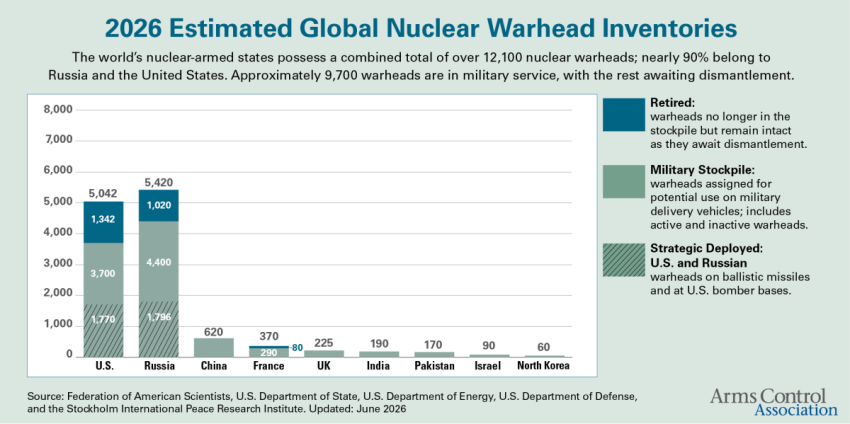
The Stockholm International Peace Research Institute (SIPRI) released June 8 its 2026 annual yearbook on disarmament, including a detailed assessment of the forces, doctrines, and modernization efforts of the nuclear-armed states. The assessment, which draws on the open-source research of the Federation of American Scientists, concludes that the “world’s nuclear arsenals expanded and upgraded” during 2025, according to a press release.
Although the total inventory of nuclear forces around the world likely declined due to the dismantlement and retirement of older warheads, the size of active stockpiles and the number of deployed warheads increased in 2025. Additionally, all nuclear-armed states are believed to be conducting modernization or upgrade programs to various degrees.
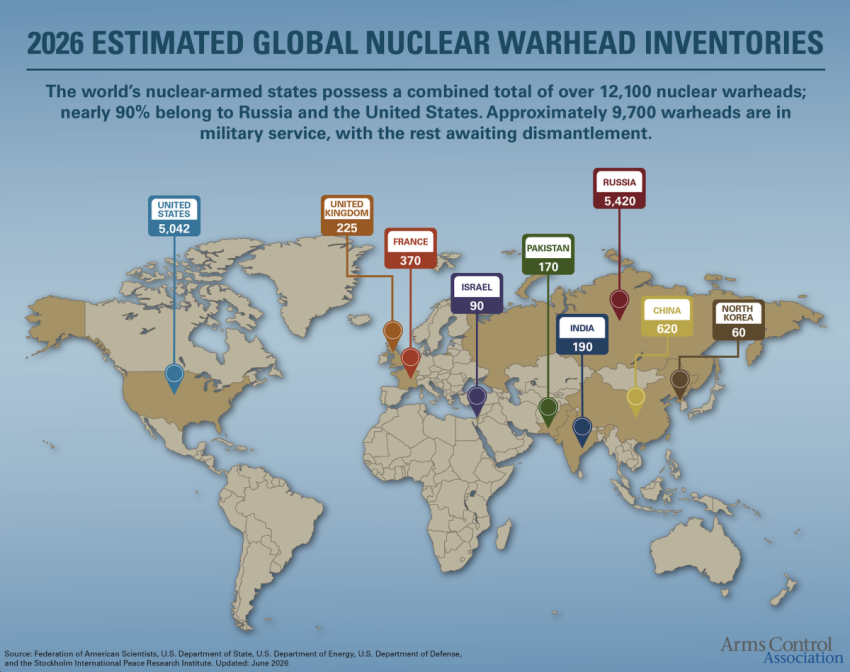
The most notable changes occurred in China and India. China has pursued advances in missile defense and launch-on-warning systems, and has begun deploying some missiles at heightened levels of readiness in silos. Additionally, China’s number of deployed missiles increased by between 24 and 34 between January 2025 and 2026. Coupled with new deployments of warheads on missiles with mobile battalions and near-constant SSBN deterrence patrols, these changes may signal China’s transition away from the strictest interpretation of a “no-first use” policy and toward an “early warning counter strike strategy” as it seeks to reinforce its second-strike capability.
India appears to have changed its policy of storing warheads and missiles separately and has begun loading missiles in canisters and deploying warheads on an SSBN conducting deterrence patrols. SIPRI reported that in January 2025 India was believed to have no warheads regularly deployed on missiles, but by January 2026, it had twelve. In conjunction with the May 2025 conflict between India and Pakistan, which included conventional strikes on Pakistani sites housing components of Islamabad’s nuclear weapons program, this policy change may indicate increased escalation risks within the region.
The yearbook also details a growing coordination and collaboration between the UK and France. Both countries are seeking to supplement and stabilize deterrence of the perceived risk of Russian aggression as the Trump administration’s anti-NATO rhetoric has intensified.
Looking forward, the yearbook predicts that increases in stockpiles and deployed weapons, as well as decreases in transparency and data-sharing, will continue.
France Talks Nuclear Planning with Allies
With the addition of Norway and Finland, the number of NATO countries that are consulting with Paris on supporting French nuclear forces in contingencies has increased to ten. The dialogues follow the announcement in March by French President Emmanuel Macron of a new strategy of “forward” deterrence that could allow for the temporary deployment of nuclear strike aircraft outside of France. Belgium, Denmark, Germany, Greece, the Netherlands, the United Kingdom, Poland, and Sweden have also expressed an intention to discuss cooperation with France.
Norway’s involvement in the scheme advanced May 27 with the signing of a mutual defense agreement with France and the announcement of further consultations on participation in a “process to determine how France’s nuclear weapons can contribute to security and deterrence in Europe,” according to a Norwegian government press release. Finland’s involvement remains at a preliminary stage, with Prime Minister Petteri Orpo informing Finnish news agency STT on June 4 that Macron’s government had transferred further details regarding the proposed arrangement, which is now under discussion in Helsinki.
The shift in French policy responds to perceptions in Europe of a weakened U.S. commitment to the defense of the continent. The Financial Times reported June 2 that the United States has held talks through NATO channels with several states on potentially hosting U.S. nuclear weapons under an expansion of the existing NATO nuclear sharing arrangement. The newspaper reported that sources indicate the talks were intended to demonstrate a willingness to provide a greater nuclear commitment to Europe while Washington draws down conventional forces.
U.S. to Return Intermediate-Range System to Japan
Japan will host U.S. intermediate-range ground-launched missiles for military exercises in June, the Japanese newswire Kyodo News reported May 21. A ground-launched Tomahawk cruise missile unit will deploy to Kanoya Airbase in Kagoshima prefecture, southwestern Japan, as part of the Valiant Shield and Orient Shield joint exercises, the newswire reported. This marks the second deployment of the Typhon mid-range capability system to Japan after a unit participated in exercises last September.
Although the report said that the missiles and launchers would remain in storage in Japan following the exercises, the Russian news agency TASS reported May 22 that the Japanese Embassy in Moscow had informed press the unit would be gone “by mid-October.” The Russian government criticized the move as “seriously detrimental” to the “stability and security of the Asia-Pacific region.”
The missile unit is intended to contribute to long-range land- and maritime-attack capabilities of U.S. military forces in the Asia-Pacific, mirroring similar long-range conventional weapons in the Chinese arsenal. A Chinese Ministry of Foreign Affairs spokesperson described the Tomahawk ground-launcher as “a strategic offensive weapon [that] will harm the legitimate security interests of other countries,” at a May 22 press conference.
Comment Period on U.S. Plutonium Pit Production Plan Closes July 16
The Department of Energy’s semi-autonomous National Nuclear Security Administration (NNSA) will continue receiving written public comments on its draft programmatic environmental impact statement for plans to expand plutonium pit production until midnight July 16. The agency invites comments from state and local governments, public interest groups, businesses, and individual members of the public.
The draft programmatic environmental impact statement assesses the likely consequences of three production alternatives, none of which include no expansion of plutonium pit production capacity. The draft ultimately endorses the NNSA’s plans to produce 80 pits per year at Los Alamos National Laboratories and the Savannah River Site, as mandated by Congress.
Vatican Calls for Nuclear Disarmament, Limits on Autonomous Weapons
In a major May 15 theological statement, the Catholic Church called for limits on autonomous weapons and decried the “erroneous belief that nuclear deterrence is an indispensable prerequisite for security.” The statement, an encyclical promulgated by Pope Leo XIV, comes after months of rhetorical clashes with the White House over the church’s promotion of peace and disarmament.
The encyclical primarily addresses the implications of artificial intelligence technologies, but also touches on other peace and security issues. In a brief section on nuclear weapons, it criticizes the belief that lower-yield “miniaturized” nuclear weapons can be “a more viable option” for use in warfare.
It laments that a shared “recognition of the threat posed by weapons capable of destroying all of humanity” has been “left behind,” contributing to a new arms race. The encyclical also acknowledges the 2021 Treaty on the Prohibition of Nuclear Weapons, but notes that major nuclear powers have not acceded to the treaty.
The new theological statement calls for accountability built into and responsible human control over autonomous weapons, as well as an international regime to “curb the technological arms race and ensure robust protection for civilians and the infrastructures necessary for their survival.”
For further coverage of the Papal encyclical, please look forward to the July/August edition of Arms Control Today.
On the Disarmament Calendar
July 7: 9th anniversary of the adoption of the Treaty on the Prohibition of Nuclear Weapons
July 16: 81st anniversary of the Trinity test
August 6 and 9: 81st anniversary of the U.S. atomic bombings of Hiroshima and Nagasaki
August 29: International Day Against Nuclear Tests
September 24: 30th anniversary of the opening for signature of the Comprehensive Nuclear Test Ban Treaty
Nov. 30- Dec. 4: First Review Conference of the Treaty on the Prohibition of Nuclear Weapons, New York
In Case You Missed It:
“2026 Adopted Resolutions: Urging the United States to Lead a Global Effort to Halt and Reverse the Nuclear Arms Race,” U.S. Conference of Mayors, June 2026.
“Premeditated: 2025 Global Nuclear Weapons Spending,” Alicia Sanders-Zakre and Susi Snyder, International Campaign to Abolish Nuclear Weapons, June 2026.
“Friendly Proliferation: Assessing U.S. Perceptions on Proliferation Among Allies and Partners,” Astrid Chevreuil, Center for Strategic International Studies, June 9.
“Mitigating Miscalculation: The Role of Pre-Launch Notifications in Strategic Stability,” William Alberque et al., Pacific Forum, May 2026.
“Contriving Imaginary Gaps in Nuclear Deterrence,”Jay Tilden, War on the Rocks, May 29.
“Trump's Nuclear Review,” Madelyn Creedon et al., RealClearDefense, May 26.
“Restrain and Hedge: A New U.S. Nuclear Strategy for a Two-Peer World,” Tyler Bowen, War on the Rocks, May 15.
“The “Karaganov Debate”: How Policy Entrepreneurs Shape Russia’s Nuclear Doctrine,” Alexander Graef and Gabriela Iveliz Rosa Hernandez, Global Studies Quarterly, April 24.
“Future-Proofing U.S. Nuclear Policy: Forecasting Outcomes of the Nuclear-Armed Sea-Launched Cruise Missile,” Amy J. Nelson and Mariam Kvaratskhelia, New America, Feb. 26.