


“Over the past 50 years, ACA has contributed to bridging diversity, equity, inclusion and that's by ensuring that women of color are elevated in this space.”
France to Increase Nuclear Force and European Nuclear Cooperation
March 2026
By Libby Flatoff
In a major shift in policy, French President Emmanuel Macron announced a new nuclear strategy that would allow for temporary deployment of nuclear air forces outside of France and ordered an increase in France’s nuclear arsenal.
“I have ordered an increase in the number of nuclear warheads in our arsenal,” Macron stated March 2. “We will no longer communicate on the figures of our nuclear arsenal, unlike what may have been the case in the past.”
Macron stressed that, “My responsibility is to ensure that our deterrence maintains — and will maintain in the future — its assured destructive power.” He said called the approach “dissuasion avancée,” or advanced deterrence, noting that this new French approach creates opportunities for European allies.
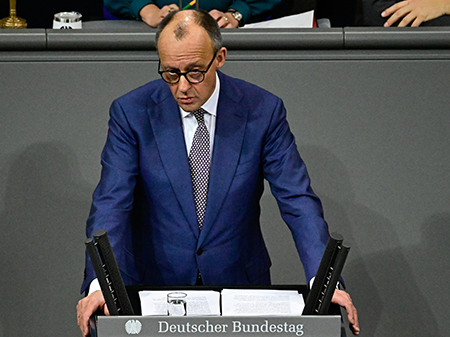
France and Germany also announced Mar. 2 their intention to create “a joint steering group to coordinate strategic doctrine and exercises,” in a move to increase cooperation on nuclear deterrence.
Comments from other European leaders in recent weeks provided hints of greater European defense and nuclear coordination. In a Jan. 29 speech, German Chancellor Friedrich Merz said European states were “discussing the development of a joint nuclear umbrella with European allies,” although he insisted “Germany will not possess nuclear weapons.”
The shift in German government thinking is particularly significant. Bruno Tertrais, deputy director of France’s Strategic Research Foundation, noted that, “Germany’s mention of nuclear capabilities would have been unimaginable just five years ago.”
Marko Mihkelson, chairman of the Estonian parliament’s foreign affairs committee, suggested that the “most logical, fastest, and most cost-effective option would be to use France’s nuclear capability as the foundation for an independent European nuclear deterrent,” according to Politico Feb. 5.
Meanwhile, in response to a question about hosting nuclear weapons on Swedish soil, Defense Minister Pål Jonsson stated Feb. 27 on Swedish radio SR, “If there were to be war, we would naturally consider any option that could secure Sweden’s survival and Swedish security.”
The shift in French and European policy is a response to growing NATO concerns that they can no longer rely on U.S. defense commitments in the event of an attack by Russia, including the potential employment of U.S. nuclear weapons, such as the 100 plus forward-deployed U.S. nuclear gravity bombs that are stationed at bases in five countries in Europe.
Last July, France and the United Kingdom, which both possess nuclear weapons, issued a statement called the Northwood Declaration that commits them to coordinate nuclear policy and notes that their “nuclear forces are independent, but can be coordinated.” (See ACT, September 2025.) The declaration also established a nuclear steering group, co-chaired by French and UK officials, which held its first meeting in Paris Dec. 10.
European concerns deepened following U.S. President Donald Trump's statements threatening acquisition of Greenland and the new U.S. National Defense Strategy document, released in January. Despite the ongoing Russian war on Ukraine and its asymmetric intrusions on European infrastructure, the strategy document describes Russia as a “manageable threat to NATO’s eastern members” and calls on Europe to take “primary responsibility for its own defense.”
At the February 2025 NATO defense ministers meeting, U.S. Secretary of Defense Pete Hegseth, responding to a reporter’s question, reinforced European concerns. Hegseth said that, “without burden sharing, without creating the right set of incentives for European countries to invest, then [the United States] would be forced to attempt to be everywhere for everybody all the time, which in a world of fiscal restraints is, again ... just not reality.”
At the World Economic Forum, Jan. 21 in Davos, Switzerland, Trump reiterated that he was “not sure [if NATO] would be there for us” if there were an attack against the United States. That has become a frequent Trump complaint despite the fact that NATO invoked Article 5 for the only time in its history after the 9/11 terrorist attacks against the United States in 2001.
France has about 290 nuclear weapons and the UK has 225, according to independent estimates by the Federation of American Scientists. Neither country currently deploys its weapons within the borders of other nations.