

“Over the past 50 years, ACA has contributed to bridging diversity, equity, inclusion and that's by ensuring that women of color are elevated in this space.”
NNSA Holds Pit Production Hearings
June 2026
By Xiaodon Liang
In a series of public hearings, the U.S. National Nuclear Security Administration (NNSA) defended its plans for plutonium pit production at two sites at Los Alamos, New Mexico, and Savannah River, South Carolina, as Congress raised questions at budget hearings about cost overruns and delays to the pit program.
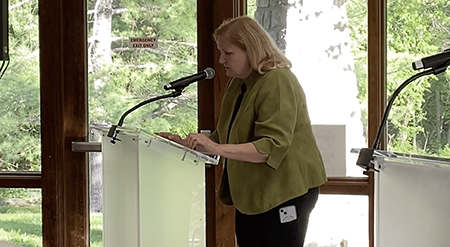
The hearings were held on five dates in May 2026 at cities near the two proposed production plants, as well as at sites near Lawrence Livermore National Laboratory in California, the Kansas City weapons components plant in Missouri, and in Washington, D.C.
In each case, NNSA officials presented an overview of a programmatic environmental impact statement released April 10 for the two-site production plan. The agency was ordered to produce the environmental study and to hold public hearings after a judge ruled in September 2024 that the NNSA had breached the National Environmental Policy Act by failing to adequately study the environmental consequences. (See ACT, November 2024.)
The draft impact statement describes the NNSA’s assessment of three alternatives: a no-action option that would produce 30 pits per year at Los Alamos National Laboratory while continuing construction of the Savannah River Plutonium Processing Facility, a single-site option that would focus production of 80 pits per year at one or the other site, and a multi-site option that corresponds with the agency’s preferred plan to produce 30 pits annually at Los Alamos and 50 pits annually at Savannah River.
In the study, the NNSA argues that its options are constrained by demands of the U.S. Congress, including an instruction in last year’s national defense authorization act that the agency pursue pit production at both sites. (See ACT, January/February 2026.)
The draft statement is “a retroactive rubber stamp,” said Dylan Spaulding, a senior scientist at the Union of Concerned Scientists, at the May 14 hearing in Santa Fe, New Mexico.
Tom Clements of Savannah River Site Watch, a plaintiff in the lawsuit that forced the new hearings, said at the May 5 hearing in North Augusta, S. C., that the draft statement still lacks a realistic plan for management of transuranic and low-level waste.
Not all comments at the hearings were critical of the NNSA’s study. Some local interest groups and chambers of commerce spoke in favor of the economic benefits pit production would bring to Los Alamos and Savannah River.
The hearings come at a critical time for the Savannah River facility, which is under increasing scrutiny as the NNSA reports a “budgetary placeholder” estimate of $25 billion as the cost of the construction project in the agency’s fiscal year 2027 budget request.
“I want to ask the hard questions. Do we need two plutonium pit production facilities?” asked Sen. John Kennedy (R-La.), chair of the energy and water development subcommittee of the Senate Appropriations Committee, at an April 29 hearing. “I’m not saying we don’t, but we’re going to have to talk about it,” Kennedy said, in a rare admission of Republican doubts.
On Feb. 27, the NNSA re-tendered the managing and operating contract for the Savannah River Site, after a Dec. 9 performance evaluation found that the current contracting consortium “underperformed” in executing work on the new plutonium facility.
“The timeline and the budget is not acceptable,” said Brandon Williams, the NNSA administrator, at a May 13 hearing before the Senate Armed Services Committee. “We are reevaluating the requirements from a bottom-up, top-down approach,” he said.
Sen. Lindsey Graham (R-S.C.), a longtime supporter of projects at the Savannah River Site, quizzed Secretary of Energy Chris Wright April 22 over the reprogramming of $149 million of appropriated funds from Savannah River to Los Alamos. “I don’t feel good about it,” Graham said at a hearing of the Senate Appropriations energy and water subcommittee. “That wasn’t the intent” of Congress.
David Beck, the NNSA deputy administrator for defense programs, told the Senate Armed Services Committee April 20 that projections for pit production at Los Alamos in 2026 have risen after he “brainstormed ideas with experts across the complex” and made changes to the “regulatory environment” at the facility.