

“The Arms Control Association and all of the staff I've worked with over the years … have this ability to speak truth to power in a wide variety of venues.”
Russia Tests New Heavy Missile
June 2026
By Xiaodon Liang
Russia aims to deploy on combat duty the first regiment of the RS-28 Sarmat heavy intercontinental ballistic missile (ICBM) by the end of this year, following a second successful test of the missile.
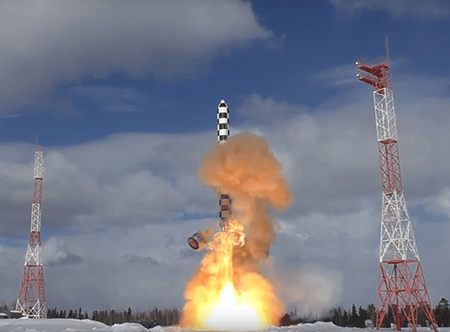
The test took place May 12, according to a statement published the same day by the office of Russian President Vladimir Putin. The liquid-fueled missile was likely fired from the Yasny missile base in Dombarovsky, Orenburg region, and landed at the Kura missile test site, open-source analysts concluded based on safety announcements issued by Russian authorities.
The successful Sarmat test was followed by large-scale strategic forces exercises May 21—unusual, but not unprecedented, timing for drills that are typically conducted in the fall.
Belarusian and Russian forces also conducted tactical nuclear weapons exercises. Gen. Valery Gerasimov, the chief of the Russian General Staff, said troops carried out “the delivery and transfer of nuclear munitions to Russian and Belarusian units that can use nuclear weapons,” according to a translation of a May 21 Kremlin press release by Pavel Podvig, a senior researcher at the UN Institute for Disarmament Research.
The exercises occurred after Putin’s return from a state visit to Beijing, where he and his Chinese counterpart, Xi Jinping, issued a joint statement on strategic cooperation. The document, which mirrors other lower-level bilateral statements on strategic stability, reiterates shared concerns about U.S. missile defense, space interceptors, nuclear sharing with allies, and long-range conventional strike capabilities. (See ACT, June 2025.)
In the new statement, the two countries recognize each other’s positions on the expiration of the New Strategic Arms Reduction Treaty (New START) and express concern about the possibility of nuclear proliferation by Japan and non-nuclear European states.
As Russia continues the modernization of its strategic forces, the U.S. Department of State assesses that total deployed warhead numbers at the end of 2025 “likely exceeded” the New START central limits, which Russia has said it will continue abiding by despite the expiration of the treaty in February 2026.
This assessment, in the department’s annual New START implementation report, also finds with “high confidence that Russia did not engage in any large-scale activity above the Treaty limits in 2025.”
The RS-28 Sarmat ICBM, which also has the NATO designation SS-29, is believed to be capable of delivering up to 10 nuclear warheads. The missile it will replace, the aging RS-20V Voevoda ICBM (SS-18 Mod 6), was likewise declared under arms control treaties as having a payload of 10 warheads.
In the May 12 statement, Putin said the Sarmat has a combined payload yield “more than four times greater than that of any existing Western counterpart.” The missile’s ability to travel on a suborbital trajectory “extends its operational range to over 35,000 kilometres while simultaneously doubling the accuracy,” he said.
The flight test in May is only the second confirmed successful full test of the Sarmat. Since April 2022, when the missile first completed a flight test, there have been at least three failed attempts in February 2023, November 2024, and last November. (See ACT, November 2024.)
The failed test last November also took place at the Yasny base, according to an open-source analysis published Jan. 29 by the Fondation pour la Recherche Stratégique, a French think tank.
Sergei Karakayev, the commander of the Russian Strategic Missile Forces, said the first Sarmat unit would be stationed at the Uzhur missile field in Krasnoyarsk territory, according to the Russian statement.
The Federation of American Scientists assesses that the Strategic Missile Forces will deploy 46 siloed Sarmat missiles to fully replace the RS-20V Voevoda.
The Sarmat may also replace the UR-100NUTTH (SS-19 Mod 4), another Soviet-era ICBM, of which 12 are presently active.