


"Though we have achieved progress, our work is not over. That is why I support the mission of the Arms Control Association. It is, quite simply, the most effective and important organization working in the field today."
U.S. Budget Unveils Hypersonic Goals, Blocks Transparency
May 2026
By Xiaodon Liang
The Department of Defense would buy thousands of intermediate range, ground-launched hypersonic weapons over the next five years under plans described in the Pentagon budget request for fiscal year 2027.
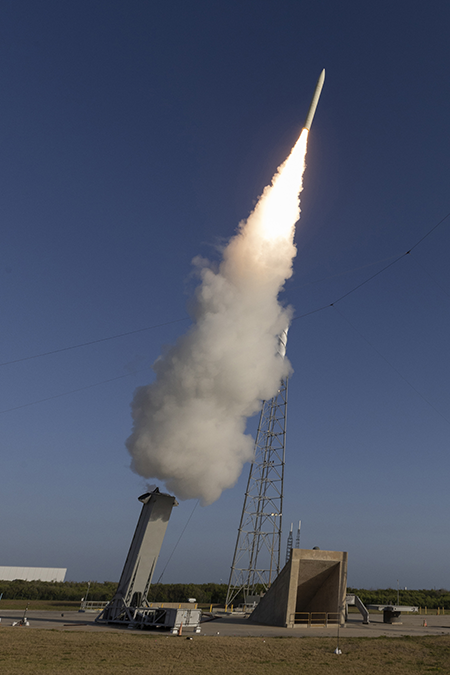
The Army proposes spending $749 million on the Long-Range Hypersonic Weapon in fiscal 2027, down slightly from the $983 million appropriated last year. But strikingly, the service now also says it intends to purchase 4,500 of the intermediate-range missiles through fiscal 2031, at a total cost of $10.1 billion.
Given a current unit cost of roughly $39 million, the Army either expects the weapon’s production cost to improve dramatically or to revise upward its cost estimate in future years.
The service is in the process of purchasing three batteries of ground equipment for the hypersonic weapon, but Army plans call for at least one hypersonic unit to serve with each of the five multidomain task forces. (See ACT, May 2024.) Each battery is capable of launching eight missiles at a time and will be equipped with eight spares.
The first operational battery is “very close” to receiving its full complement of missiles and equipment, the Army general in charge of the hypersonic program, Lt. Gen. Frank Lozano, said to a defense industry conference March 17.
Senior Army officers told Defense Secretary Pete Hegseth during a Dec. 12 inspection at Redstone Arsenal in Huntsville, Ala., that the weapon has a conventional warhead “under 30 pounds” and a range of 3,500 kilometers. The Army’s envisioned role for the missile, according to budget documents, is to destroy anti-access/area denial capabilities, opposing long-range missiles, and “other high-payoff/time-critical targets.”
“Theater combatant commands, in coordination with U.S. Strategic Command, will execute mission planning and target engagement” for the new Army weapon, the Pentagon’s office of the director, operational test and evaluation, reported in its fiscal year 2025 review of the program.
The Navy variant of the same missile, the Conventional Prompt Strike system, would receive $2.1 billion in funding this year, compared with $772 million last year. The service intends to procure a more modest number, 59 missiles, through fiscal 2031.
The variants of the missile share the same Navy-produced two-stage, solid-state booster and a common hypersonic glide body that the two services will produce separately. The services conducted a third successful test of the common missile March 26.
In January, the Navy completed installation of launch tubes for the new hypersonic system aboard the USS Zumwalt, the first ship capable of launching the missile. The weapon will also be integrated with two other ships of the same destroyer class, as well as a newly launched program to build a guided-missile battleship.
Air Force plans for two other hypersonic programs will become harder to track as the service marks intended procurement quantities as “controlled unclassified information.”
The Air-Launched Rapid Response Weapon, a boost-glide missile, would cost taxpayers $798 million in fiscal 2026, up from $496 million last year. The Hypersonic Attack Cruise Missile, a scramjet design, would cost $1.2 billion as it enters its first year of procurement spending, up from $838 million in R&D spending alone last year.
Looking beyond the existing program of record, the Navy and Air Force are also researching how nuclear warhead components perform in a hypersonic test bed. R&D documents indicate plans to perform tests of a warhead fuze in such a test bed in fiscal 2028.
The budget request calls for $49.5 million to fund R&D on a new long-range Air Force weapon, named the Air-Launched Ballistic Missile. It would “mature existing hypersonic weapon technologies,” according to the request.
Testifying before the House Armed Services Committee April 29, Defense Secretary Pete Hegseth also said that the Pentagon is considering a hypersonic follow-on to the nuclear-capable sea-launched cruise missile.