

"Though we have achieved progress, our work is not over. That is why I support the mission of the Arms Control Association. It is, quite simply, the most effective and important organization working in the field today."
Coping with Syria’s Chemical Weapons Legacy: An Interview with Mohamad Katoub, Syrian Ambassador to the Organisation for the Prohibition of Chemical Weapons
May 2026
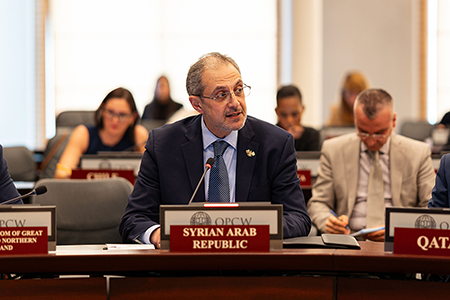
Syria faces daunting challenges as it seeks to recover from its 2011-2024 civil war. Rebuilding its battered economy, reconstructing its devastated infrastructure, standing up a competent government and repairing trust within its national polity are all on the list. None of the trials is as unique, or sordid, as coping with the chemical weapons legacy of former President Bashar al-Assad, who was overthrown in 2024 and fled to Russia. Experts consider his government’s extensive use of chemical weapons the most significant challenge to the international nonproliferation regime in the 21st century. Last year, Syrian Foreign Minister Assad al-Shibani called the Assad regime’s chemical weapons abuses “one of the darkest chapters” in world history and promised the new government in Damascus would work to dismantle what is left, adhere to international norms and ensure accountability for past wrongs. Syria’s ambassador to the Organisation for the Prohibition of Chemical Weapons (OPCW), Mohamad Katoub, is the man charged with working with the organization on these goals, which are complicated by the fact that Assad kept the program top secret. Katoub discussed the Syria-OPCW mission April 16 over Zoom with Arms Control Today publisher Daryl G. Kimball and Carol Giacomo, the journal’s chief editor. The interview has been edited for space and clarity.
Arms Control Today: You were appointed last year to head Syria’s mission to the OPCW in part because of your personal encounter with chemical weapons and the victims of chemical attacks during the Syrian civil war. Why is it important to complete the unfinished task of dealing with the Assad regime’s deadly chemical weapons arsenal?
Ambassador Mohamad Katoub: The approach of the Syrian government is based on three pillars. First is the safety of our people and the national security of Syria. Those remnants of chemical weapons are dangerous in case they’ll go to the wrong hands, and also, the Syrian people don’t have the required awareness or the notification mechanism to deal with such equipment. We have sincere concerns for any civilians who have to deal with those remnants without knowing what they are, especially because many of those [chemical weapons] sites are not known to us. The second pillar concerns Syria’s obligations as a state to international law. This is coming from our belief in international law and the Chemical Weapons Convention.
The third one is accountability and justice. Accountability and justice for Syria is peacebuilding. Without holding perpetrators accountable and bringing justice for the victims, the peace in Syria will keep being fragile. The Syrian people suffered from those chemical weapons, and part of justice is the destruction of the remnants of chemical weapons. Part of it is the guarantee of nonrecurrence of those crimes in the Syrian Arab Republic or in any other place. We have victims and their families who suffered from those chemical weapons, from the intimidation, from the propaganda, and from the denial. Many Syrians were subject to several layers of violations, not only to chemical weapons.
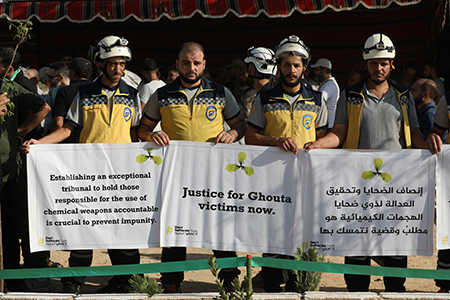
Look at Ghouta, as an example. The people of Ghouta were besieged for years, and they were subject[ed] to chemical weapons. Many of them were subject to forced disappearance, arrest, and were forced to leave their hometowns.… These multiple layers of violations mean that these victims need support, they need to see justice with their eyes. Part of accountability is to guarantee a nonrecurrence of the use of chemical weapons in our country, It’s much wider than the destruction of the chemical weapons. We saw ISIS developing and using chemical weapons in Syria without having a big infrastructure and advanced technology. Accountability is a measure of nonrecurrence.
ACT: How did chemical weapons (CW) use in Syria affect you personally?
Katoub: I used to work for medical aid organizations when I was in Syria, and also after I left Syria, I kept working in this sector for years. Part of the work was documenting chemical attacks. I witnessed victims of chemical attacks in my hometown, Douma; coming from the biggest attack in Ghouta; and also attacks before. People are aware mostly of attacks, which killed a big number of civilians, but this attack in Ghouta on August 21, 2013, was number 32 in Syria. There were at least 10 attacks in Ghouta before this one.
I named this the “unfortunate experience.” I had to learn to collect samples to document those attacks, to connect witnesses to the investigation bodies; I had to understand more about the conventions, the obligations of the state, how the OPCW works, how is the process of decision-making in the organization, and also how other mechanisms for accountability work in the world. I had to cooperate with different investigation bodies.
The Syria conflict is one of the most documented conflicts when it comes to CW violations. It started with the joint investigation team that was established by the UN secretary-general in 2013, and which was in Damascus the night of the Ghouta massacre, followed by investigations by the Commission of Inquiry, which was established by the UN Human Rights Council. The OPCW later established the fact-finding mission in Syria. The UN Security Council established the joint investigation mechanism, which was stopped by a veto in 2017; and then, the OPCW made a very brave and important step by establishing the investigation and identification team, [which was mandated for the first time to identify perpetrators of CW use in Syria].
I witnessed all this history—the development of investigations and working with witnesses. I remember in 2013, witnesses asking how we should document and collect samples and maintain a chain of custody and work with investigators. By 2017-2018, [they started being frustrated from being interviewed time after time without any consequences, without any results, and the question became instead of how, why we need to collect samples, why should we work on documenting those attacks. They started to lose hope. Now, it’s another opportunity. Those witnesses can speak freely now. The OPCW can have access to original documents now, can have access to witnesses where they can be interviewed in Damascus.
In February this year, we hosted an event here in the OPCW with the [Syrian] National Commission for Transitional Justice. One of the speakers was a survivor of chemical weapons; he lost his two daughters in the massacre in Ghouta. He was on the panel, speaking inside the OPCW for the first time and he said, “for me, this is a step toward justice, to speak here freely about my pain in the OPCW.” So yeah, those are the first steps. We still have a long journey.
ACT: In March at the UN, Syria announced the “Breath of Freedom” task force, a group of countries that is going to assist the Syrian government in getting rid of the remnants of the CW program established by the former government. Could you tell us about the goals of that initiative and what is known currently about the status of the CW arsenal.
Katoub: The Breath of Freedom task force is a technical group that’s working together for the purpose of elimination of the remnants of chemical weapons of the Assad era. The states [that] are members of the task force have been supporting the rights of the Syrian people in fighting chemical weapons and in demanding justice and accountability for the usage of chemical weapons. They believe in our goal.
We are facing different types of challenges when it comes to the destruction of chemical weapons. Some are related to the security situation because of the Israeli airstrikes or what’s happening now in the region or related to the remnants of conventional mines or any other remnants that might block access of inspection teams, and also to technical teams who want to do the [CW] destruction.
The second challenge is the secretive nature of the program. That means a lot of work [is needed] to collect and analyze information. We have very good progress in collecting information and sharing information with the [OPCW, which has] more technical capability than the Syrian national teams at this stage.
And the third one is the gap in the national capacity in Syria because this is not our [government’s CW] program, this is the Assad regime’s program. We knew nothing about it before the liberation except what was available publicly, but we know that Syria was subject[ed] to over 200 attacks because of those chemical weapons.
To overcome all those challenges, we need technical support, technology, and expert teams. If you look at the task force members, each one has a unique experience when it comes to dealing with chemical weapons. The elimination of the program doesn’t just involve destruction, but it is a wider scope of work that includes identifying the sites, facilitating the convoys of the inspectors, removing any remnants of conventional weapons, securing the site from any risk, [and] being prepared for medical evacuation to respond to any urgent situation.
Syria has approval from the [OPCW] Executive Council to use on-site expedited destruction in case the materials are not transferrable, or if the site doesn’t have sustainable access. So, there are certain criteria that we are working with the [OPCW] Technical Secretariat to develop for on-site expedited destruction.
The concept about establishing the task force is to create a mechanism for coordination between different states, either within the group or out of this group, [that] want to support Syria in those efforts under the verification of the Technical Secretariat. At the same time, we are trying to differentiate between the mandate of the Technical Secretariat and the obligations of the state. Certain types of support cannot be provided directly by the Technical Secretariat, given the need to maintain a clear distinction between its verification mandate and other forms of engagement. The secretariat cannot simultaneously undertake verification activities and deliver support in destruction. Accordingly, these functions should be led by the Syrian side, with the technical support of partner states.
ACT: On the Breath of Freedom task force, which countries currently are you working with, along with the OPCW? It sounds like you’re seeking additional assistance from additional states beyond the initial group.
Katoub: It’s Canada, France, Germany, Qatar, Turkey, the United Kingdom, and the United States. All their contributions and support are valuable to us. Outside the group, we started conversations with some [other] states. We hope that we will get an agreement soon with Jordan.
ACT: How many sites have you been able to survey so far, and when do you think your government might be in a position to make the necessary declarations to the OPCW about what remains of the program?
Katoub: Syrian national teams identified 35 sites so far. The Technical Secretariat has a longer list of 100 sites. We are working to verify and triangulate information, as well improve the readiness of our teams, whenever the Technical Secretariat decides to share the whole list of 100 sites with us, to work with them on those sites one by one.
We were able to facilitate 26 visits to suspected sites, so many of them are still not evaluated. We have about at least six sites, which were not declared [to the OPCW] by the Assad regime, and we are working to verify the information, so hopefully we will be able to make an interim update of the declaration of the Syrian Arab Republic to the OPCW on the CW program. I’m trying to be very careful on the language here, so it will not be a final update of declaration, but an interim one.
We don’t believe that we’ll be able to have a 100-percent accurate declaration. We might keep finding other sites while digging into the information and documents that we’re finding.… We look at the experiences of other states, [which] are finding chemical weapons after World War II now, after 70 or 75 years.
The plan is to update the declaration. We have an optimistic plan that we will be able to do so this summer. Because of the situation in the Middle East, the Technical Secretariat team had to evacuate since March 17, and this means that the verification will go slower. But this doesn’t mean we will not be able to work. Our national teams have the capability and whatever administration work we can do remotely or with the teams here from The Hague, we are doing this with them.
But there are circumstances out of our hands. We have an institutional capacity gap in Syria. We have three ministries that were established from zero and are involved in the destruction of chemical weapons: defense, interior and emergency and disaster management. If we find materials that we can destroy within the capacity that we have, we’ll go forward. If not, we will consolidate those until either we have the capacity, or if this capacity or technology will be very expensive or will take too much time, then we are open to deliver those remnants to another country like what happened in 2014, when other countries were involved in the destruction of the arsenal of the Assad regime.
ACT: Have you been able to do any destruction of chemical weapons so far?
Katoub: No, so far. We are still in the reconnaissance, evaluation, and assessment phase. We still didn’t start verification. This is why I’m saying sometimes circumstances are against us. We have now the information about several sites. Next step would be to do verification, to share that information with the Technical Secretariat, [and] verify it with them, but they should either visit the sites or find alternative methods for remote verification. That happened in certain circumstances, especially if the materials or the sites are very sensitive and they can’t access the site for any reason. There are methods and tools for remote verification, like sealed cameras or others. We are considering those; nothing final yet. So, this is an ongoing conversation between us and the Technical Secretariat.
ACT: Are the sites that you’ve identified being safeguarded?
Katoub: Most of them are guarded and under the control of the Ministry of Defense. Guaranteeing that unauthorized access is blocked in situations like Syria is challenging. Since the first day after the liberation [after Assad’s ouster], the Syrian army started to secure the sites that we had information about. Still, it’s not easy to maintain the blockade of unauthorized access. This is why this mission is urgent. This is why we need to accelerate destruction and have all the resources required.
In the first year, we worked a lot on structuring the teams and pooling resources to support them. Now, we are in a phase where we started to have a clearer structure and we have resources more available to us. I can’t say we have 100-percent accurate timeline, but we have a plan with milestones, and we’ve started to progress. Until the end of the year, we should be able to verify all the information about the list of 100 sites with the Technical Secretariat. By then, we’ll be able to do the destruction within the resources and the capacities that
we have.
This will ease the burden of safeguarding those sites, especially those that are abandoned and not under the use of the Syrian army. This is where the challenge comes from, because we need to provide surveillance for those sites. Whenever we know that there are materials of high risk or high priority, those are definitely guarded. The issue is when we have materials that should be declared and [are] in abundant sites. We need to guarantee the safety of those sites from any unauthorized access.… But whenever we have high-risk materials, yes of course, we have those safeguarded. We were able to consolidate some materials to a temporary consolidation facility, and we have one site with high-risk materials, and this is under surveillance, or under guard, from the Syrian army.
ACT: As you describe it, it’s a very complicated undertaking. Under the best circumstances, how long do you think it would take Syria and the international community to complete the dismantling and destruction of these weapons? How much will it cost?
Katoub: They are two important and technical questions. We hope that at the end of 2026 we will be able to verify the information and do evaluations for the whole list that the Technical Secretariat has. We are trying to accelerate sharing information with us about those sites, so we can verify the information with the Technical Secretariat and with the help of other states. After the evaluation, we’ll be more able to put a timeline.
This verification will help us in another thing, which is to determine what kind of technology we need for the destruction.… Destruction can happen anytime, whenever we have those materials secured, in a consolidation facility. Destruction is not the biggest problem. This can happen in Syria, or it can happen in another country.
On estimate of cost, we have a list of needs, and to be frank, unfortunately, in Syria we don’t have the experts to do evaluation or a budget estimate for those very technical needs. We know what technology we need to do all the steps before destruction—as I mentioned, destruction is based on what we find—but the list of needs includes materials and training for enabling operation, convoy command, security for the convoys, logistics, medical preparedness, site evaluation and security from mines and other aspects, chemical weapons management, protection gear, on-site destruction, and the destruction.…We still don’t have a budget for it, but.… we’ve started to receive offers from state members of the task force to fill those gaps. Some of those are in-kind, some are training, and others will need financial contributions, maybe not within the group itself, maybe coming from other members of the OPCW. But unfortunately, we don’t have a budget.
But I can mention that a number that everyone knew, the annual budget for the technical secretariat work in Syria, the estimation is about 12 million euros. That’s only the Technical Secretariat; I’m not talking about the national teams. Definitely, it will be a big budget to do all of this. We have, of course, an ultimate goal to build national capacity, not only the destruction, because after two, three, four years, Syria should be a stable country, hopefully.… and then, we should take care of the legacy of those chemical weapons. So, building the national capacity itself is a goal for us.
ACT: Could you turn to your government’s plans and strategy for holding those who you find accountable for these past crimes? I suppose that the Ministry of Justice is in the lead of that?
Katoub: In the national working group that’s working on the chemical dossier, beside the ministries of defense, emergency and disaster management, health, and foreign affairs, we have the Ministry of Justice, Ministry of Interior, and the National Commission for Transitional Justice. So, the Ministry of Interior is leading the investigation in that regard. They have some good progress on that.
We were able, in an unprecedented step last October, to have the Executive Council of the OPCW decide to give access to the Syrian national accountability mechanisms to the information that was collected by the organization. This is a big step for us. We have the political decision now by the council, but we still don’t have the mechanism because this is complicated. Also, the International, Impartial, and Independent Mechanism (IIIM) established by the UN General Assembly doesn’t share information with us. We’re working with them to explore ways to do that. I’m happy we have good cooperation with them, and I think we should be able to achieve more progress.
On parallel, there is a lot of work to be done to reform the legal system in Syria. This is a big challenge, because the same system was used during the Assad era to give impunity to perpetrators for years. The same system never adapted to the obligation of the state to international law and to the conventions that Syria is part of, like the chemical weapons convention. Even the terms in this system don’t include things like war crimes or crime against humanity or genocide. The terms of still need to be adjusted.
We also have the Commission for Transitional Justice working a lot on structuring their team and also building mechanisms [to conduct] investigations. We should have some good news by the end of the year, hopefully, on the progress on accountability. I mean not that big, because, unfortunately, most high-ranking officials involved in this program fled the country. The hope is to establish the tribunal within the transitional justice system in Syria to hold those perpetrators accountable and to have those international mechanisms cooperating with it—either international organizations or also other states who can help us in holding perpetrators accountable. There are mechanisms for that, and we are very open to cooperate. We are very open to cooperating with states who use the universal jurisdiction mandate in their countries to hold perpetrators accountable, or to open the door for victims to file cases against those who used chemical weapons. We started conversations with some of them.
There are several options on the table on accountability. There was a group that discussed [potential accountability] in Syria before the liberation, before the fall of the Assad regime. Twelve states discussed several potential models of accountability for the use of chemical weapons, not only in Syria, but worldwide. From the outcome of this discussion, we take that we want the accountability mechanism to be national. Those perpetrators should be held accountable in Syria, in front of the Syrian people but of course, in cooperation with international mechanisms. This is the hope, of course. This is a long journey, again.
The expectations from the Syrian people are too high when it comes to justice. The first week of April marked the anniversaries of two chemical attacks in Syria—the one in Khan Shaykhun on April 4 and the Douma attack on April 7. On both anniversaries, the people of the two towns commemorated the victims and hosted an event, and some government representatives were there. The questions [from the people] were not about reparations. The questions were not about what those towns deserve. The questions were about when to hold those perpetrators accountable. So, they expect their government to be able to do that, and this is why we should work on it. We expect support from other states. This is another task that we here in the mission are working on. We already established the mechanism to support chemical weapon destruction, and we are working on ways to either establish or to join alliances and partnership to step forward on accountability, and to support the efforts of investigation and accountability in Syria.
ACT: One other challenge that you mentioned, of course, are the victims. How many victims have there been of these chemical attacks? What are the government’s plans to assist them, whether medical assistance or some other kind. Is this something that other countries have shown an interest in helping with?
Katoub: This is very important, actually. The number that we have from documentation is over 1,500. This is for the victims who were killed by chemical weapons. But those who were affected, the number is at least 10 times that, so at least 15,000. If you look at each one of those attacks, especially those which targeted urban areas, the victims were subject to several layers of violations: forced displacement, sometimes forced disappearance, besiegement, or others. If there were to be reparation measures, this should be part of a wider program on reparation for all the victims, not only for chemical weapons. Favoring victims based on the kind of violation that they were subject[ed] to causes a lot of damage to the community and to the society. There should be a program for the reparation for all victims in Syria.
There are ways to measure the support provided to each victim based on their needs more than based on how much they were damaged by this attack or whatever kind of violation they were subject[ed] to. Syria is trying to avoid favoring victims based on the type of violation. The second thing is, Syria does not have many resources for reparation programs. There should be a fund established to support Syrian victims, and then to have contributions from states who are willing to support this because this is peacebuilding for the country. Reparation doesn’t mean always financial support. It means acknowledgement of the pain of those people, even if it’s some minor measures that the government applies, sometimes with the help of civil society, international organizations, international community. This is very important for the peace in Syria.
The Commission for Transitional Justice is working hard on reparation measures and evaluating what measures they should provide to victims of different types. At the [Syrian] mission here in The Hague, we are encouraging academic institutions and researchers to study the long-term impact of usage of chemical weapons on communities and on individuals. We are very happy to connect anyone who wants to research this with research centers and universities in Syria because they will need labs and hospitals and clinical capacity. I encourage states to fund such programs. This is very important, not only for Syria. This is the widest use of chemical weapons after the convention was adopted in 1993. This was a wound in our hearts, and now it’s a lesson to learn from.
ACT: The Chemical Weapons Convention has near-universal support, yet some states in the Middle East have not yet joined. What message do you think your government’s commitment to completing the elimination of chemical weapons in Syria should be sending to your neighbors and others who have not yet joined this important agreement?
Katoub: Syria hopes to see all—not only neighboring countries—join this convention because Syria suffered and we know what chemical weapons use means. My memory about chemical weapon incidents that I witnessed is the fear in the eyes of the people. Terrible. Where I lived in Ghouta, during the hardest days of the siege, and I witnessed attacks, airstrikes, all kinds of weapons, barrel bombs, everything. But chemical weapons are different: You see the fear in the faces is different. because the community has the sense that nothing will protect them. Not a fortified shelter, nothing. So, chemical weapons should not be used under any circumstances in any place. If Syria sends a message to everyone, it’s that we’ve suffered enough from them. The world suffered enough from chemical weapons, and they should not be used again.