


“The Arms Control Association and all of the staff I've worked with over the years … have this ability to speak truth to power in a wide variety of venues.”
Costs Soar in $1.45 Trillion Defense Request
May 2026
By Xiaodon Liang
U.S. spending on nuclear weapons and delivery systems in the Pentagon budget will rise to $71.4 billion in fiscal year 2027 if Congress approves President Donald Trump’s $1.45 trillion departmental budget proposal.

That sum is a 15-percent jump over last year’s proposed Pentagon nuclear weapons budget of $62 billion. Both figures include proposed appropriations through the regular appropriations process and through budget reconciliation bills.
Trump is asking Congress to appropriate $1.1 trillion for the Department of Defense through the regular process, while banking on the Republican-controlled Congress to provide an additional $350 billion through reconciliation.
That request may prove a risky bet, with Senate Budget Committee chair, Sen. Lindsey Graham (R-S.C.), opting to exclude additional defense spending in a budget reconciliation bill for fiscal year 2026 that was released April 21.
Congress will still have a chance to pass an additional fiscal year 2027 budget reconciliation act later in the year. Any such effort would face daunting prospects with both chambers of Congress in play in the November midterm elections.
“Regular order appropriations are the right way to meet the scale and scope of the requirements of our military,” said Sen. Mitch McConnell (R-Ky.), chair of the Senate Appropriations Subcommittee on Defense, expressing skepticism of the reconciliation strategy in an April 3 press release.
His minority counterpart, Sen. Chris Coons (D-Del.), opposed the president’s top line in his press release on the White House’s budget, claiming that “this request defies the bounds of what is needed.” Coons added: “The president thought of the highest number he could fathom and then tweeted it.”
The $350 billion reconciliation portion of the defense request includes large sums for defense industrial base expansion, autonomous weapons, artificial intelligence investments, and munitions. Unlike last year’s reconciliation act, this year’s bill only includes small additions to nuclear weapons spending.
The increase in this year’s nuclear weapons budget is driven by modernization programs entering full-scale production.
The Columbia-class submarine would cost taxpayers $16.1 billion under the president’s proposal, spread across shipbuilding and research and development accounts. This year’s budget request, which provides full funding for the fourth boat of the class, is slightly more than two-thirds higher than the $9.6 billion enacted last year.
The Navy projects that the 12-boat program will have a lifetime shipbuilding cost of $146.4 billion. That is nearly 16 percent higher than the $126.4 billion estimate in the fiscal 2025 budget request.
The Navy may buy three more Columbia boats, Robert Kadlec, the assistant secretary of defense for nuclear deterrence, chemical, and biological defense, policy and programs, told the House Armed Services Committee's Strategic Forces subcommittee April 23.
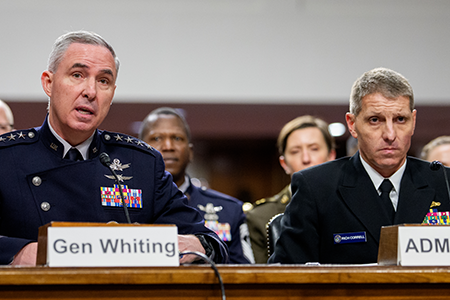
Speaking before the Senate Armed Services Committee March 26, the chief of U.S. Strategic Command, Adm. Richard Correll, said that “additional capacity and capability at sea, in terms of launchers, is very beneficial from my perspective.”
The Navy still expects to receive the first Columbia-class boat by the end of 2028, Vice Adm. Robert Gaucher, the service’s direct reporting portfolio manager for submarines, said April 20 at an industry conference.
A life-extension program for the Trident II submarine-launched ballistic missile—the second such program for the missile—will exit an R&D phase and move fully into procurement in fiscal 2027, leading to an increase in costs from $2.6 billion enacted last year to $3.9 billion. Costs for R&D work on the Mark 7 aeroshell for the W93 warhead would rise from $619 million to $841 million.
The Navy did not request additional funding for the nuclear-capable, sea-launched cruise missile this year as it continues to spend down last year’s reconciliation money. The service anticipates asking Congress for $6.1 billion more, however, in R&D funding for the missile through fiscal 2031.
The B-21 bomber program costs are also increasing as low-rate initial production continues, with spending rising from $5.6 billion in enacted funds last year to $6.1 billion under the president’s proposal.
Although the prior year’s reconciliation act provided an additional $4.5 billion to expand bomber production capacity, the Air Force has yet to announce an increase in the service’s planned fleet, which currently targets 100 planes.
In written testimony March 17 to the House Armed Services Committee, Correll confirmed that U.S. Strategic Command is continuing to advocate for more bombers but also that “assessments to determine the final procurement quantity” were ongoing. (See ACT, May 2025.)
His counterpart at Indo-Pacific Command, Adm. Samuel Paparo, called for 200 B-21s at an April 21 Senate Armed Services Committee hearing.
Kadlec said Apr. 23 that the Air Force will buy more of the Long-Range Standoff Weapon, a nuclear-tipped, air-launched cruise missile that will arm the B-21 and B-52H strategic bombers. Procurement costs for the weapon, which is undergoing integration flight tests with the B-52H, will total $11.8 billion over the program’s lifetime, budget documents suggest. Two years ago, those projected costs were $9.8 billion.
The budget request calls for spending $1.5 billion on the missile in fiscal 2027, compared with about $790 million enacted last year.
Ongoing design work for the air-delivered nuclear delivery system, an early-stage program for a nuclear bunker-buster weapon, would cost $91.6 million in fiscal 2027. (See ACT, March 2026.)
R&D and procurement spending on the Sentinel intercontinental ballistic missile (ICBM) will fall slightly, from $5.0 billion appropriated for fiscal 2026 to $4.6 billion proposed for fiscal 2027.
The Air Force anticipates attaining Milestone B approval for the Sentinel program by the end of 2026, following significant cost overruns and a subsequent program restructuring. (See ACT, September 2024.)
The Air Force and lead contractor Northrop Grumman broke ground in February on a test silo that will validate a new modular silo launcher design, U.S. Strategic Command announced in a Feb. 17 press release.
Although military construction costs for the Sentinel program would rise under the budget request, no money is earmarked for large-scale silo construction. Instead, roughly $1 billion would go toward construction of support buildings, land acquisition, and a utility corridor. Congress appropriated $110 million for similar construction last year.
Gen. Dale White, the Air Force’s direct reporting portfolio manager for critical major weapon systems, said the Pentagon will produce a new cost estimate for the restructured Sentinel program this summer.
The budget zeroes out two polar-orbit missile warning satellites, while funding for two geosynchronous satellites grows from $1.4 billion to $1.5 billion.
Spending on the program, known as the evolved strategic satellite communications program, to replace the legacy advanced extremely high frequency satellite-based communications network would also nearly double from $1.1 billion to $2.0 billion.
Other NC3 programs include the E-4 Survivable Airborne Operations Center, which would rise from $1.8 billion to $2.2 billion, and replacement of the E-6B Mercury—the link between headquarters and Navy ballistic missile submarines—with the E-130J, which would increase from $1.2 billion to $1.9 billion.
Proposed spending on missile defense this year is divided between $67.9 billion for the Missile Defense Agency and the armed services and a defense-wide special Golden Dome fund that is allocated $17.9 billion. In total, this $85.8 billion proposed budget is more than 25 percent above the corresponding $68.3 billion request in fiscal 2026.
Substantial reconciliation funding would go toward replenishing stocks of theater medium- and intermediate-range missile interceptors, expended during the U.S.-Israeli war against Iran that began in February.
The budget proposes spending $4.2 billion on procurement of the SM-3 Block IIA missile, which was tested against an ICBM-range target in December 2020, up from $445 million. That sum would buy 114 interceptors, compared with 12 last year. But of those 114, 88 would be contingent on Congress delivering reconciliation funds.
Similarly, the Army would spend $11.4 billion to purchase 857 Terminal High Altitude Area Defense (THAAD) interceptors under the budget proposal. Of those interceptors, 830 would be paid for through reconciliation. Budget documents indicate the Army will continue buying interceptors at a cost of about $6 billion a year through fiscal 2031, equivalent to more than 450 interceptors annually.
These large purchases would replenish and deepen Pentagon stockpiles. According to an April 21 analysis from the Center for Strategic and International Studies, the Navy has expended between 130 and 250 of its SM-3 interceptors—including older Block IB missiles—out of a prewar inventory of 410. Likewise, the Army has used between 190 to 290 of its prewar inventory of 360 THAAD interceptors.
The Washington Post reported April 8 that the White House still intends to send Congress an additional separate request for $80-100 billion for Iran war costs.
Ongoing Missile Defense Agency R&D programs would also receive a boost under the new budget. Work on the Ground-Based Midcourse Defense system would rise from $764 million to $1.4 billion. R&D on the glide-phase interceptor would increase from $185 million to $214 million and on ballistic missile defense sensors, it would quadruple from $183 million to $865 million.
The Pentagon did not provide line-item details on the Golden Dome fund—almost entirely a reconciliation-funded proposal—choosing instead to name several priorities, including space-based interceptors, a space-based hypersonic and ballistic missile tracking satellite network, a missile defense underlayer, non-kinetic options, and integration efforts.
The Space Force announced April 24 it had entered into agreements with 12 companies for work on space-based interceptors over the past half year. Those companies stand to earn up to $3.2 billion in awards through the competitive arrangement to develop a proliferated constellation of boost-phase, midcourse, and glide-phase interceptors. (See ACT, November 2025.)
The Pentagon’s Cooperative Threat Reduction program will endure a 22-percent cut to $221 million under the new budget, with its biological threat reduction program accounting for most of the reduction. The program’s budget request suggests it will seek to offload the cost of biological threat programs in Europe to regional allies and partners.