


"Though we have achieved progress, our work is not over. That is why I support the mission of the Arms Control Association. It is, quite simply, the most effective and important organization working in the field today."
When Gorbachev and Reagan Tried to End the Nuclear Threat
May 2026
By Frank N. von Hippel
Anyone concerned about today’s crumbling world order might be encouraged by a time four decades ago when an insane nuclear weapons buildup ended suddenly and was followed by a period of relaxed nuclear tensions and deep reductions in Russia and U.S. nuclear forces.
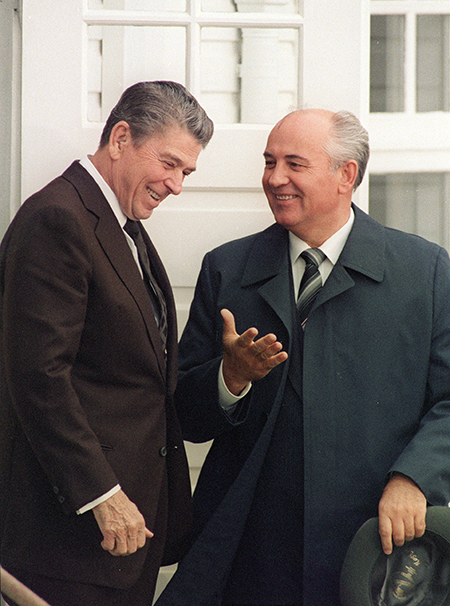
On January 15, 1986, less than a year after he had taken office and was confronted by a U.S. program to build up its nuclear warfighting capabilities with a new generation of more accurate long-range missiles,1 Soviet leader Mikhail Gorbachev issued a proposal for “nuclear disarmament by the year 2000.” The Soviet Embassy in Washington published the proposal as a full-page ad in The New York Times.2
U.S. Secretary of State George Schultz sent it to President Ronald Reagan with a note: “While this proposal contains many serious problems, it will be universally considered to be a major step and will raise hopes that your vision of the elimination of nuclear weapons may be realizable.”3
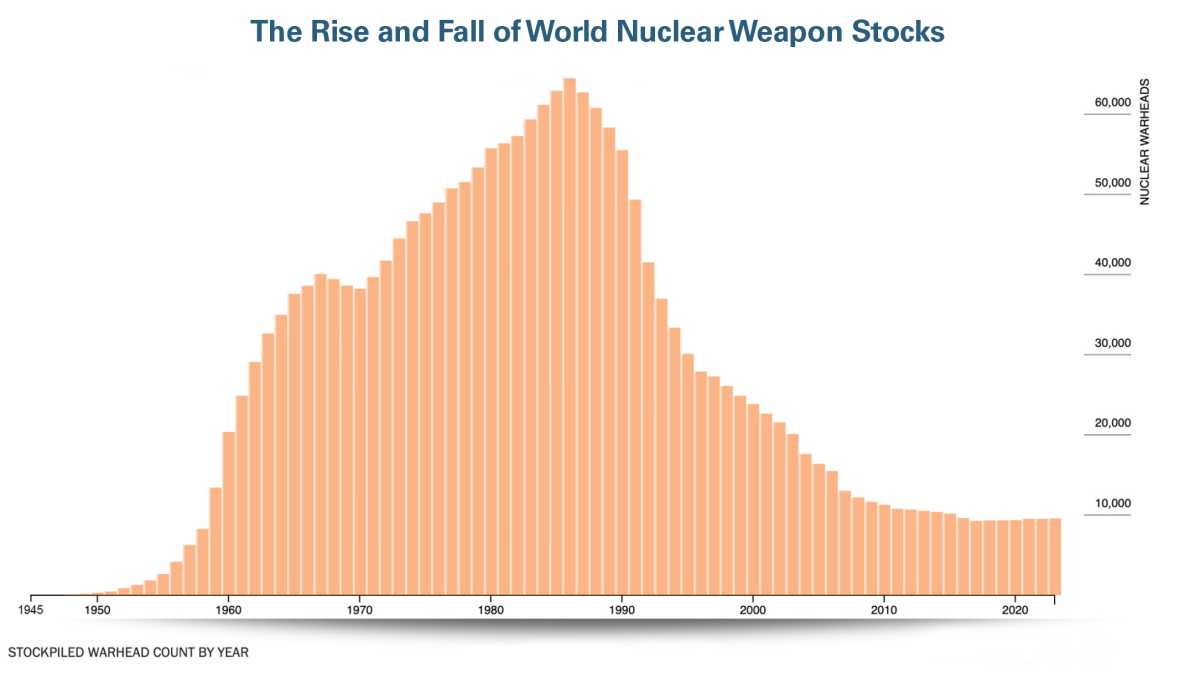
Gorbachev’s target year of 2000 was 14 years away, and it turned out that he had only six years before the Soviet Union disintegrated and he lost power. During the time he had, however, Gorbachev helped set the Soviet Union and United States on a course to deep nuclear cuts from a combined peak of about 60,000 warheads in 1986 to a plateau of about 8,000 warheads in 2018, when the last U.S.-Russia nuclear reductions treaty, the New Strategic Arms Reduction Treaty (New START), limits were met. (The other seven nuclear-weapon states today have a combined estimated stockpile of about 1,400 warheads.)4
At a moment of acute nuclear angst, Gorbachev’s proposal paved the way for the October 1986 summit with Reagan in Reykjavik, Iceland, which produced no concrete outcome but energized bilateral nuclear arms negotiations and prepared the ground for the 1987 Intermediate-Range Nuclear Forces (INF) Treaty, the first to eliminate an entire class of weapons.
Gorbachev’s nuclear disarmament proposal in the Times was organized in stages, starting with bilateral reductions by the Soviet Union and United States. It said that “the USSR and the USA will reduce by one half the nuclear weapons that can reach the other’s territory” followed by the “complete elimination of medium-range missiles of the USSR and the USA in the European zone, both ballistic and cruise missiles.” In addition, he proposed that the “USSR and the USA should from the very beginning agree to stop all nuclear explosions and call upon other states to join in” and, by 1995 “All nuclear powers will eliminate their tactical nuclear weapons, i.e., weapons having a range (or radius of action) of up to 1,000 kilometers.”
By the end of Gorbachev’s tenure, many of these actions were either accomplished or well underway.
Reducing Soviet and U.S. Strategic Arsenals
The U.S.-Soviet Strategic Arms Reduction Treaty (START) talks began in Geneva in May 1982 after Reagan, in a speech at his alma mater, Eureka College, called for “equal ceilings, at least a third below the current levels.”5 The negotiations stalled, however, after Reagan announced his Strategic Defense Initiative in March 1983.
Gorbachev’s January 1986 definition of strategic weapons extended beyond the traditional intercontinental bombers and missiles and submarine-launched ballistic missiles to include nuclear-armed, sea-launched cruise missiles (SLCMs), which also could “reach the other’s territory.” The Reagan and George H.W. Bush administrations refused to include SLCMs in START, however, agreeing only to an unverified commitment not to deploy more than 880 nuclear-armed SLCMs.6
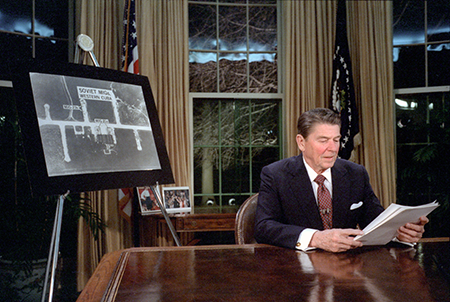
Gorbachev initially conditioned any Soviet agreement to deep cuts on the United States committing to keep any orbiting space lasers and ballistic-missile interceptors, developed as part of Reagan’s Strategic Defense Initiative (SDI), from being tested in space for at least 10 years. Reagan refused, resulting in the failure of their Reykjavik summit. Gorbachev’s technical advisers, Evgeny Velikhov and Roald Sagdeev, argued that the U.S. systems being proposed could be neutralized with much less costly “asymmetric” countermeasures.7 After Reykjavik, their arguments were reinforced by Andrei Sakharov.
Sakharov spoke out at an international conference on nuclear disarmament in Moscow in February 1987, a year after Gorbachev made his nuclear disarmament proposal. At the time, Sakharov was freshly released from seven years of isolation in Gorky (now Nizhny Novgorod) after his public opposition to the Soviet invasion of Afghanistan in 1979. He dismissed the U.S. proposal for defending against ballistic missiles as “a Maginot Line in space,”8 a reference to the impressive French line of fortifications along the German border that Germany’s army simply circumvented at the beginning of World War II.
Jeremy Stone—the president of the Federation of American Scientists—and I met with Sakharov in his apartment the night before his presentation. Stone had traveled several times to Moscow in the late 1960s to promote what became the 1972 treaty limiting antiballistic missiles. At our meeting with Sakharov, Stone made the prescient argument that the SDI program would collapse of its own weight. After the Soviet Union disintegrated in late 1991, Matthew Evangelista provided me with a copy of the transcript of our discussion with Sakharov, which had been recorded by the KGB and translated for Gorbachev.9
START, signed in July 1991 by Gorbachev and Bush, imposed a limit of 6,000 strategic warheads each on Russia and United States by 2001, down from about 12,000 warheads held by the United States and 10,000 warheads by the Soviet Union in 1985.10 Two follow-on reduction treaties cut the number of deployed strategic warheads to about 1,700 each under New START. (The treaty’s warhead counting rules, which attribute only one warhead to each nuclear bomber, considered 1,550 the official warhead limit).11 New START expired in February 2026.
To date, all the treaties reducing Soviet/Russian and U.S. strategic nuclear warheads have focused on deployed warheads. The United States also has kept a reserve of nondeployed warheads—the “hedge”—and extra carrying capacity on its strategic missiles. As a result, Washington could today double its deployed warheads relatively quickly.12
In 2023, the Commission on the Strategic Posture of the United States created by Congress recommended that the “U.S. strategic nuclear force posture should be modified … [to address] the larger number of targets due to the growing Chinese nuclear threat” and specifically, to “Prepare to upload some or all of the nation’s hedge warheads.”13
George H.W. Bush let Reagan’s Strategic Defense Initiative fade away but the Republicans in Congress kept ballistic missile defense alive and President Donald Trump has revived Reagan’s fantasy, renaming it the “Golden Dome for America.”14
Eliminating Certain Soviet and U.S. Missiles
In a speech at the National Press Club in November 1981, Reagan declared, “The United States is prepared to cancel its deployment of Pershing II [ballistic missiles] and ground-launched cruise missiles [to Western Europe] if the Soviets will dismantle their SS-20, SS-4, and SS-5 missiles” targeted on Western Europe.”15 During negotiations on this proposal, which led to the 1987 INF Treaty, the weapons to be eliminated expanded to include both nations’ land-based, intermediate-range missiles worldwide and to include additional shorter-range missiles down to 500-kilometer range.
A total of about 2,700 nuclear-armed INF missiles were destroyed.16 The shells of a dismantled SS-20 missile and a dismantled Pershing II were used to make the body of a dragon being killed by St. George in a sculpture presented by the Soviet Union to the UN in 1990 and displayed outside the UN headquarters in New York City.
In 2019, based on Russia’s testing of a cruise missile in the INF range, however, the first Trump administration, eager to match China’s buildup of land-based missiles targeted on U.S. bases and allies in the Far East, took the United States out of the INF Treaty and Russia immediately followed.17
Ending Nuclear Testing
Gorbachev declared a unilateral Soviet moratorium on nuclear testing August 6, 1985, that lasted through 1986. In July 1986, his adviser, Velikhov, dramatically demonstrated Soviet openness to in-country verification by arranging for a U.S. environmental group, the Natural Resources Defense Council, to set up seismic stations around the test site in Kazakhstan.18 In October 1991, two years after massive public protests following a bad vent of radioactivity from an underground nuclear testing ended in Kazakhstan,19 Gorbachev reinstated his unilateral test moratorium. After the disintegration of the Soviet Union at the end of that year, Russian President Boris Yeltsin took over responsibility for Soviet nuclear weapons and continued the moratorium.
In September 1992, in response to the Soviet/Russian moratorium, the U.S. Congress decided to end U.S. nuclear testing. It passed legislation allowing up to 15 tests for safety or reliability reasons between October 1993 and September 1996, but the Clinton administration decided that those tests were unnecessary. The Comprehensive Test Ban Treaty was negotiated in Geneva and opened for signature in 1996.20 The treaty has not come into legal force because the United States and six other nuclear-weapon states plus Egypt and Iran have not ratified it.21 Only North Korea has conducted confirmed tests since 1998, but the first Trump administration accused Russia, and the second Trump administration accused China, of conducting clandestine low-yield tests.
Eliminating Tactical Nuclear Weapons
Almost all U.S., and a large fraction of Soviet, tactical nuclear weapons were withdrawn from deployment in 1991-1992, as the Soviet Union disintegrated. Concerned about the security of Soviet nuclear weapons, Bush initiated these reductions, which removed over 3,000 U.S. nuclear artillery shells, short-range nuclear missiles, and nuclear bombs from NATO allies while leaving hundreds of nuclear bombs for delivery by U.S. and allied fighter-bombers.22 Gorbachev reciprocated by denuclearizing Soviet ground forces but kept about 3,500 tactical warheads—since reduced to about 1,500—for Russia’s Navy, Air Force, and Air and Missile Defense Forces.23
With the advent of precision-guided conventional munitions capable of destroying tanks as effectively as nuclear weapons, the United States has reduced the number of U.S. nuclear bombs for U.S. and allied (Belgian, Dutch, German, and Italian) fighter-bombers in Europe further, from about 500 in 200524 to about 100 today.25 Otherwise, there are no U.S. tactical nuclear weapons deployed elsewhere outside the United States. In 2018, however, the first Trump administration launched the development of a new nuclear-armed cruise missile to be carried by U.S. attack submarines.26
Gorbachev deserves a substantial amount of the credit for the deep cuts of U.S. and Soviet/Russian nuclear weapons since 1986. So do the Western European publics that rose up against the introduction of U.S. nuclear-armed, ground-launched cruise missiles and Pershing II intermediate-range ballistic missiles, as well as the U.S. popular movement to “freeze” the nuclear arms race that rallied against the Reagan administration’s initial proposal to develop more accurate offensive missiles for nuclear warfighting.27
Reagan, too, deserves credit for responding to that public uprising, including by declaring in a radio address in April 1982 that “a nuclear war cannot be won and must never be fought,”28 and becoming serious about reducing nuclear arms despite his hope that defenses could make “nuclear weapons impotent and obsolete.”29
The lesson from this successful downsizing of the U.S. and Soviet/Russian nuclear arsenals is that nuclear arms control cannot be left to the professional militaries. If war comes, their duty is to destroy the enemy with the tools they have been given—and we have given them thousands of nuclear explosives. Millions of people could perish as a result.
Militaries try to put such consequences out of mind as “collateral damage,” which can be grossly underestimated. It is the duty of the public and political leaders to draw the line on what weapons are acceptable. In the 1980s, significant segments of the U.S. and European publics declared that nuclear weapons are unacceptable. Gorbachev and Reagan heard that and responded. But they left the job incomplete.
Our civilization could still be destroyed by the 10,000 warheads that remain in military service today, when the current U.S. and Russian leaders once again see war as legitimate. There are many issues in the current political chaos that need to be dealt with, but to continue leaving the nuclear issue to the professionals is to continue “gambling with Armageddon.”30
ENDNOTES
1. Harold Feiveson and Frank von Hippel, “The Freeze and the Counterforce Race,” Physics Today, January 1983, pp. 36, 38, 40, 42, 44, 46-49.
2. Mikhail Gorbachev, “Nuclear Disarmament by the Year 2000,” The New York Times, February 5, 1986, p. A13.
3. Secretary of State George Schultz, “Memorandum to President Reagan” from Washington on January 15, 1986, Foreign Relations of the United States, 1981-1988, Volume V, Soviet Union, March 1985-October 1986, U.S. Government Publishing Office, 2020, p. 772.
4. Bulletin of the Atomic Scientists, “Nuclear Notebook: Nuclear Arsenals of the World,” accessed April 21, 2026.
5. Ronald Reagan, “Address at Commencement Exercises at Eureka College, Eureka, Illinois,” Ronald Reagan Presidential Library & Museum, May 9, 1982.
6. U.S. State Department, “Declaration of the United States of America Regarding its Policy Concerning Nuclear Sea-Launched Cruise Missiles,” START Treaty Associated Documents, July 31, 1991, pp. 59-61.
7. Pavel Podvig, “Did Star Wars Help End the Cold War? Soviet Response to the SDI Program,” Science and Global Security, Vol. 25, No. 1 (2017), pp. 3-27,
8. Andrei Sakharov, Moscow and Beyond: 1986 to 1989, Alfred A. Knopf, 1991, p. 22.
9. Frank N. von Hippel, “Sakharov, Gorbachev, and nuclear reductions,” Physics Today, April 2017, pp. 48-54.
10. Robert S. Norris and Thomas B. Cochran, US-USSR/Russian Strategic Offensive Nuclear Forces, 1945-1996, Natural Resources Defense Council, January 1991, p. 12.
11. Hans M. Kristensen, Matt Korda, Eliana Johns & Mackenzie Knight-Boyle, “United States nuclear weapons, 2026,” Bulletin of the Atomic Scientists, Vol. 82, No. 2 (2026), pp. 119-150; “Russian nuclear weapons, 2025,” Bulletin of the Atomic Scientists, Vol. 81, No. 3 (2025), pp. 208-237.
12. Matt Korda, “If Arms Control Collapses, US And Russian Strategic Nuclear Arsenals Could Double In Size,” Federation of American Scientists, February 7, 2023.
13. Congressional Commission on the Strategic Posture of the United States, “America’s Strategic Posture,” Institute for Defense Analyses, 2023, pp. 47, 48.
14. Erica L. Green, “Trump Unveils Plans for ‘Golden Dome’ Missile Defense System,” The New York Times, May 20, 2025.
15. Ronald Reagan, “Remarks to Members of the National Press Club on Arms Reduction and Nuclear Weapons,” The American Presidency Project, University of California, Santa Barbara, November 18, 1981.
16. Daryl G. Kimball, “The Intermediate-Range Nuclear Forces (INF) Treaty at a Glance,” Arms Control Association, August 2019.
17. “In Tit-For-Tat Move, Putin Announces Russian Suspension Of INF Treaty,” Radio Free Europe/Radio Liberty, February 2, 2019.
18. William J. Broad, “Westerners Reach Soviet to Check Atom Site,” The New York Times, Sec. 1, p. 1, July 6, 1986.
19. Togzhan Kassenova, “How Kazakhstan Fought Back Against Soviet Nuclear Tests,” Carnegie Endowment for International Peace, February 14, 2022.
20. Frank N. von Hippel, “The Decision to End U.S. Nuclear Testing, Arms Control Today, December 2019, pp. 14-19.
21. Comprehensive Test Ban Treaty Organization, “Status of Signature and Ratification, Annex 2 States,” accessed April 21, 2026. Ratification by the 44 Annex 2 states is required for the CTBT to come into force.
22. Hans M. Kristensen, “US Nuclear Weapons in Europe: A Review of Post-Cold War Policy, Force Levels, and War Planning,” Natural Resources Defense Council, February 2005,
p. 32.
23. Jaya Tiwari, “U.S. and Russian Tactical Nuclear Weapons: A Forgotten Threat,” (Physicians for Social Responsibility, Center for Global Health & Security and Health, 2001; “Russian nuclear weapons, 2025.”
24. Hans M. Kristensen, “U.S. Nuclear Weapons in Europe,” p. 9.
25. “United States nuclear weapons, 2026.”
26. Anya L. Fink, “Nuclear-Armed Sea-Launched Cruise Missile (SLCMN),” Congressional Research Service, January 8, 2026.
27. Lawrence S. Wittner, Toward Nuclear Abolition: A History of the World Nuclear Disarmament Movement: 1971-Present, Stanford University Press, August 2003.
28. Ronald Reagan, “Radio Address to the Nation on Nuclear Weapons,” Ronald Reagan Presidential Library & Museum, April 17, 1982.
29. Ronald Reagan, “Address to the Nation on Defense and National Security,” Ronald Reagan Presidential Library & Museum, March 23, 1983.
30. Martin J. Sherwin, Gambling with Armageddon: Nuclear Roulette from Hiroshima to the Cuban Missile Crisis (New York, Alfred A. Knopf, 2020).