


"Though we have achieved progress, our work is not over. That is why I support the mission of the Arms Control Association. It is, quite simply, the most effective and important organization working in the field today."
Sudan Army Said to Use Chlorine as Weapon
January/February 2026
By Daryl G. Kimball
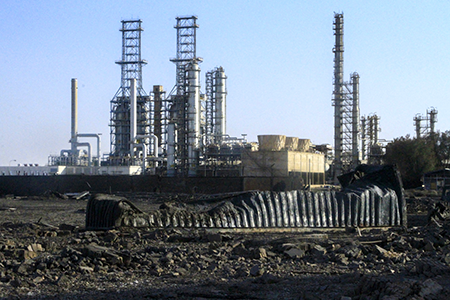
A months-long investigation by the France 24 news organization found strong evidence of the use of chlorine gas as a chemical weapon near the al-Jaili refinery, north of the Sudanese capital Khartoum, by the Sudanese Army Forces Sept. 5 and 13, 2024.
When used as a weapon, chlorine is a choking agent that can cause severe respiratory issues, lung damage, and death. Its use as a weapon is prohibited by the 1997 Chemical Weapons Convention (CWC).
According to the investigation by France 24, published Oct. 29 in cooperation with C4ADS, a nonprofit organization with a mission to defeat the illicit networks that threaten global peace and security, army forces dropped barrels containing chlorine gas from the sky in their attempt to recapture the refinery from the Rapid Support Forces militia, their opponents in the brutal and ongoing civil war.
The use of chemical weapons represents a new low in a conflict in which both sides have been accused of commiting war crimes on a wide scale. The army is the only armed group in Sudan with the aerial military capacity to carry out such attacks. Similar tactics were employed by the military forces of former dictator Bashar al-Assad during the civil war in Syria.
On Jan. 16, 2025, the United States under the Biden administration sanctioned Gen. Abdel Fattah al-Burhan, commander of the army and Sudan’s de facto head of state, alleging that the army had used chemical weapons, but did not publish any evidence for the claim.
On April 24, the U.S. Department of State announced that it had determined that the Sudanese government used chemical weapons in 2024, triggering the imposition of sanctions, including restrictions on U.S. exports to Sudan and on access to U.S. government lines of credit.
Sudan’s ministry of foreign affairs denied the allegations and complained that the United States did not raise the issue through the Organization for the Prohibition of Chemical Weapons (OPCW) as required. Both countries are members of the CWC and Sudan serves on the OPCW Executive Council.
The France 24 investigation traced documents showing that an Indian company, Chemtrade International Corporation, exported the chlorine to Sudan. Chemtrade told France 24 that the Sudanese importer assured them that the chlorine would be used “only to treat potable water,” which is an important civilian use for this product in Sudan where clean water is scarce. It is estimated that 17 million people in Sudan do not have access to safe drinking water, which has exacerbated disease outbreaks. During the course of the war, the rebel militia has destroyed water treatment facilities and power plants.
On Nov. 29, Sudan’s pro-democracy Civil Democratic Alliance for Revolutionary Forces demanded an immediate investigation by the OPCW into reports that the army has used chemical weapons.