


“For half a century, ACA has been providing the world … with advocacy, analysis, and awareness on some of the most critical topics of international peace and security, including on how to achieve our common, shared goal of a world free of nuclear weapons.”
Countries Leave Mine Ban Treaty
January/February 2026
By Jeff Abramson
Estonia, Latvia, and Lithuania completed their withdrawal from the 1997 Anti-Personnel Mine Ban Treaty in December and Finland and Poland will follow suit in early 2026, marking the largest number of exits from a humanitarian disarmament treaty.
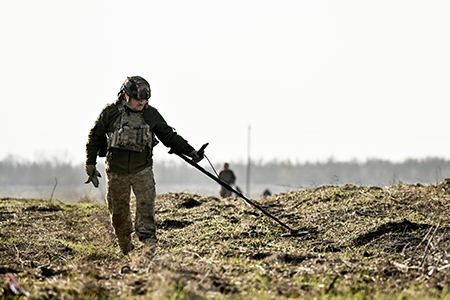
Departing states claimed their decisions were in response to Russia’s full-scale invasion of Ukraine.
The 1997 Ottawa Convention, also known as the Mine Ban Treaty, outlaws the production, use, storage and transfer of victim-activated anti-personnel landmines worldwide. It entered into force in 1999 and, before the recent withdrawals, had 166 states-parties, with the Marshall Islands and Tonga joining last year.
UN officials and many delegations criticized the withdrawals at the annual meeting of Mine Ban Treaty states-parties held Dec. 1-5 in Geneva. The special envoy to the convention, Prince Mired Raad Zeid Al-Hussein of Jordan, warned that the treaty risks losing its “teeth” and called for stepping up collective efforts to universalize and fully implement it.
In a separate development, the Washington Post reported Dec. 19 that U.S. Secretary of Defense Pete Hegseth issued a directive Dec. 2 for a forthcoming policy to allow for expanded use by the United States of weapons banned by the accord. This directive will essentially reverse the approach adopted during the Biden administration.
The withdrawals, although controversial, were expected as foreign ministers of the Baltic states and Poland recommended in a March joint statement that their countries should leave the treaty. (See ACT, April 2025.) In April, Finland’s prime minister made a similar statement, and between June 27 and August 20, all five countries deposited instruments of withdrawal, starting six-month clocks after which their exits could become official.
At the Geneva meeting, some delegations acknowledged the security concerns of the withdrawing states, while others emphasized the indiscriminate nature of the weapons and rejected any claimed military utility when compared to the human harm landmines cause. In the final report of the meeting, state-parties expressed “regret” over the withdrawals and said they “represent[ed] a setback and challenges in universalization efforts.”
After the report’s adoption, the New Zealand delegation, speaking on behalf of Brazil, Colombia, Mexico, and Panama, said that the final text was not strong enough on this point and did “not reflect the significant repercussions of these withdrawals for the Convention’s aims.”
Even more controversially, Ukraine, a state-party to the treaty, had communicated a decision to “suspend the operation” of the treaty in July. Ukraine did not attend the Geneva meeting, but states-parties rejected Kyiv’s action. In the final report, they affirmed that the treaty “does not allow the suspension of its operation and consequently its obligations” and called for “Ukraine … to further engage within the framework of the Convention.” The treaty does not have a provision for suspension and only allows withdrawal for countries not engaged in armed conflict.
In November and December 2024, under President Joe Biden, Washington announced it would provide treaty-prohibited anti-personnel landmines to Ukraine under a “limited exception” to its anti-transfer policy. (See ACT, December 2025.) It is unclear whether Trump has continued those transfers.
Hegseth’s Dec. 2 memo delivered another blow to the Mine Ban Treaty by rescinding the Biden administration’s more restrictive 2022 policy so that the United States may deploy landmines without geographic restriction and allow combatant commanders to decide where and when “non-persistent” (but still banned) landmines may be deployed.
Although President Bill Clinton in the 1990s was an early champion of a treaty banning landmines, the United States never joined the convention, arguing that such weapons were still needed on the Korean peninsula. As presidents have since gone back and forth as to whether to eventually join the treaty, the United States had refrained from transferring treaty-prohibited landmines except to Ukraine in 2024, did not use them except in one isolated incident Afghanistan in 2002, did not produce new landmines, and was the global leader in funding humanitarian demining.
Trump’s policy will further complicate global anti-landmine efforts, as will plans by Finland, Lithuania, and Poland to begin new landmine production after their withdrawals are finalized.