


"The Arms Control Association’s work is an important resource to legislators and policymakers when contemplating a new policy direction or decision."
Democratic Lawmakers Challenge U.S. Policy on Israeli Nuclear Weapons
June 2026
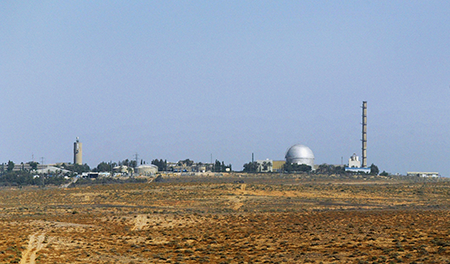
Thirty Democratic members of the U.S. House of Representatives are urging President Donald Trump’s administration to provide Congress with information regarding Israel’s undeclared nuclear weapons program.
They made their request in a letter to Secretary of State Marco Rubio May 4 that represents a rare congressional effort to challenge longstanding U.S. policy regarding its ally Israel’s nuclear posture.
Led by Rep. Joaquin Castro (D-Texas), the lawmakers said that greater transparency regarding Israel’s nuclear capabilities is necessary given the nuclear risks associated with the ongoing conflict involving the United States and Israel against Iran.
“We are in the fullest sense, fighting this war side by side with a country whose potential nuclear weapons program the United States government officially refuses to acknowledge,” they wrote. They argued that “We cannot develop coherent nonproliferation policy for the Middle East, including with respect to Iran’s civil nuclear program,” while maintaining “official silence” on Israel’s nuclear capabilities, and urged that the administration “hold Israel to the same standard of transparency” applied to other states.
“We do not believe we have received that information,” the lawmakers wrote. Signatories included the Congressional Nuclear Weapons and Arms Control Working Group co-chairs, Don Beyer (D-Va.) and John Garamendi (D-Calif.), as well as Alexandria Ocasio-Cortez (D-N.Y.) and Ro Khanna (D-Calif.).
Israel is not a party to the nuclear Nonproliferation Treaty, the bedrock of international nuclear arms control, and has long maintained a policy of nuclear ambiguity, under which it neither confirms nor denies possessing nuclear weapons.
U.S. policy toward Israel’s nuclear program largely traces its origins to a tacit 1969 understanding between President Richard Nixon and Israeli Prime Minister Golda Meir. Under the arrangement, Israel has maintained nuclear ambiguity while successive U.S. administrations refrained from publicly challenging Israel’s undeclared nuclear status.
Public estimates by the Federation of American Scientists and the Nuclear Threat Initiative place Israel’s arsenal at approximately 90 nuclear warheads.—SHAGHAYEGH CHRIS ROSTAMPOUR