


“The Arms Control Association and all of the staff I've worked with over the years … have this ability to speak truth to power in a wide variety of venues.”
Trump Dismisses Using Nuclear Arms Against Iran as Talks Stall
May 2026
By Kelsey Davenport
U.S. President Donald Trump said he would not use nuclear weapons against Iran weeks after his threat to destroy Iranian civilization prompted concerns that he was considering nuclear strikes.
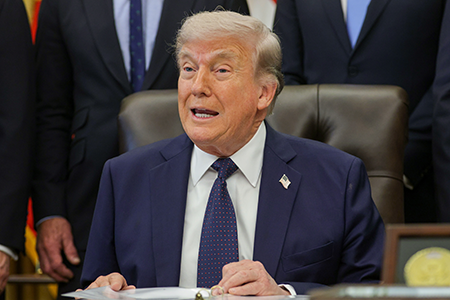
Trump’s comment ruling out nuclear weapons came two days after he extended a two-week cease-fire to give Iran more time to respond to a proposal to end the war that U.S. negotiators presented to an Iranian team during Pakistani-mediated talks April 11-12.
Iranian Foreign Minister Abbas Araghchi posted on the social media site X that he shared a “workable framework to permanently end the war on Iran” after an April 24-25 trip to Islamabad. It appears, however, that the two sides remain far apart on key issues, including nuclear restrictions, as Trump announced on his social media site, Truth Social, April 25 that his negotiators would not return to the Pakistani capital.
When asked by a reporter April 23 if he would use nuclear weapons, Trump said the United States “in a very conventional way decimated [Iran] without it.… A nuclear weapon should never be allowed to be used by anybody.”
In an April 7 statement on Truth Social, Trump triggered broad international criticism, including from Pope Leo XIV, when he threatened that a “whole civilization will die tonight” if Iran refused to reach a deal and open the Strait of Hormuz.
Later that same day, however, Trump backed away from the threat, saying on Truth Social that “Almost all of the various points of past contention have been agreed to between the United States and Iran.” He announced a two-week cease-fire to “allow the Agreement to be finalized and consummated.”
Trump’s optimism, however, proved premature. A U.S. negotiating team led by Vice President JD Vance traveled to Islamabad April 11 for talks with the Iranian team, which included Araghchi and Mohammad Bagher Qalibaf, a member of Iran’s parliament and lead negotiator, but the meetings ended without an agreement. Statements from officials on both sides suggested that key sticking points remained unresolved after negotiating sessions that spanned two days.
Before leaving Islamabad April 12, Vance told reporters that the United States needs to see “an affirmative commitment that [Iran] will not seek a nuclear weapon and they will not seek the tools that would enable them to quickly achieve a nuclear weapon.”
He said that the U.S. team was “quite flexible” but also noted that the negotiating team put “our final and best offer” on the table before leaving Islamabad and that “we’ll see if the Iranians accept it.”
He said the failure to reach a deal was “bad news for Iran much more than it’s bad news for the United States of America.”
Araghchi said the United States was to blame for the failure to reach an agreement. In an April 12 post on X, he said that the parties were “just inches away” from a memorandum of understanding when the Iranian team “encountered maximalism, shifting goalposts, and blockade.” He suggested that the United States has not learned from previous negotiations: “Good will begets good will. Enmity begets enmity.”
Two key sticking points in the talks appear to be the duration of a moratorium on Iranian nuclear activities and the future of Iran’s 440 kilograms of uranium enriched to 60 percent, a level just shy of the 90 percent U-235 considered weapons grade.
Trump said April 16 that Iran agreed to hand over its “nuclear dust,” presumably referring to the enriched uranium gas, to the United States. Iranian Foreign Ministry spokesman Esmail Baghaei denied Trump’s claim, saying on state-run TV April 17 that “Iran’s enriched uranium is not going to be transferred anywhere under any circumstances.” Araghchi had previously stated that the stockpile must remain in Iran, but said Iran would blend down the highly enriched uranium gas to lower levels.
On several occasions, Trump has threatened to deploy U.S. forces to remove the enriched uranium from Iran, an operation that would likely require thousands of troops on the ground, take several weeks, and require the transport of special equipment to secure the material. It is also unclear if the United States could locate all of the enriched uranium, some of which may be difficult to access given U.S. strikes on key nuclear facilities in June. (See ACT, July/August 2025.)
The two sides also disagreed over the duration of a suspension on certain nuclear activities, particularly enrichment. According to unnamed U.S. officials quoted in The New York Times April 13, Vance’s team asked for a 20-year “suspension,” but when asked about that report, Trump told the New York Post April 14 that he does not like the 20-year time limit. He suggested that he still wants a permanent ban, which was the U.S. position before the Feb. 28 strikes. Trump said he does not want Iran “to feel like they have a win.”
Iran responded to the 20-year suspension by offering a 5-year suspension, according to U.S. and Iranian officials cited in The New York Times April 13.
The issue of monitoring Iran’s nuclear program did not appear to be a key area of focus in the Islamabad talks. International Atomic Energy Agency Director-General Rafael Mariano Grossi has repeatedly emphasized the importance of resuming IAEA inspections. He told reporters April 15 that “Iran has a very ambitious, wide nuclear program so all of that will require the presence of IAEA inspectors.” Without inspections, “you will have an illusion of an agreement,” he said.
Originally, comments from Trump and Pakistani officials suggested that a second round of negotiations would be held April 21. Vance was planning to attend that round of negotiations, but Iran said it would not participate while the United States was violating the terms of the cease-fire.
Both sides levied accusations about cease-fire violations, specifically regarding the Strait of Hormuz, which Trump said would be reopened as part of the cease-fire. However, Araghchi, in an April 7 statement confirming Iran’s acceptance of the cease-fire, said that “safe passage through the Strait of Hormuz will be possible via coordination with Iran’s Armed Forces.” Since then, Iran has attacked and seized ships transiting the waterway that Tehran says are not complying with the Iranian terms.
The United States accused Iran of violating the terms the cease-fire and, in response, Trump announced a blockade on Iranian ships transiting the Strait. The U.S. Navy intercepted and seized an Iranian-flagged container ship, the Touska, that was enroute to Iran. In an April 22 post on X, U.S. Central Command said it turned around 31 ships, most of which were oil tankers traveling to or from Iran.
Iranian state-run media cited the U.S. blockade as a key reason why Iran decided not to return to Islamabad for talks April 21.