


“It will take all of us working together – government officials, and diplomats, academic experts, and scientists, activists, and organizers – to come up with new and innovative approaches to strengthen transparency and predictability, reduce risk, and forge the next generation of arms control agreements.”
North Korea Tests Missiles with Cluster Munitions
May 2026
By Kelsey Davenport
North Korea announced it is developing cluster munitions and tested several short-range missiles armed with that type of warhead in April. As North Korea is investing in new missile capabilities, the head of the International Atomic Energy Agency (IAEA) warned that Pyongyang’s expanding nuclear program could accelerate the production of nuclear warheads.
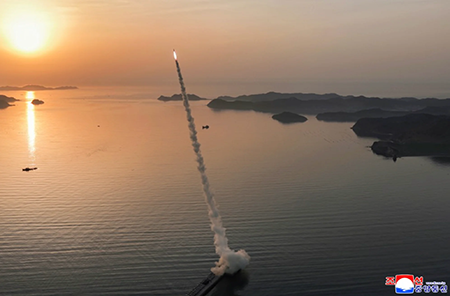
North Korea tested five tactical-range ballistic missiles, the Hwasong-11Ra, armed with a new “cluster bomb warhead and fragmentation mine warhead” April 19. The missiles flew about 90 miles before landing in the Sea of Japan, according to a statement from South Korea’s Joint Chiefs of Staff.
Cluster munitions are designed to scatter smaller submunitions or bomblets over a larger area. In 2010, the Convention on Cluster Munitions, which bans the production and use of cluster munitions, entered into force, but North Korea is not a party to the treaty. The April 19 launch appears to be North Korea’s second test of a missile armed with cluster munitions. North Korea said it tested a different short-range missile armed with a cluster munition warhead as part of a series of launches April 7-8.
The state-run Korean Central News Agency (KCNA) said April 20 that the purpose of the test was to “verify the characteristics and power” of the warheads. North Korean leader Kim Jong Un was present for the launch and “expressed great satisfaction” with the test. According to KCNA, Kim said the warheads have “weighty significance in military actions to boost the high-density striking capability to quell a specific target area as well as the high-precision striking capability.”
Kim’s comments and the short range of the missiles suggest that North Korea will deploy these systems near the border with South Korea.
Several days before the launch, IAEA Director-General Rafael Mariano Grossi visited South Korea and warned about the implications of North Korea’s advancing nuclear program. Grossi told reporters in an April 15 press briefing that the agency has observed a “rapid increase in the operation of the Yongbyon [5-megawatt] reactor,” which produces plutonium into spent fuel that is reprocessed for nuclear warheads. Grossi said that this light water reactor and the “activation of other facilities … all of them point to a very serious increase in the capabilities” of North Korea to produce nuclear weapons “which is estimated at a few dozen warheads.”
One of the other facilities Grossi was referring to might be a new enrichment plant at Yongbyon. He reported to the IAEA Board of Governors March 2 that the agency was monitoring construction of a new facility at the Yongbyon complex that had similar dimensions as the uranium enrichment facility at Kangson.
Prior to Grossi’s visit, South Korean Unification Minister Chung Dong-young told his country’s parliament that North Korea was operating an enrichment facility at Kusong. The Kusong site had not been officially confirmed as a nuclear facility and, according to South Korean media, the United States is restricting some intelligence-sharing with South Korea in response to Chung’s comments.
According to Yonhap News Agency, the United States started restricting access to certain satellite intelligence at the beginning of April. The official quoted in Yonhap said the restriction does not affect South Korea’s military readiness or information-sharing about North Korea’s military activities.
After the media reported on the U.S. decision to restrict certain intelligence, Chung said his comments about Kusong
were based on publicly available information and was not an intelligence leak.
South Korean President Lee Jae Myung defended Chung in an April 20 post on the social media site X. Lee said the information about the site was “widely known” and that he would look into “why such an absurd thing is happening.”