


“Right after I graduated, I interned with the Arms Control Association. It was terrific.”
UN Disarmament Commission Suspends Meeting over U.S. Objections
May 2026
By Libby Flatoff
The UN Disarmament Commission (UNDC) suspended its April 6 opening meeting after U.S. objections to the session’s substantive agenda.
The United States refused the inclusion of emerging technology on the agenda and called for the removal of the working group on this topic, saying that the UNDC was not the correct forum to address this topic, according to an April 6 UN press release. The delegation also accused the UN of seeking “centralized governance” within the disarmament framework and opposed this path, the press release said.
The UNDC is a deliberative subsidiary organ of the UN General Assembly, and all 193 member states participate in the dialogue. The April 6-24 UNDC session was intended to be the final one in a three-year cycle.
The commission meets annually and usually concentrates on discussing two agenda items in substantive plenary sessions and working groups. This year, it was meant to continue discussions on “formulating recommendations for achieving nuclear disarmament and non-proliferation of nuclear weapons, as well as fostering common understandings related to emerging technologies in the context of international security.”
After the United States voiced its objections, the UNDC moved into informal consultations and an informal plenary dedicated to exploring possible adjustments to its work and working methods.
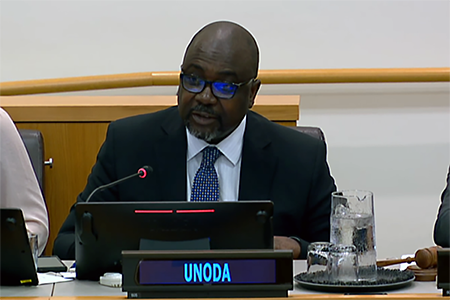
In a statement issued April 9, Adedeji Ebo, UN director and deputy to the High Representative for Disarmament Affairs, warned that “By failing to open a space for deliberations, we reinforce those claims that the United Nations is obsolete and unable to meet the challenges of the time.”
“The failure of the commission to complete its cycle, therefore, represents a tangible loss,” Ebo said.
In a separate statement the same day, the German delegation expressed regret over the meeting suspension. “We strongly regret that the Commission was not able to formally adopt the agenda of the substantive session and had to move into informal mode without discussing the working groups,” it said. “The commission therefore is not able to fulfill its mandate to have an exchange of thoughts and ideas with the goal to formulate recommendations—a task which is at the core of multilateralism.”
The Russia delegation also expressed regret, citing “the inability to conduct a comprehensive discussion including within the working groups, as well as to develop recommendations based on the results of the three-year cycle of the commission.”
During last year’s UNDC annual meeting, there were no apparent U.S. objections on including emerging technologies on the agenda. Julie Rodriguez, the emerging technologies working group chair, reported that the group held seven informal meetings, heard expert presentations on science and technology, and on their potential role and impact on international security and disarmament efforts, according to a UN press release. She also noted exchanges on “Member State-led initiatives related to emerging technologies.”
The failed UNDC consensus and process foreshadow a difficult path forward for international efforts on disarmament, especially ahead of the 2026 nuclear Nonproliferation Treaty Review Conference that began April 27. The Trump administration has often been critical of the UN and has decreased participation in its activities.