


“We continue to count on the valuable contributions of the Arms Control Association.”
White House Renews Call for Trilateral Arms Control Talks
October 2026
By Xiaodon Liang
U.S. President Donald Trump called again for arms control talks between China, Russia, and the United States in a Sept. 24 meeting with his Chinese counterpart, according to a White House readout of the one-day summit.
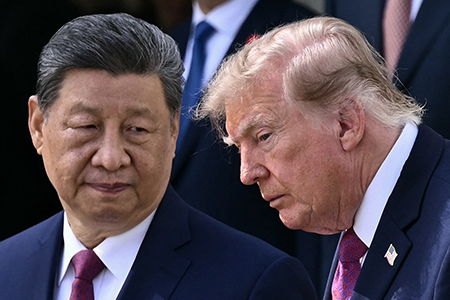
“The President advocated for trilateral arms control negotiations” among the three countries, the White House statement said. A press release from the Chinese Foreign Ministry summarizing the talks between Trump and President Xi Jinping did not mention arms control at all, however.
After a May bilateral presidential summit in Beijing, Trump also told reporters he had raised arms control negotiations between the possessors’ of the world’s three-largest nuclear arsenals. (See ACT, June 2026.)
Russia and the United States each have more than 5,000 nuclear weapons, whereas China has more than 600. Moscow and Washington each deploys around 1,800 strategic warheads with their delivery systems daily. Although Beijing has historically kept its arsenal under tight central control at a low level of readiness, it is shifting toward deploying more warheads on delivery vehicles as its sea-, land-, and air-based nuclear forces modernize.
Russian Deputy Foreign Minister Sergei Ryabkov said Sept. 6 that Russia was tentatively open to a trilateral meeting among the three countries’ leaders on the sidelines of the Nov. 18-19 Asia-Pacific Economic Cooperation leaders’ meeting in Shenzhen, China. “The main question boils down to how the substance of the meeting will be formulated, and what we can expect as a result,” Ryabkov said, according to a Reuters report citing the Russian state news agency TASS.
The first Trump administration proposed trilateral nuclear arms control talks as well, as the U.S.-Russia New Strategic Arms Reduction Treaty was approaching its original expiration date, but the idea was rejected by China. Attempting to apply diplomatic pressure, the U.S. State Department went so far as to set out seats for a Chinese delegation at a June 2020 bilateral meeting with Russia in Vienna. (See ACT, July/August 2020.)
The State Department has also held bilateral meetings with Chinese officials at least three times in 2026, on the margins of the “P5 process” dialogue on nuclear matters—which involves the five nuclear-weapon states recognized under the nuclear Nonproliferation Treaty—to promote nuclear risk reduction measures, the Wall Street Journal reported Sept. 24.
Led by Assistant Secretary of State for Arms Control and Nonproliferation Christopher Yeaw, the U.S. side pressed Chinese diplomats on the U.S. allegation of a Chinese nuclear test in June 2020. (See ACT, March 2026.)
The United States has also asked China to provide more advance notice of ballistic missile tests, the Journal reported. (See ACT, September 2026.)
Following the Sept. 24 summit between Trump and Xi, the two sides announced a bilateral dialogue to “exchange views on risks and benefits” related to artificial intelligence, scheduled for November 2026.
Both countries’ summaries of the summit also affirmed their opposition to Iran’s acquisition of a nuclear weapon and to the imposition, by any country or institution, of tolls on international waterways.