


“The Arms Control Association and all of the staff I've worked with over the years … have this ability to speak truth to power in a wide variety of venues.”
A Leading U.S. Nuclear Negotiator of the Post-Cold War Era: Thomas Graham, Jr. (1933-2026)
October 2026
By Susan F. Burk
A great man, a national treasure, a man who believed in peace: These are the words used to describe Thomas Graham, Jr. at his memorial service last month in Washington, D.C. When Tom died on September 3 at the age of 92, the world lost one of the leading authorities in international arms control and nonproliferation, and a public servant whose career was uniquely dedicated to reducing the dangers of nuclear and other weapons of mass destruction. Many of us also lost a trusted colleague, mentor, and dear friend.
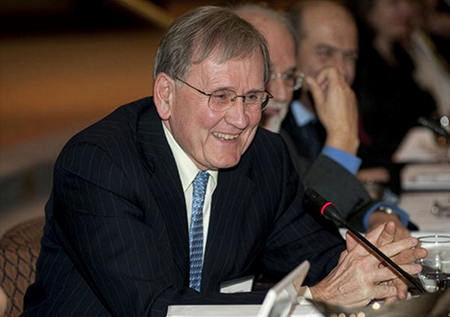
Before joining the U.S. Arms Control and Disarmament Agency (ACDA) in 1970, Tom earned his undergraduate degree from Princeton University, served in the U.S. Army for two years, graduated from Harvard Law School, and held various other positions, including on Capitol Hill. He joined the ACDA as its general counsel and held that role for 15 out of his 27 years with the federal government.
At the ACDA, Tom brought his formidable intellect, diplomatic skills, and deep commitment to mitigating the threat of nuclear Armageddon by negotiating international agreements with robust verification measures to address that threat. He held the rare distinction of being at the center of every major international arms control and nonproliferation negotiation from 1970 to 1997. This included the Strategic Arms Limitation Talks, the Strategic Arms Reduction Treaties, the Anti-Ballistic Missile Treaty, the Intermediate-Range Nuclear Forces Treaty, the Treaty on Conventional Forces in Europe, and the Comprehensive Test Ban Treaty. He also supported the negotiation and ratification of the Chemical Weapons Convention and the Biological Weapons Convention protocol to strengthen compliance.
In 1993, Tom served as acting director of the ACDA, and then as acting deputy director until July 1994. From 1994 through 1997, he was President Bill Clinton’s special representative for arms control, nonproliferation, and disarmament with the rank of ambassador. It was in that position that he undertook the defining mission of securing the indefinite extension of the nuclear Nonproliferation Treaty (NPT), the cornerstone of the international nuclear nonproliferation regime. The ACDA led the U.S. government preparations for the 1995 NPT Review and Extension Conference, where 175 states-parties met to decide whether to make the treaty permanent. Graham’s energetic commitment to the diplomatic strategy that was aimed at persuading a majority of NPT parties to support indefinite extension was legendary.
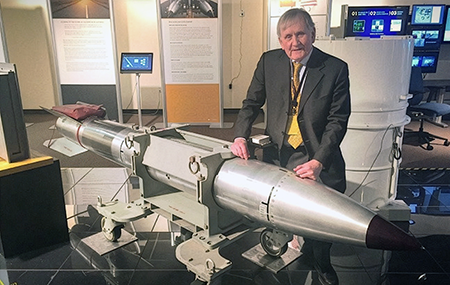
As a veteran of difficult and complex bilateral nuclear arms control negotiations with the Soviet Union, he enthusiastically embraced the challenge of the multilateral diplomacy required by the NPT. Tom met with senior representatives of more than 100 treaty parties in capitals all over the world and in New York. He patiently listened to the concerns of scores of foreign ministers, senior policy officials, and leaders of civilian nuclear programs. In addressing concerns about the U.S. commitment to its NPT disarmament obligations, Tom could respond authoritatively, including with anecdotes based on personal involvement, about the real progress that had been and was being made. He made clear how a strong, reliable NPT had been providing, and would continue to provide, an essential foundation for arms control progress.
The treaty was not a favor to the non-nuclear-weapon state-parties, he would argue, but was indispensable to the security of all parties, including the United States. He was relentlessly optimistic about its prospects. This personal optimism, and his reputation in the arms control field, served as a valuable antidote to the pessimism that so often characterized NPT meetings. “Susan,” he would tell me, “we will get an indefinite extension.” Thank goodness that he was absolutely right.
After Tom retired from government in 1997, he proceeded to write more than a dozen books and was a sought-after speaker. He worked at organizations including Lawyers Alliance for World Security and the law firm Morgan Lewis. He was Lightbridge Corporation’s executive chairman and served on the board of CanAlaska Uranium. He also taught undergraduate and graduate courses at Stanford University, University of Virginia, and University of Washington, and other institutions.
He penned well over 100 commentary articles in major newspapers and online publications. Until his death, he wrote regularly for his Substack blog, Defending Democracy, whose articles were often amplified on the platform by a larger blog, The Contrarian. His writings addressed not only nuclear disarmament and nonproliferation, but a variety of other topics including Ukraine, Taiwan, and worldwide attacks on democracy.
In addition to working closely with Tom on the NPT extension, I supported him on many of his diplomatic missions, including to Egypt, Jordan, Kenya, Indonesia, Malaysia, Morocco, Namibia, Saudi Arabia, and South Africa, as well as frequent meetings with the NPT depositary states (Russia, the United Kingdom, and the United States). He was indefatigable, unflappable, and very kind.
Tom was born in Louisville, Kentucky and remained devoted to his Kentucky roots. The Kentucky Derby was a “religious holiday,” he used to tell his friends. He actually attended more than 50 derbies. When we were both retired, he invited me to speak to students at the University of Louisville about the NPT. While there, we visited his beloved Churchill Downs—another memorable Tom Graham moment.
With Tom’s passing, the world has lost a giant in the arms control field at a time when the arms control and nonproliferation successes of the past are fading and the future for constraining nuclear weapons looks bleak. For those still fighting the fight and those preparing to join their ranks, it might be useful to consider: “What would Tom Graham do?”
He is survived by his wife, Christine Ryan; three children from his first marriage to Clover Nicholas; two stepchildren from his second marriage; and seven grandchildren.