


“The Arms Control Association and all of the staff I've worked with over the years … have this ability to speak truth to power in a wide variety of venues.”
IAEA Reports Iran to UN Security Council
October 2026
By Kelsey Davenport and Shaghayegh Chris Rostampour
The International Atomic Energy Agency’s Board of Governors voted to report Iran to the UN Security Council for failing to meet its safeguards obligations, but with Russia and China opposing the board’s decision, it is unlikely that the council will act against Tehran.
After the resolution passed, Iranian officials said Tehran is willing to resume inspections, but only as part of a broader diplomatic agreement. Diplomacy remains stalled, however, even after U.S. and Iranian officials met in September.
The board resolution directing the IAEA Director-General Rafael Mariano Grossi to report on Iran’s noncompliance with its nuclear Nonproliferation Treaty (NPT)-required safeguards agreement passed Sept. 9 by a 23-3 vote, with Russia, China, and Niger in opposition and eight states abstaining. The resolution also calls upon Iran to “urgently remedy its non-compliance” so the IAEA can provide assurance that Tehran has not diverted nuclear materials.
The resolution followed a Sept. 1 IAEA report, which noted Iran’s “continued refusal to engage the Agency.” As a result of Iran’s failure to provide the agency with access to certain nuclear sites, the IAEA “could not verify the status, for safeguards purposes, of these facilities and associated nuclear material.”
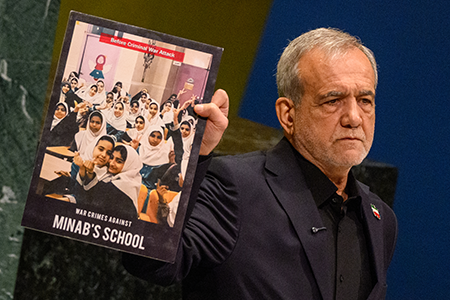
In a Sept. 9 statement to the IAEA board, Iran’s ambassador to the IAEA, Reza Najafi condemned the resolution as “dangerous and entirely counterproductive.” He said “granting safe access to such facilities is materially impossible” due to U.S. and Israeli military strikes. Iranian President Masoud Pezeshkian told Fox News Sept. 24 that “we are willing to submit ourselves to verification,” but that doing so must be part of a diplomatic agreement.
The board’s decision to pass the U.S.-backed resolution was expected. After the illegal Israeli and U.S. strikes on Iran’s nuclear program in June 2025, Tehran suspended cooperation with IAEA. Although Iran has subsequently granted periodic access to unaffected sites, such as the Bushehr power reactor, it has refused to grant IAEA inspectors access to bombed facilities or provide updated reports on nuclear materials. As a result, the IAEA board found Iran in noncompliance with its safeguards obligations in June 2026. (See ACT, July/August 2026.)
Speaking on behalf of France, Germany, the United Kingdom, and the United States, the U.S. ambassador to the IAEA, Wells Griffith III, said Sept. 10, “It is imperative that we hold Iran to account for its refusal to abide by its safeguards obligations.” The resolution is “necessary to send the message that safeguards obligations are not optional,” he said. Griffith expressed hope that the Security Council taking up Iran’s file will “underscore the collective will of the broader international community to hold Iran to account so that it will fulfil its legal obligations under the NPT.”
Action by the Security Council in response to the Sept. 10 resolution, however, is unlikely. China and Russia, veto-wielding members of the Security Council, joined Iran in a Sept. 9 statement condemning the resolution. The statement said that the decision to report Iran to the Security Council “lacks a legal basis and risks politicizing what should fundamentally remain a technical matter.”
When the IAEA Board reported Iran to the Security Council in 2006 for failing to cooperate with an agency investigation into undeclared activities, the Security Council passed a resolution requiring Iran to halt certain nuclear activities and cooperate with the IAEA. When Iran failed to do so, the Security Council passed a succession of resolutions sanctioning Iran.
Those resolutions were suspended under the 2015 nuclear deal, but reimposed in 2025 after the United States and Iran failed to reach an agreement on how to restore the accord. (See ACT, November 2025.)
In addition to requesting that the director-general report Iran’s noncompliance to the Security Council, the Sept. 9 resolution expressed support for a diplomatic resolution.
Iranian Foreign Minister Abbas Araghchi engaged indirectly with U.S. envoy Steve Witkoff on the sidelines of the UN General Assembly in New York Sept. 21. Araghchi told reporters Sept. 25 that Iran presented the United States with a plan to reopen the Strait of Hormuz and restart nuclear talks within seven days. Before the meeting, Iran and Oman reached an agreement on how to proceed with reopening the waterway. (See ACT, September 2026.)
U.S. President Donald Trump rejected the plan, telling reporters the following day that he wants a deal, but Tehran’s proposal “would not be acceptable.” He said Iran made the offer because it is “losing so badly.” Trump threatened once again to annihilate Iran during his Sept. 22 speech to the UN General Assembly.
Before Trump’s decision to reject the deal, U.S. Secretary of Energy Chris Wright told ABC News Sept. 6 that “there may not be a nuclear agreement.” The U.S. approach “may be simply destroying their capabilities,” he said.
In the absence of an agreement, Iran does not appear to be excavating its nuclear materials that were bombed by the United States and Israel or restarting any activities indicative of a decision to weaponize.
Factions in Tehran, however, continue to call for Iran to withdraw from the NPT. A small group of lawmakers submitted a bill to the parliament calling for withdrawal from the NPT in response to the IAEA board’s decision to report Iran to the Security Council.
Khabar Online News Agency reported Sept. 13 that Abbas Goodarzi, the spokesman for the presidium of the Iranian Parliament, advocated “withdrawal from the NPT and [revising] the nuclear doctrine” as measures that would put the United States and its allies “in their place.”
When asked by Fox News if Iran wants nuclear weapons, Pezeshkian said, “Not at all. Not at all.”