


"I find hope in the work of long-established groups such as the Arms Control Association...[and] I find hope in younger anti-nuclear activists and the movement around the world to formally ban the bomb."
U.S. Senate Panel Approves AI, Autonomous Weapons Rules
July/August 2026
By Xiaodon Liang
A key U.S. Senate committee recommended imposing on the military a regulatory framework for autonomous weapons and military artificial intelligence that emphasizes human judgment and ultimate human responsibility, while largely endorsing the Pentagon’s embrace of lethal autonomous weapons and urging that the department “maximize uses” of these emergent technologies.
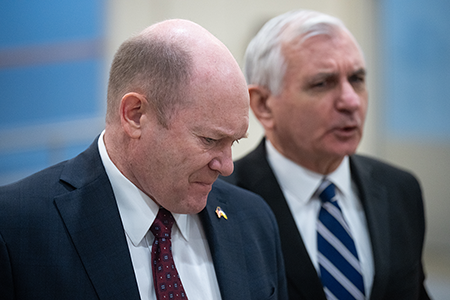
The Senate Armed Services Committee endorsed the new framework in its draft of the fiscal year 2027 National Defense Authorization Act, which the panel finished marking up June 10.
The sections pertaining to autonomous weapons and military AI would require the department to “ensure personnel exercise appropriate levels of human judgment” and that relevant systems are “designed and employed in a manner that enables commanders and operators to exercise ultimate human responsibility over the use of force.”
The requirement of “appropriate levels of human judgment” is already established in Department of Defense Directive 3000.09, on autonomy in weapons systems, but has lacked a clear definition. (See ACT, March 2023.)
The new framework seeks to elaborate on the principle by specifying that systems must allow for supervision by human operators, include methods for intervention or termination, include fail-safe mechanisms to enable manual control, provide adequate monitoring data to controllers, maintain records of target selection data and logic, and operate in compliance with “international law, rules of engagement, the law of armed conflict, applicable treaties, and Department of Defense policy.”
The proposed legislation would codify the existing review process mandated by the 2023 directive, while also specifying verification, validation, testing, and evaluation criteria. The department’s office of the Director, Operational Test and Evaluation, which has had its proposed budget slashed by two-thirds in this year’s Pentagon budget request, would be charged with ensuring that covered systems function “as anticipated in realistic operational environments against adaptive adversaries and are sufficiently robust to minimize failures.”
The committee text also would establish an incident repository for tracking data on system failures, unintended behavior, and near-miss events.
The language on autonomy and AI would categorically prohibit the use of these technologies for any “decision to initiate the launch or detonation of a nuclear weapon,” a move sought on a bipartisan basis in 2023 by Sen. Ed Markey (D-Mass.), Rep. Ted Lieu (D-Calif.), Rep. Don Beyer (D-Va.) and Rep. Ken Buck (R-Colo.).
The new Senate Armed Services Committee proposal does not, however, include a ban on the use of AI for the targeting of nuclear weapons, as proposed by Sen. Kristen Gillibrand (D-N.Y.) in a stand-alone bill introduced June 2.
Gillibrand’s bill was one of several introduced in the last few weeks seeking to address autonomous weapons and military use of AI by primarily Democratic members of Congress. The others included separate proposals by Sen. Adam Schiff (D-Calif.), Sen. Elissa Slotkin (D-Mich.), and Sen. Mark Kelly (D-Ariz.) in collaboration with Rep. Suhas Subramanyam (D-Va.).
Ultimately, the Senate committee language largely tracks a bill introduced June 8 by Democratic leadership, represented by ranking member Jack Reed (D-R.I.) and his counterpart on the Senate’s defense appropriations subcommittee, Chris Coons (D-Del.). The text, which was accepted by the Republican majority into the base text of the draft of the key policy bill, also incorporates substantial portions of the Kelly-Subramanyam bill.
The Senate committee text, as based on the Coons-Reed bill, is less specific in its protections against domestic surveillance as compared to the other proposals put forward by Democratic senators.
Elsewhere in the draft bill, the committee recommends that the Senate mandate creation of a robotics and autonomous systems command that would be responsible for “force generation, joint training, interoperability, doctrine development, and operational employment through other combatant commands.”
Reflecting bipartisan concerns about the effects of AI adoption, a separate section in the Senate’s draft act incorporates a bill proposed by Kelly and Sen. Tom Cotton (R-Ark.) that would instruct the Pentagon to assess the effect of AI use “on the maintenance and retention of essential warfighter skills.”
Otherwise, the text is largely supportive of Pentagon efforts to expand usage of generative AI and so-called agents, or AI-powered autonomous software.
The new draft legislation for regulation of autonomous weapons systems and military AI faces an uncertain path toward gaining final passage by the full Congress.
The sparer House variant of the defense policy bill, which was approved by the House Armed Services Committee June 5, instructs the Pentagon to update its directive on autonomous systems and military AI while taking into account many of the issues covered in the Senate bill, but provides less specificity and more deference to the Pentagon.
The recent wave of legislative interest in the Senate in autonomous weapons and military AI reflects growing unease over the Trump administration’s revisions to Pentagon policies on the use of AI.
Secretary of Defense Pete Hegseth instructed the department Jan. 9 to adopt a new policy that vendors be required to accept that their AI models may be deployed for “any lawful use.” The order implied that previous departmental restraints would be reassessed.
In February and March, the Pentagon took unprecedented coercive actions against a prominent U.S. technology firm, Anthropic, when the company rejected contract modifications that removed safeguards against use of its AI models in fully autonomous weapons systems and for domestic mass surveillance. (See ACT, April 2026.)
President Donald Trump signed a national security presidential memorandum on AI in the national security enterprise June 5 that, among other measures, tasks the Pentagon to rewrite Directive 3000.09, which was last updated in January 2023.