


"I find hope in the work of long-established groups such as the Arms Control Association...[and] I find hope in younger anti-nuclear activists and the movement around the world to formally ban the bomb."
How Can the U.S. Engage China in Arms Control? A Chinese Perspective
July/August 2026
By Tianjiao Jiang
The 2026 nuclear Nonproliferation Treaty (NPT) Review Conference once again unfortunately failed to reach a consensus final document. The Iranian nuclear issue is certainly a major reason, but the competing views between China and the United States on nuclear arms control have also been fully reflected in the review process outcome. China has firmly refuted U.S. criticism about the modernization and opacity of the People’s Liberation Army’s nuclear arsenal and rejected U.S. multilateral nuclear disarmament and dialogue initiatives.1 In Beijing’s view, the U.S. multilateral negotiation initiative is an attempt to shirk its responsibility as a nuclear superpower to prioritize nuclear disarmament, while criticism of China’s nuclear modernization is an excuse for its own nuclear expansion.2
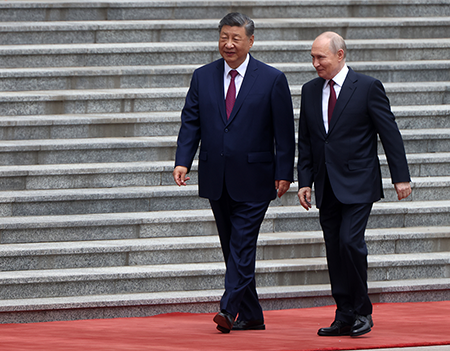
As the review conference convened in New York, the leaders of China and the United States met in Beijing and established a new bilateral relationship centered on constructive strategic stability.3 Theoretically, this approach should include actively engaging in dialogue and cooperation on nuclear arms control and nonproliferation issues, avoiding arms races, and strengthening crisis management. However, Beijing and Washington have not provided a clear path. Therefore, this article attempts to explore from a Chinese perspective the long-term structural challenges faced by China and the United States on nuclear strategic stability, and to provide suggestions for advancing further bilateral engagement and dialogue.
Recent China-U.S. Nuclear Discussions
China recently released its first arms control white paper in 20 years.4 In addition to reiterating long-standing policies such as no first use of nuclear weapons, nonparticipation in arms races, and ensuring a defensive national defense policy, it included a chapter on arms control in emerging technologies—space, cyber, and artificial intelligence—thus reflecting China’s willingness to play a more active role in multilateral arms control. The white paper also explicitly states, however, that only when the countries with the largest nuclear arsenals take the lead in nuclear disarmament and make further substantial cuts in their nuclear arsenals will conditions be ripe for all states to participate in multilateral nuclear disarmament.
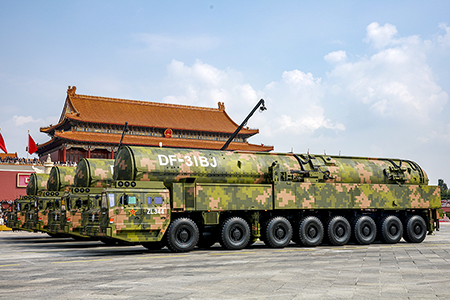
In recent years, the U.S. strategic community has expressed serious concerns about China’s rapidly growing and opaque nuclear arsenal. The Pentagon’s 2022 China military report estimated that China’s nuclear weapons stockpile will reach 1,500 by 2035,5 although a subsequent report put the estimate at 1,000 nuclear weapons by 2030.6 Regardless, the trajectory has generated serious consideration about how to simultaneously confront both China and Russia as strategic nuclear competitors in the so-called tripolar nuclear age.7
Meanwhile, the United States has been criticizing China’s refusal to participate in trilateral arms control negotiations. Some experts argue that because China lacks the will for arms control, the United States should not continue engagement but instead shift to a more competitive policy to force China to reconsider its position.8 This could include encouraging so-called friendly nuclear proliferation—deploying or even allowing its Asia-Pacific allies to possess nuclear weapons9—as well as further strengthening U.S. nuclear forces, developing a nuclear-armed, sea-launched cruise missile, strengthening a conventional triad and forward deployment of military units to deter China.10
Such practices would not resolve the structural contradictions in U.S.-Chinese strategic stability. On the contrary, they may provoke China to take even tougher measures, leading both sides into a more serious security dilemma and conflict escalation. China’s reluctance to respond to U.S. arms control proposals stems primarily from fundamental differences in nuclear strategy between the two adversaries. China’s arms control white paper clearly states that China has long adhered to the principle of no first use. Although this principle is often questioned, it reflects Beijing’s consistent belief that nuclear weapons are political weapons, whose role is limited to deterrence or counter-nuclear blackmail and cannot be used in war-fighting. China’s nuclear principle emphasizes a small, lean, and efficient force. As U.S. strategic scholars such as Robert Jervis have argued, as long as a country possesses reliably survivable and credible nuclear retaliation capabilities, nuclear deterrence is automatically effective, regardless of the size of the nuclear arsenal.11 Therefore, China vows not to participate in any arms race.
The U.S. nuclear strategy is completely different. Due to the Cold War rivalry between the United States and the Soviet Union, the U.S. nuclear strategy focused on war-fighting. Since the 1960s, the United States not only deployed thousands of tactical nuclear weapons but also developed numerous theories on escalation dominance and formulated a series of nuclear strike plans. In the U.S. view, nuclear weapons could be used on the battlefield, and Washington had to win against Moscow by cleverly controlling the use of nuclear weapons.12
Although the United States and the Soviet Union quickly fell into a state of mutually assured destruction, the U.S. government and strategic community sought ways to escape this situation of mutual hostage-taking. Thus, counterforce and damage limitation strategies emerged, aiming to destroy the opponent’s nuclear forces through a first strike on the one hand, and to intercept the opponent’s nuclear retaliation and reduce casualties through missile defense, on the other.13 During the Cold War there were constraints imposed by the 1972 Anti-Ballistic Missile (ABM) Treaty, but U.S. President Ronald Reagan’s Strategic Defense Initiative was not technologically feasible, and successor initiatives have only been partially effective.
China’s Nonresponse to Nuclear Negotiations
For China, the prospect of the U.S. nuclear war-fighting and damage limitation strategy is deeply unsettling. After the end of the Cold War, the United States quickly withdrew from the ABM Treaty and began accelerating the expansion of its global missile defense system, culminating in the recent Trump administration proposal for the “Golden Dome” plan. According to experts who participated in U.S.-Chinese Track II arms control dialogues over the past few decades, China has complained consistently to the United States about its missile defense expansion, but Washington has been unwilling to impose any limitations.14 Because China until recently only possessed 200 to 300 nuclear weapons, a U.S. first strike, combined with missile defense interception, could potentially prevent China’s nuclear retaliation from hitting its targets. This concern is corroborated in papers by Keir A. Lieber and Daryl G. Press, who noted that around the year 2000, the United States did not believe China possessed a reliable nuclear retaliatory capability and therefore refused to accept the concept of mutual vulnerability between the two countries.15
By 2010, with the development of China’s military capabilities, Beijing and Washington began discussing strategic stability, but these discussions did not last. One significant obstacle was the U.S. alliance system and extended deterrence strategy, which had been in place since the Cold War. Beijing, having learned from the Sino-Soviet split that alliances could be costly, maintained a nonaligned stance and opposed providing a nuclear umbrella to other countries. During the Clinton administration, China and the United States reached an agreement on mutual non-targeting of nuclear weapons, which Beijing saw as an indication of an improving strategic relationship.16 However, China was soon put back on the U.S. nuclear strike list.
Beijing believes that as long as Washington is unwilling to discuss the no-first-use principle, it means that the United States intends to launch a first strike against China and offset its retaliation capability by damage limitation. During the Obama and Biden administrations, U.S. officials discussed the possibility of adopting a “sole-purpose” nuclear doctrine, which is similar to a no-first-use policy. This was not possible due to opposition from East Asian allies such as Japan, which believed such a policy declaration would weaken the U.S. extended deterrence. Japan argued that a U.S.-Chinese strategic stability agreement would also reduce the credibility of Washington’s security guarantees to Tokyo.17
From China’s perspective, structural contradictions in the U.S.-Chinese strategic stability relationship have long existed. Beijing has raised many topics for discussion, but Washington has been unable to respond for various reasons. Now, critics in the United States question why, despite these long-standing issues, China suddenly significantly expanded its nuclear arsenal and deployed various advanced weapons, such as hypersonic weapons, at some point in the past decade.
The answer is obvious. During his first term, President Donald Trump explicitly advocated a return to great-power competition, designating China as the strategic rival and pacing threat, demanding an increased role for nuclear weapons, deploying the W76-2 low-yield nuclear warhead—which is understood to be aimed at China and blurs the line between nuclear and conventional weapons—and insisting on intercepting missiles fired at the United States from anywhere at any time. The last point marks a major expansion in U.S. missile defense policy because it includes intercepting China’s nuclear retaliatory forces and thus undermining the credibility of China’s nuclear deterrence. Coupled in Trump’s second term with a trade war, a tech war, and the Taiwan issue, mutual trust between Beijing and Washington has sharply declined.
To adapt to the return of great-power competition, the U.S. strategic community advocates winning the new cold war through technological and arms races. In this view, the United States never accepted the notion of mutually assured destruction with the Soviet Union in the past and should not accept mutual vulnerability with China now. It holds that the United States needs to ensure absolute military superiority through the development of emerging technologies and offset its adversaries’ retaliatory capabilities.18
This perspective is also reflected in relevant U.S. military operational concepts and actions. They include the U.S. Cyber Command’s “persistent engagement” and “hunt forward” strategies, which could potentially penetrate China’s nuclear command-and-control systems and disrupt Chinese missile launches. In Beijing’s view, the Starlink and Golden Dome programs could become space weapons. The Starlink program plans to launch more than 40,000 satellites, while China currently has fewer than 1,000 satellites in orbit. Starlink could threaten China’s space assets with a collision—China’s space station has been approached by Starlink satellites several times without knowing their intention—and support preemptive actions by the U.S. military. Through the use of artificial intelligence, the U.S. military can not only significantly improve the effectiveness of missile defenses such as Golden Dome, but also more effectively identify, locate, and track China’s mobile missile launch vehicles by more efficiently analyzing satellite imagery, electromagnetic signals, and cyberattack intelligence. All of this poses a serious challenge to the credibility of China’s nuclear retaliation.
To restore strategic stability and enhance the credibility of its nuclear deterrent, China is making dynamic adjustments to its nuclear arsenal. The United States criticizes this approach, arguing that if the goal is to improve survivability, China could simply increase its strategic nuclear submarines instead of increasing missile silos. This approach would be difficult because strategic nuclear submarines require a high degree of stealth technology, which China cannot rapidly increase in the short term. Expanding the number of missile silos, by contrast, would buy China time and consume U.S. strike capabilities and attention.
Beijing’s reluctance to engage in dialogue with Washington on this issue is largely due to differences in strategic culture. From the U.S. perspective, the lack of mutual trust makes strategic dialogue between the two countries even more necessary, and they should discuss various nuclear issues separately, following the compartmentalized approach employed by the United States and the Soviet Union in the Cold War. However, China is not the Soviet Union and insists on viewing this issue through a comprehensive security framework. Without a foundation of mutual trust, and divided over other major issues such as trade and Taiwan, effective dialogue between the two countries is very difficult.
Can the U.S. Engage China on Arms Control?
Currently, the U.S. strategic community is relentlessly criticizing China and hyping a nuclear tripolar rivalry, arguing that China and Russia will force the United States to rely on nuclear capabilities in two theaters, either at the same time or sequentially, and using this as a pretext to strengthen nuclear weapons modernization and conventional triad forces.
On the one hand, this viewpoint is highly misleading. Although the United States appears to be cornered, China and Russia have not actually become military allies. Why does the United States not consider a divide-and-conquer strategy against China and Russia, instead deliberately creating a more difficult situation that would involve simultaneously contending with both?
On the other hand, this kind of narrative not only fails to resolve the long-standing structural contradictions in U.S.-Chinese strategic stability but also intensifies the arms race and security dilemma. For the United States, its massive nuclear arsenal overhaul program is likely to be costly and may not even achieve the desired results. Historically, such projects have often been behind schedule and over budget. For example, a key component of the 2018 Nuclear Posture Review was the replacement of land-based intercontinental ballistic missiles, originally planned for completion in 10 years, but now likely to be delayed until 2050 at best, with budget costs projected to nearly double.
The United States also needs to simultaneously build new plutonium pits, new warheads, new bombers, new missiles, and strategic nuclear submarines, but has stopped manufacturing nuclear weapons for over 40 years. Restarting this manufacturing operation will impose enormous time, money, manpower, and environmental costs.
Why is the United States wasting resources and employing outdated Cold War methods to address problems 80 years later, with results that are likely to be unsatisfactory? Why not consider resolving the long-standing structural contradictions between China and the United States through cleverly designed arms control mechanisms and gradual adjustments to nuclear strategy? Although the United States criticizes China for being unwilling to engage in arms control dialogue, the United States never took Chinese concerns seriously.
In many Track II dialogues, U.S. experts have proposed numerous ways to reduce nuclear risks, including increased transparency, missile launch notification, and nuclear fail-safe, but China views acknowledging the mutual vulnerability between Beijing and Washington as the primary concern. Without addressing this concern, other risk reduction measures are merely stopgap and could even have serious negative consequences. That is because China has always worried about a preemptive U.S. strike and believes that without acknowledging mutual vulnerability, increased transparency and information sharing could easily be exploited to issue nuclear threats or carry out a decapitation strike. The United States should demonstrate to China the tangible benefits of participating in arms control dialogues, such as exploring mutual vulnerabilities and the sole-use doctrine to prevent escalation of nuclear conflict. Trump’s explicit expression of aversion to nuclear war suggests that he would also be interested in these topics.19
The establishment of a constructive strategic stability relationship would provide an opportunity for China and the United States to engage in a nuclear strategic stability dialogue. The May 17 summit in Beijing did not explicitly link constructive strategic stability with nuclear strategic stability. Considering that there will be multiple other opportunities for the top leaders of China and the United States to meet this year, the strategic advisers on both sides should work together on the following issues.
First, they should convey clear messages to each other’s top leaders that a strategic stability dialogue should be put on the table as one of the priorities. Due to the interference of numerous other issues in bilateral relations, strategic stability has long failed to receive the attention it deserves. Given the political polarization in the United States, China is also keen to know how the United States views the issue of strategic stability with China. What might the future U.S. strategic direction look like? The Trump administration has also clearly stated its desire to avoid a major military conflict with China through dialogue.
Next, the strategic advisers should suggest that the two leaders reaffirm in a joint statement that a nuclear war cannot be won and must never be fought, thereby fostering mutual trust and setting an example for strengthening the global nuclear taboo and reducing nuclear risks. This commitment should already be implicit in the constructive strategic stability relationship, but both sides are still building and have not truly established a strategic stability relationship. Such a statement can be seen as an indirect way of saying that the mutual vulnerability exists, thus avoiding pressure from U.S. domestic politics and allies. China and the United States should also jointly conduct strategic dialogues with stakeholders in the Asia-Pacific region to explore how to achieve regional security through conventional measures and legal frameworks instead of enhancing the role of nuclear weapons.
Finally, both sides should engage in dialogue on issues such as nuclear doctrine, missile launch notifications, transparency and confidence-building measures, nuclear fail-safe, and crisis communication. China and the United States recently resumed a bilateral dialogue on AI, but mainly discussed issues related to civilian technology regulation and export control. Placing a special emphasis on the entanglement of emerging technologies such as AI, cyber and space with nuclear weapons, both sides should quickly establish terminology handbooks and risk management channels through joint research and dialogue mechanisms to prevent accidental nuclear escalation due to technical flaws or misunderstandings.
In September this year, China and the United States will hold another bilateral summit. Experts from both sides should work together toward these goals and strive to solve the structural problems that have long plagued the strategic stability of the two countries. If this opportunity is missed, the logic of strategic competition may overwhelm the notion of constructive strategic stability, leading to a further decline in strategic mutual trust between the two sides and a deeper security dilemma. It is crucial for international peace and stability that China and the United States do not engage in a nuclear war and avoid the escalation of nuclear conflicts. This is a red line that cannot be crossed in the competition.
ENDNOTES
1. Sun Xiaobo, “Statement at the General Debate of the Eleventh Review Conference of the Treaty on the Non-Proliferation of Nuclear Weapons” (in Chinese), Ministry of Foreign Affairs of the People’s Republic of China, April 30, 2026.
2. Chinese delegation to the 2026 NPT Review Conference, “Reply Statement at the Eleventh Review Conference of the Treaty on the Non-Proliferation of Nuclear Weapons on April 29” [in Chinese], Ministry of Foreign Affairs of the People’s Republic of China, April 30, 2026.
3. The White House, “Fact Sheet: President Donald J. Trump Secures Historic Deals with China, Delivering for American Workers, Farmers, and Industry,” May 17, 2026.
4. State Council Information Office of the People’s Republic of China, “China’s Arms Control, Disarmament, and Nonproliferation in the New Era” (in Chinese), white paper, November 27, 2025.
5. Office of the Secretary of Defense, “Military and Security Developments Involving the Peoples Republic of China 2022” annual report to Congress, U.S. Department of Defense, December 2022.
6. Office of the Secretary of Defense, “Military and Security Developments Involving the Peoples Republic of China 2025,” annual report to Congress, U.S. Department of Defense, December 2025.
7. Vipin Narang and Pranay Vaddi, “How to Survive the New Nuclear Age,” Foreign Affairs, July/August 2025 (June 24, 2025); Andrew F. Krepinevich Jr., “Lighting the Path Ahead: Scenario-Based Planning in the Tripolar Nuclear Age,” Hudson Institute, January 8, 2026.
8. Marco Rubio, “The Next Era of Nuclear Arms Control,” U.S. Department of State, February 6, 2026.
9. Moritz S. Graefrath and Mark A. Raymond, “America’s Allies Should Go Nuclear,” Foreign Affairs, November 19, 2025; Henry Sokolski and Thomas D. Grant, “How to leverage US nukes overseas,” Breaking Defense, April 17, 2025.
10. Dan Plesch and Manuel Galileo, “What the West Misses About China’s Nuclear Build-up,” The Diplomat, March 27, 2026; Frank A. Rose, “Bringing China into the fold on arms control and strategic stability issues,” Brookings Institution, September 25, 2019.
11. Robert Jervis, The Meaning of the Nuclear Revolution: Statecraft and the Prospect of Armageddon (Ithaca, NY: Cornell University Press, 1989).
12. Herman Kahn, On Escalation: Metaphors and Scenarios (New York: Frederick A. Praeger, 1965).
13. Colin S. Gray and Keith Payne, “Victory Is Possible,” Foreign Policy, No. 39 (Summer 1980), pp. 14-27.
14. Gregory Kulacki, “Chickens Talking With Ducks: The U.S.-Chinese Nuclear Dialogue,” Arms Control Today, September 30, 2011.
15. Keir A. Lieber and Daryl G. Press, “The Rise of U.S. Nuclear Primacy,” Foreign Affairs, March/April 2006 (March 1, 2006).
16. William J. Clinton, “The President’s News Conference With President Jiang Zemin of China in Beijing,” The American Presidency Project, University of California, Santa Barbara, June 27, 1998.
17. “United States Experts Call on Japan Not to Oppose a U.S. No-First-Use Policy,” No-First-Use Global, August 10, 2021.
18. Keir A. Lieber and Daryl G. Press, The Myth of the Nuclear Revolution: Power Politics in the Atomic Age (Ithaca, NY: Cornell University Press, 2020); Austin Long and Brendan Rittenhouse Green, “Stalking the Secure Second Strike: Intelligence, Counterforce, and Nuclear Strategy,” Journal of Strategic Studies, Vol. 38, No. 1-2 (2015), pp. 38-73; Brendan R. Green and Austin Long, “The MAD Who Wasn’t There: Soviet Reactions to the Late Cold War Nuclear Balance”, Security Studies, Vol. 26, No. 4 (2017), pp. 606-641.
19. The White House, “President Trump Has Always Been Clear: Iran Cannot Have a Nuclear Weapon,” June 17, 2025; Andrea Shalal and Steve Holland, “Trump says he wants to work with Russia, China on limiting nuclear weapons,” Reuters, February 13, 2025.