


"The Arms Control Association’s work is an important resource to legislators and policymakers when contemplating a new policy direction or decision."
U.S. and G-7 Commit to Secure Chernobyl
June 2026
By Kelsey Davenport
The United States announced it would contribute funds to repair damage done to the Chernobyl nuclear power plant and urged other states to also commit resources to securing the site.
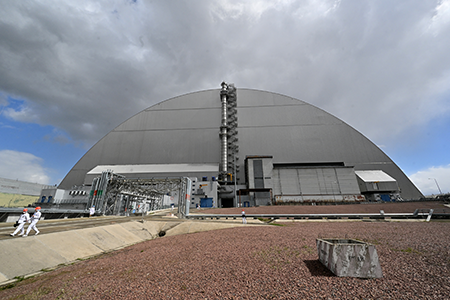
In an April 29 press release, the State Department announced that the United States would provide up to $100 million “to ensure the continued containment of fissile nuclear material at the Chornobyl nuclear power plant in Ukraine.”
The repairs are necessary after the International Atomic Energy Agency (IAEA) assessed that the New Safe Confinement structure, built over the reactor at the Chernobyl site after it melted down in 1986, sustained damage during a February 2025 drone strike. The IAEA concluded in a November 2025 report that the containment structure “lost its primary safety functions” due to damage caused by the strike during the full-scale Russian war against Ukraine. (See ACT, January/February 2026.) “Without repairs, the [existing structure] can no longer provide adequate protection, creating the specter of a dangerous leak of highly radioactive material in Europe,” the State Department spokesperson’s office wrote.
The Group of 7 world economic powers estimated that the total cost of the repairs will be $500 million. In the April 29 press statement, the State Department called “upon [its] G7 and European partners to follow suit and make substantial financial commitments to share the burden of these essential repairs.”
In an April 25 statement marking the 40-year anniversary of the Chernobyl accident, the European Union’s Directorate-General for Enlargement and Eastern Neighbourhood said that the “EU will continue supporting Ukraine and assisting in ensuring nuclear safety, security and radiation protection.” The statement noted that the EU’s Instrument for Nuclear Safety Cooperation provided $43 million for nuclear safety in Ukraine last year, some of which would go toward repairing the New Safe Confinement structure.
The statement used the Chernobyl anniversary to call attention to the ongoing nuclear security and safety risks in Ukraine. Russia’s illegal seizure and continued occupation of the Zaporizhzhia Nuclear Power Plant in Ukraine “significantly increase the risk to human life and environmental protection,” the statement said. It added that “Moscow’s systematic attacks on Ukraine’s energy infrastructure threaten the stable power supply required for the safe operation of nuclear facilities.”
According to a May 7 statement from IAEA Director-General Rafael Mariano Grossi, a drone struck the External Radiation Control Laboratory at the Zaporizhzhia plant May 3. The IAEA team at Zaporizhzhia visited the laboratory the following day, and “observed damage to meteorological equipment used to collect real-time environmental parameters in the event of a nuclear or radiological emergency,” according to Grossi’s statement. The equipment is currently not operable, the statement said.
Grossi said that “we cannot afford for the next damage to occur on essential nuclear safety equipment” and called upon “both sides to make all efforts to avoid military activities in the vicinity of nuclear facilities—wherever they are located.”
The previous week, a worker at the Zaporizhzhia complex was killed by a drone strike, according to an April 30 statement from the IAEA. In that statement, Grossi urged all parties to abide by Pillar 3 of the “seven indispensable pillars” of nuclear security and safety during conflict.
Pillar 3 states that “the operating staff must be able to fulfil their safety and security duties and have the capacity to make decisions free of undue pressure.” Grossi announced the seven pillars in May 2022, shortly after Russia attacked Chernobyl and Zaporizhzhia in the opening days of its illegal invasion of Ukraine.