


“For 50 years, the Arms Control Association has educated citizens around the world to help create broad support for U.S.-led arms control and nonproliferation achievements.”
Iran Threatens to Withdraw from the NPT
May 2026
By Libby Flatoff
Iran has threatened to withdraw from the nuclear Nonproliferation Treaty (NPT) in response to U.S. and Israeli military strikes on its territory. The implementing legislation requiring withdrawal was introduced in Iran’s parliament just weeks before states-parties met in New York to review the treaty and discuss steps to strengthen it.
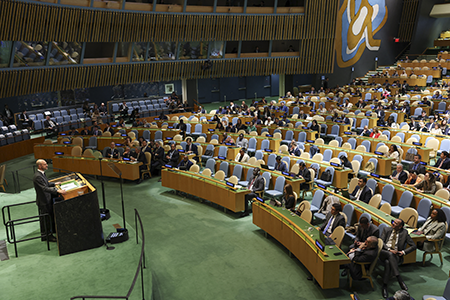
Malek Shariati, a member of the Iranian parliament, introduced the legislation titled “Support for the Nuclear Rights of the Iranian Nation” March 28. The Iranian news agency WANA reported that the proposal is built on three main pillars: withdrawal from the treaty, repeal of the law on implementing the 2015 nuclear deal known as the Joint Comprehensive Plan of Action, and support for forming new international agreements with partner countries to advance peaceful nuclear technologies.
Article X of the NPT allows a state-party to withdraw “if it decides that extraordinary events, related to the subject matter of this Treaty, have jeopardized the supreme interests of its country.” The state-party must give a three-month notice of intent to withdraw and submit a statement on the extraordinary events that led to the decision to withdraw.
In a March 27 post on the social media site X, Ebrahim Rezaei, spokesman for the National Security and Foreign Policy Commission of Iran’s parliament, said that remaining a part of the NPT would be meaningless as it “has had no benefit for us.”
According to Iranian media reports, the bill is to be fast tracked “with triple urgency.” However, since Israel and the United States began strikes against Iran Feb. 28, the parliament has not met in person and there is no clarity on when sessions may resume. If the legislation passes parliament, it will still need to be reviewed by the Guardian Council, which has the power to veto it.
Iranian Foreign Ministry spokesman Esmail Baghaei, in remarks March 28 to Iranian media, confirmed the legislation had been introduced and reaffirmed that “the Islamic Republic of Iran has never sought, and does not seek, nuclear weapons.” He added that, “regarding remaining a party to this treaty, and notwithstanding our clear position on the prohibition of all weapons of mass destruction, this is a matter of genuine discussion within public opinion and at the parliamentary level.”
WANA quoted Fada Hossein Maleki, a member of the national security commission, as saying that the strikes by the United States and Israel provide an “opportune moment” for Iran to begin reconsidering its international commitments.
Iran submitted five working papers for the 2026 NPT Review Conference after the war broke out, suggesting that it still plans to participate in the conference, which runs April 27 to May 22.
If Iran withdraws from the NPT, the bedrock of the international nonproliferation regime, it will be the second state to do so, after North Korea illegally withdrew without proper notice in 2003. (See ACT, January/February 2003.)