

“For 50 years, the Arms Control Association has educated citizens around the world to help create broad support for U.S.-led arms control and nonproliferation achievements.”
UN Urges U.S. to Address Marshall Islands Nuclear Legacy
November 2026
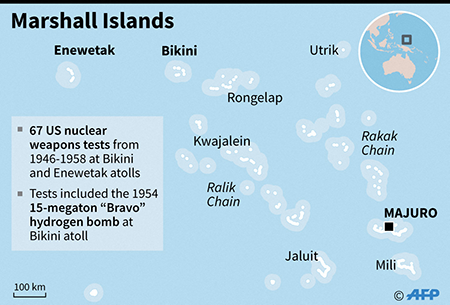
The UN Office of the High Commissioner for Human Rights (OHCHR) has called on the United States to address the legacy of 67 nuclear tests conducted in the Marshall Islands between 1946 and 1958.
A report published Oct. 1 concluded that “there has not yet been a comprehensive just settlement of [Marshallese] claims arising from the nuclear testing programme” and urged Washington to “permit the pursuit of further avenues of redress.”
Requested under UN Human Rights Council Resolution 57/26, the report used a “transitional justice” framework, which addresses systemic human rights abuses through truth-seeking, reparations, accountability, and guarantees of non-recurrence, rather than focusing solely on criminal prosecutions. It drew on consultations in the Marshall Islands and the United States and more than 60 submissions from governments, nongovernmental organizations, and environmental and human rights experts.
The report recommended that the United States declassify information about nuclear testing and engage in “good faith” dialogue with the Marshallese. It also urged Washington to provide healthcare, address environmental remediation needs, and ensure that Marshallese communities in the diaspora can access “culturally appropriate” benefits and services.
The Marshall Islands Nuclear Claims Tribunal assessed more than $2.3 billion in personal injury and property damage claims, but no claimant has received full compensation because of insufficient funds, according to the OHCHR deputy high commissioner, who spoke at a Human Rights Council session Oct. 1. During the dialogue, the Marshall Islands also called for greater transparency and accountability. OHCHR said the UN should consider acknowledging and apologizing for the role of the Trusteeship Council in allowing testing to continue.
Established in 1945, the council was a UN body responsible for monitoring the administration of territories and helping them achieve independence. It adopted resolutions in 1954 and 1956 that permitted nuclear testing to continue under certain conditions, despite appeals by the Marshallese to halt the tests altogether.
Under the 1986 Compact of Free Association, the United States and the Marshall Islands established the Section 177 settlement framework, which provided $150 million for a nuclear claims fund and an independent tribunal. The agreement also allowed the Marshall Islands to seek additional compensation under a “changed circumstances” provision. In 2000, the Marshall Islands petitioned for more than $3 billion in additional compensation, but the United States concluded in 2005 that the petition did not meet the provision’s criteria.
The two countries signed a renewed compact agreement in 2023. (See ACT, November 2023.) However, it did not resolve the nuclear legacy claims. Joseph Yun, then the U.S. special envoy responsible for negotiating the compact, said in 2023 that the new agreement did not affect those claims.—SHAGHAYEGH CHRIS ROSTAMPOUR