


“Your association has taken a significant role in fostering public awareness of nuclear disarmament and has led to its advancement.”
Nuclear-Weapon States Consult as Trump Talks Denuclearization
November 2026
By Daryl G. Kimball
Officials representing the five nuclear-armed members of the nuclear Nonproliferation Treaty (NPT) met in New York the week of Oct. 5 for the latest “P5 process” consultation aimed at increasing mutual understanding of one another’s nuclear doctrines and postures, multiple diplomats told Arms Control Today on condition of anonymity.
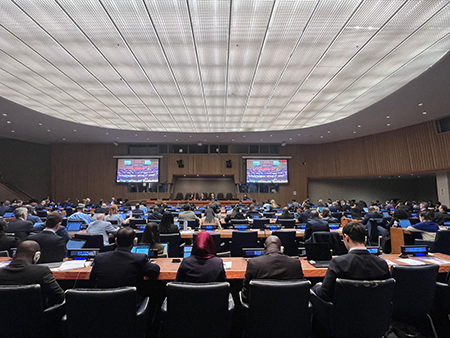
Since 2010, the P5 process dialogue has involved informal discussion among senior nuclear policy officials of the five states, sometimes at the level of undersecretary or deputy minister, sometimes at the lower technical-expert level. The sessions have only been held infrequently and never at the level of heads of state. Many experts say that this format is insufficient to deal with intensifying nuclear weapons challenges.
The French foreign minister, whose country currently chairs the P5 process, announced April 27 at the 2026 NPT Review Conference that the five nuclear-armed states this year would be urged to discuss “measures to reduce strategic risks, a moratorium on the production of fissile material for nuclear weapons, the entry into force of the comprehensive nuclear-test-ban treaty, [and] the launch of discussions on strategic stability with a view to establishing a new security framework in the future.”
To date, none of the five governments has publicly described the content or outcomes from the latest P5 process dialogue, which took place on the fringes of the 81st session of the UN General Assembly’s First Committee on Disarmament and International Security.
Ahead of the P5 process meetings, however, U.S. officials told the Wall Street Journal Sept. 24 that the Trump administration has been quietly holding talks with China about its rapidly expanding nuclear arsenal and U.S. allegations that Beijing conducted a 10-ton nuclear explosion in June 2020. That event, if confirmed as a nuclear explosion, would be a violation of the 1996 Comprehensive Test Ban Treaty (CTBT). (See ACT, March 2026.)
A separate CNN report published Oct. 6 said that the Trump administration had discussed beginning “reciprocal nuclear [test] site visits with China” and that China had proposed reciprocal visits of Chinese and U.S. nuclear weapons laboratories.
U.S. officials have supported a proposal announced by French officials May 1 to seek talks on confidence building measures, which may or may not require or involve reciprocal site visits. Senior Chinese officials who spoke with Arms Control Today Oct. 9 denied they had proposed reciprocal visits as CNN reported.
Echoing a proposal made in 2023 by the head of the U.S. National Nuclear Security Administration, France, the United Kingdom, and the United States proposed May 1 that the P5 process states engage in multilateral strategic stability talks on “confidence-building measures regarding nuclear explosive test monitoring, including increasing the ability to detect tests of any yield toward ensuring nuclear weapons states adhere to [the] zero-yield standard” established by the CTBT.
The prospects for such talks are murky, however, in the wake of what was described by several diplomatic observers as a “confrontational” presentation by U.S. Assistant Secretary of State for Arms Control and Nonproliferation Christopher Yeaw at a public side-event sponsored Oct. 8 by the U.S. delegation at the UN.
In announcing the event, the U.S. Mission to the UN claimed that, “The world has been hoodwinked into believing that an actual norm against nuclear testing exists, when in fact it’s an illusion created by an unverifiable treaty.” The CTBT has 188 state signatories, including the United States.
In his remarks and presentation slides obtained by Arms Control Today, Yeaw repeated the U.S. charge that China conducted a yield-producing nuclear test in June 2020. He also reaffirmed a contested 2019 U.S. assessment that Russia has conducted secret nuclear tests in the past that could help advance Russian nonstrategic nuclear capabilities.
Yeaw argued that the CTBT verification regime is not fit for purpose if the objective is to verify compliance with the strict zero-yield test standard. He acknowledged that the five nuclear-armed states all agreed during the CTBT negotiations that the treaty prohibits any “any test explosion that produces a self-sustaining nuclear chain reaction.”
Yeaw called the present situation regarding testing “unacceptable,” and he reiterated President Donald Trump’s threat that the United States would respond “on an equal basis” if alleged low-yield nuclear testing by other states continues. But Yeaw also said the United States prefers to address its concerns through diplomatic and multilateral channels.
In remarks at the UN First Committee Oct. 8-9, Chinese and Russian officials strenuously rejected allegations that they have violated the CTBT and called upon the United States to finally ratify the treaty to help bring it into force. That is necessary to facilitate short-notice, on-site inspections to detect and deter any clandestine, low-yield nuclear testing.
Meanwhile, Mexico and 176 states voted in favor of a resolution at the UN First Committee in mid-October that in part, “urges all States to refrain from any action that may hamper progress towards the entry into force of the Treaty and its universalization.” The resolution also “urges all states not to carry out nuclear-weapon test explosions or any other nuclear explosions, to maintain their moratoriums in this regard and to refrain from acts that would defeat the object and purpose of the Treaty.” The United States voted no.
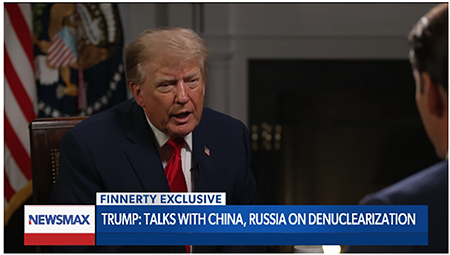
In an Oct. 15 interview with Newsmax, Trump claimed he is holding talks with Russia and China “about that denuclearization.” The following day, the Chinese Foreign Ministry said: “It is neither fair, reasonable nor realistic to ask China to join the so-called trilateral nuclear disarmament negotiations at this stage.”
On Oct. 19, in response to reports that Trump is open to a meeting proposed by Russian President Vladimir Putin and Chinese President Xi Jinping to discuss Russia’s war on Ukraine at the upcoming Asia-Pacific Economic Cooperation summit, the U.S. leader told reporters the talks were “not so much on Ukraine because Russia, frankly, has been fine on Ukraine, they haven’t been doing much, and the same with China.”
“We would have it to talk about weapons and denuclearization. If President Xi wants to have it, I’d have it,” Trump added.
After the Trump administration rejected Russia’s proposal that the United States and Russia continue to respect the central limits of the now expired New Strategic Arms Reduction Treaty, it said it would seek a “new, improved, and modernized Treaty that can last long into the future.” (See ACT, March 2026.) The administration has not explained what Trump would seek to achieve through such a dialogue, nor publicly outlined any arms control proposals.
However, in remarks Oct. 20 at the Reagan Presidential Library in California, Yeaw claimed that “Russia and China have expressed initial signs of openness to engage in strategic stability and arms control discussions, which we hope will lead to more intensive engagements and eventually a better arms control agreement than what has come before.”
“We’ve made clear that the United States is open to discussion with other nuclear states on strategic stability in arms control, and that there are no preconceived notions, no preconditions. In short, our door is open,” Yeaw said.
In Oct. 1 remarks at the annual meeting of the Valdai Discussion Club in Russia, Putin said the Kremlin is ready to resume a nuclear arms control dialogue with the White House.