


“Your association has taken a significant role in fostering public awareness of nuclear disarmament and has led to its advancement.”
U.S., Iran Threaten Escalation as Diplomacy Stalls
November 2026
By Kelsey Davenport and Shaghayegh Chris Rostampour
Iran said the U.S. response to its proposal to reopen the Strait of Hormuz and begin negotiations on a nuclear deal was insufficient, increasing the risk that conflict intensifies as both sides threaten to escalate.
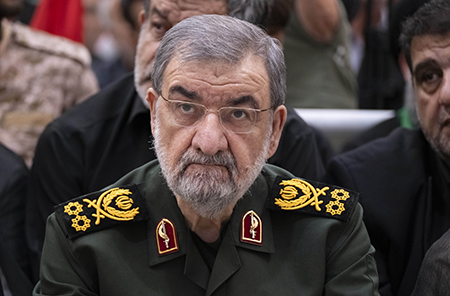
Mohsen Rezaei, Supreme Leader Ayatollah Mojtaba Khamenei’s representative to Iran’s Supreme National Security Council, confirmed that the United States responded to the proposal Iran put forward at the UN in September. (See ACT, October 2026.)
Although the United States “has agreed to some of Iran’s seven conditions,” the response was “INADEQUATE,” he wrote in an Oct. 11 post on the social media site X. “Iranian diplomacy has changed and there will be no return to the status quo ante,” he added.
Before Rezaei’s comment, U.S. officials, including Vice President JD Vance, had raised concerns about Iran’s proposal, noting that the Trump administration seeks concrete concessions on Iran’s nuclear program.
Nevertheless, U.S. President Donald Trump posted on Truth Social Oct. 8 that his administration was “having productive discussions” with Iran and the United States “will not be attacking Iran any time prior to the [U.S.] Midterm Elections” on Nov. 3.
CNN reported Oct. 15 that U.S. military plans to resume strikes on Iran include options to use the Massive Ordnance Air Blast (MOAB) bomb on nuclear sites and energy infrastructure.
When Newsmax asked Trump about the CNN report in an interview later that day, he did not confirm or deny if he would use the MOAB, which, if detonated near populated areas, could lead to devastating civilian casualties. Trump noted that the MOAB is “not nuclear at all. This is just an extremely large bomb.” He said the United States does not need to use nuclear weapons to defeat Iran. When asked whether he would send ground troops into Iran, Trump said, “No, I don’t see that.”
It is not clear how using the MOAB would advance U.S. strategic objectives. As an air blast bomb, the MOAB is unlikely to significantly damage Pickaxe Mountain, a deeply buried Iranian nuclear facility that Trump has threatened to strike. A MOAB would destroy energy infrastructure, and any use near populated areas would have a devastating effect on civilians. The United States has used the MOAB only once in conflict, on an Islamic State tunnel complex in Afghanistan in 2017.
Comments from Iranian officials suggest Tehran would view any use of the MOAB as a clear escalation.
The deputy coordinator of the Islamic Revolutionary Guards Corps, Brig. Gen. Mohammad Reza Naqdi, warned that if the United States makes the wrong move, Iran “will come for you with the father of bombs, and all your assets will be at risk.” The MOAB is often referenced as a backronym for “mother of all bombs.” Naqji, speaking Oct. 18 at a rally in the northern city of Sari, said that the United States could not achieve its objectives using heavy bombs, according to the Tehran Times.
Rezaei made a similar comment in an Oct. 18 post on X, announcing that “Iran’s armed forces have prepared a more devastating plan” compared to the 12-day war in June 2025, and the first six weeks of the ongoing war that began Feb. 28. “Iran’s new operational plan will not proceed with rules that they know,” he wrote.
The threats by both sides to escalate come as each continues to profess interest in reaching an agreement to end the conflict and address the nuclear issue.
Iranian President Masoud Pezeshkian emphasized that Tehran is still interested in negotiations. He also reiterated in an Oct. 16 meeting with the Georgian Prime Minister Irakli Kobakhidze that “Iran is not seeking nuclear weapons” and called the allegations “malicious propaganda against our country.”
Despite Rezaei’s statement indicating a shift in Iran’s approach to negotiations, Iranian Foreign Minister Abbas Araghchi said Oct. 18 that Tehran is reviewing U.S. comments on its proposal, which is “still on the table.”
Speaking to reporters in Baghdad at a meeting of the Organization of Islamic Cooperation, Araghchi said, “if there is any honesty on the U.S. part, which there isn’t, the way to reopening the Strait of Hormuz is obvious.” A month after the illegal U.S. and Israeli strikes on Iran began, Tehran closed the Strait of Hormuz, a strategic shipping route between Iran and Oman, in retaliation March 27. Although some ships are now transiting the Strait, volume is down, and Iran continues to strike ships in the waterway.
Neither Araghchi nor Rezaei provided any details on the U.S. response, but Vance suggested that the United States is looking for Iran to take more concrete action on its nuclear program. In an Oct. 5 interview with Reuters, Vance said that Iran needs to make a “meaningful” reduction in its uranium enrichment to meet U.S. demands. He said that if Iran wants “to show a commitment to not building a nuclear weapon, they would do something meaningful on their enrichment capacity.”
Vance was implicitly referring to the limitations in a future nuclear agreement—because Iran does not appear to be currently enriching uranium, International Atomic Energy Agency Director-General Rafael Mariano Grossi told The Association Press Oct. 28. Enrichment activity ceased at Natanz and Fordow in 2025, when the United States and Israel struck the facilities.
Vance’s comments are a shift from conditions Trump articulated in the past, which included a multiyear freeze on uranium enrichment or a commitment to give up enrichment entirely. It is unclear if Vance’s comments reflect the U.S. position as conveyed to Iran.
In response to Vance’s comments, the head of the Atomic Energy Organization of Iran, Mohammad Eslami, reiterated Iran’s long-standing position on enrichment, saying Oct. 7 that “Enrichment is an integral part of the nuclear process, and we will not abandon it in any way.”
Vance also told Reuters “it’s not totally clear how their country makes decisions.” Iranian Foreign Ministry spokesman Esmail Baghaei disputed Vance’s remark in an Oct. 7 press briefing, countering that the problem “lies in the contradictory positions and mixed messaging from U.S. officials.”
Despite Pezeshkian’s and Araghchi’s assertions that Iran seeks a deal, factions in Tehran continue to debate whether the country should remain party to the nuclear Nonproliferation Treaty. (See ACT, October 2026.)
Mohammad Javad Haj Ali Akbari, an imam who leads Friday prayer in Tehran and is the chief of Iran’s Friday Prayer Policy Council, said Oct. 8 that the “people’s expectation is for us to revise our nuclear doctrine. [The people ask] why should we still remain party to the NPT?”