


“The Arms Control Association and all of the staff I've worked with over the years … have this ability to speak truth to power in a wide variety of venues.”
How Appeasing Putin Heightens Nuclear Dangers
November 2026
By Daryl G. Kimball
Last month, U.S. President Donald Trump was asked about reports that his counterparts, Vladimir Putin of Russia and Xi Jinping of China, proposed a three-way meeting with Trump to discuss Russia’s war on Ukraine at November’s Asia-Pacific Economic Cooperation summit in China.
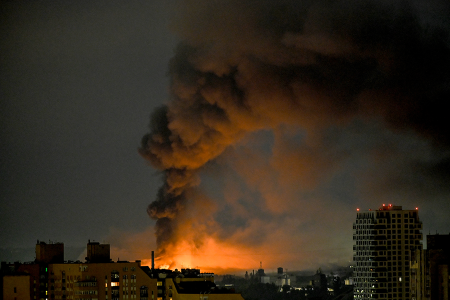 Trump responded that the talks were “not so much on Ukraine because Russia, frankly, has been fine on Ukraine.… We would have it to talk about weapons and denuclearization.”
The statement highlights Trump’s inexcusable enabling behavior toward Putin and his five-year-long illegal assault on the U.S. democratic ally, Ukraine. It shows Trump’s affinity for authoritarians and signals to Putin that he can press on with his vicious missile attacks on Ukrainian cities, infrastructure, and civilians; continue using chemical weapons and cluster munitions on the conflict’s front lines; and try to erase Ukraine as a sovereign state.
Trump’s conduct toward Putin ignores his threats of nuclear weapons use against non-nuclear states that might threaten Russia, undermines European trust in U.S. intentions, and encourages the Kremlin to continue hybrid attacks against NATO members to probe for weaknesses.
Talks on ending the war on Ukraine must involve Ukraine and will only succeed with a tougher U.S. approach to Russia. The United States should advocate for an outcome that ends Russia’s attacks, secures its withdrawal from Ukrainian territory, and creates the opportunity for durable new security arrangements that reduce Russia-NATO tensions.
Meanwhile, denuclearization talks with Russia and China are overdue. As despicable as Putin is, it is in the U.S. and European interest that U.S., Chinese, and Russian diplomats, based on serious preparation and realistic proposals, negotiate, bilaterally or multilaterally, meaningful restraints to halt and reverse the costly, arms race that the states are pursuing in the name of deterring each other’s aggressive and destabilizing behavior.
Unfortunately, the hostile Russian behavior against Ukraine that Trump encourages is the same behavior that his defense establishment cites as the basis for augmenting U.S. tactical nuclear weapons to fight and “prevail” in a future war with Russia in Europe and to counter potential Chinese aggression against Taiwan.
The Pentagon’s latest nuclear strategy review calls for more “credible” options to threaten to use or use tactical nuclear weapons in a regional war. It is an update of the 2018 and 2022 nuclear posture reviews, which declare that Washington might use nuclear weapons first in extreme circumstances in response to non-nuclear strategic attacks against itself or allies and partners.
In response, the National Nuclear Security Administration is moving to design and produce new nuclear weapons faster. Earlier this year, it launched a unified “rapid and advanced capabilities” program for “assessing, designing, prototyping, and demonstrating advanced systems.” The administration has proposed a program budget of $499 million in fiscal year 2027. A separate $100 million “futures program” would develop three new weapons designs, including a modern bunker-buster bomb.
The United States already has at least two types of tactical nuclear weapons in the stockpile: the B61-12 gravity bomb and the W76-2 low-yield warhead for the Trident II submarine-launched ballistic missile. The Navy is also acquiring a new nuclear-capable sea-launched cruise missile that may be available by the end of the decade.
Nevertheless, as Assistant Secretary of State Christopher Yeaw declared in a speech Oct. 19, “as we modernize our nuclear triad, we will develop additional options to support deterrence and escalation management …[to] ensure the president has expanded decisions space with credible options that are not simply suicide or surrender.” Translation: The United States will be prepared to use nuclear weapons to prevail or try to end a conflict.
The reality is that if nuclear weapons were used in a conflict involving another nuclear-armed adversary, there is no guarantee it will not result in all-out global thermonuclear war.
As McGeorge Bundy, George F. Kennan, and former Arms Control Association Board Members Robert S. McNamara, and Gerard C. Smith wrote in Foreign Affairs in 1982, “The time has come for careful study of the ways and means of moving to a new Alliance policy and doctrine: that nuclear weapons will not be used unless an aggressor should use them first.”
They warned: “It is time to recognize that no one has ever succeeded in advancing any persuasive reason to believe that any use of nuclear weapons, even on the smallest scale, could reliably be expected to remain limited.”
What was true then is also true today: It is in the U.S. and global interest for nuclear-armed states to rule out the first use of nuclear weapons in any conflict, severely minimize their nuclear arsenals, and negotiate verifiable agreements that move us toward a world without nuclear weapons.
After six years in office, however, Trump is failing on “denuclearization” diplomacy. Instead, he is “renuclearizing.” Congress can help effect a course correction by canceling the Trump administration’s dangerous plan for new tactical nuclear weapons and pressing Trump to engage in serious, balanced, and sustained talks on strategic and sub-strategic nuclear arms control with Russia and China.