


“We continue to count on the valuable contributions of the Arms Control Association.”
Pyongyang Launches New Missile After Seoul Urges Sanctions Relief
October 2026
By Kelsey Davenport
North Korea launched a new missile system and commissioned a naval destroyer amid South Korean calls for the United States to offer North Korea sanctions relief if it froze its nuclear weapons development.
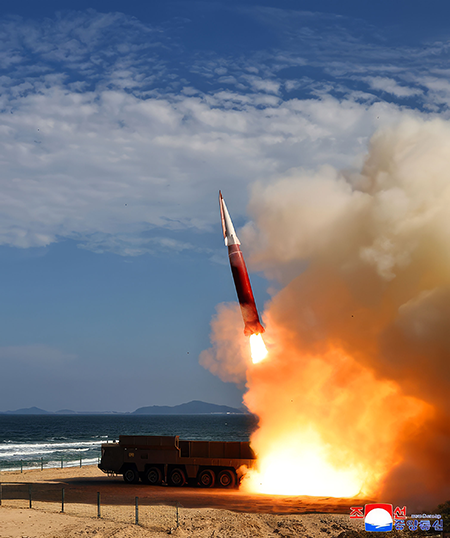
South Korea’s Joint Chiefs of Staff confirmed in a Sept. 20 statement that it detected and tracked two separate launches from North Korea’s east coast toward the Sea of Japan earlier that day. The missiles traveled about 280 and 370 miles, respectively.
According to a Sept. 22 report in the state-run Korean Central News Agency (KCNA), North Korea’s Missile Administration “successfully tested a new-type weapon, which is of great significance in the rapid development of weapon systems.” KCNA noted that North Korean leader Kim Jong Un oversaw the test and said the new missile was a “striking demonstration of ultra-modern defense technology and clear progress in the modernization of the armed forces.”
The report did not provide any details on what new capabilities North Korea tested, but Kim said that the “enemy will know better what such progress means without any explanation in the aspect of military technology.” Photos published in state-run media suggest that the missiles launched were short-range systems with hypersonic glide vehicles, dubbed the Hwasong-11E-1.
Before the missile test, Kim commissioned a new naval destroyer at the Wonsan Port Sept. 6. The ship, North Korea’s second Choe Hyon-class destroyer, “will reliably defend the inviolable maritime sovereignty and interests of our state,” KCNA said in a Sept. 7 statement. Kim implied that the destroyer is nuclear-capable. According to KCNA, he said that North Korea should “ensure that the diversified and effective operation of nuclear combat systems is conducted for an actual war through developing our navy into a nuclear-armed force.”
To stop further North Korean nuclear weapons development, South Korean President Lee Jae Myung, in a Sept. 18 interview with The New York Times urged the United States to offer to ease sanctions in return for a freeze on North Korea’s program. He said South Korea estimates that North Korea is producing, or capable of producing, 10-20 nuclear weapons per year. He raised concerns that Pyongyang may be willing to sell nuclear warheads once it “has accumulated enough nuclear weapons and missiles to guarantee its survival.”
Lee said there is “significant value in a trade-off between sanctions—which are not particularly effective anyway—and a stop to the development of additional nuclear weapons and intercontinental ballistic missile technology.” He also said that pursuing a nuclear weapons freeze would be more effective than pursuing denuclearization, which “guarantees that nothing will be accomplished.” Over time and with reciprocal incentives, he suggested that North Korea may be willing to reduce its nuclear arsenal.
U.S. President Donald Trump has expressed interest in meeting with Kim, but North Korea continues to reiterate that Kim is not in communication with Trump about a summit. (See ACT, September 2026.) North Korea also says that the United States must drop its demand for denuclearization before talks can occur. The Trump administration, however, indicated that it wants to engage North Korea on the basis of the 2018 Singapore summit declaration that Trump and Kim signed, calling for denuclearizing the Korean peninsula.