


“The Arms Control Association and all of the staff I've worked with over the years … have this ability to speak truth to power in a wide variety of venues.”
UN Holds First Nuclear Victim Assistance Meeting
October 2026
By Shaghayegh Chris Rostampour and Libby Flatoff
The United Nations convened its first international meeting on victim assistance and environmental remediation in September as it began to formally address the real-world consequences of nuclear weapons use and testing.
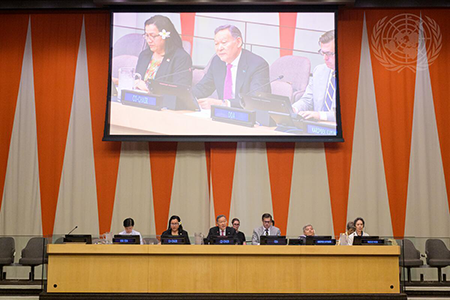
The Sept. 1 meeting brought together UN member and observer states, as well as affected communities, civil society organizations, scientists, academics, and other experts. It was held pursuant to General Assembly resolutions 79/60 and 80/56 and was co-chaired by Kazakhstan and Kiribati, two countries affected by nuclear testing.
“The consequences of nuclear weapons do not end when an explosion is over,” UN High Representative for Disarmament Affairs Izumi Nakamitsu said in opening the session. She said the meeting’s goal would be “to exchange experiences and views, advance international cooperation, and identify practical ways to support people and communities affected by the use and testing of nuclear weapons.”
In all, representatives of 20 UN member states and the Holy See shared national perspectives and experiences related to the humanitarian and environmental consequences of nuclear weapons use and testing.
Marshall Islands Ambassador to the UN John Silk, whose country experienced 67 U.S. nuclear tests from 1946 to 1958, called for strengthened and targeted assistance from the UN and other international partners in obtaining independent and external assessments of contamination. “Commitments and needs … remain unmet,” by the United States, Silk said. (See ACT, November 2023.)
Japan’s deputy UN ambassador, Shigeru Umetsu, expressed support for the UN Independent Scientific Panel on the Effects of Nuclear War in accurately understanding the physical and societal consequences of nuclear weapons. He highlighted his country’s approximately $7 million donation in grant aid for medical equipment for people affected by nuclear testing in Kazakhstan.
Discussions throughout the meeting addressed the need for greater attention to long-term health monitoring and care, compensation and recognition for affected communities, environmental remediation, and greater access to scientific and historical information.
During one panel, speakers called for greater international cooperation and funding, including the establishment of an international trust fund. Civil society activists welcomed plans for separate discussions within the framework of the Treaty on the Prohibition of Nuclear Weapons (TPNW) toward establishing such a fund for victims’ assistance. Representatives of communities affected by nuclear weapon development and testing shared their experiences.
The meeting concluded with the co-chairs announcing plans to prepare a summary of recommendations raised during the discussions for submission to the UN Secretariat. Civil society and UN delegates will gather again to address the dangers of nuclear weapons and an international trust fund for victim assistance and environmental remediation at the first TPNW Review Conference in New York Nov. 30-Dec. 4.
The UN meeting occurred during a time of renewed attention toward assistance for communities affected by nuclear weapons testing and development on an international and national level.
On Aug. 17, U.S. Reps. James Moylan (R-Guam) and 10 co-sponsors introduced the bipartisan Radiation Exposure Compensation Reauthorization Act of 2026, which would extend and expand the 1990 federal program providing compensation to people affected by radiation exposure from U.S. nuclear activities. (See ACT, September 2023.) The bill would extend the program’s application deadline by 15 years and expand its geographic and categorical scope. The program was previously extended through 2028 and expanded following a long-fought congressional debate over the scope of coverage and its costs. (See ACT, July/August 2025.)
In the United Kingdom, former Defense Minister Tobias Ellwood wrote in The Guardian Sept. 2 that nuclear-test veterans had been the victims of what he described as one of Britain’s “greatest scandals.”
Ellwood acknowledged that he had given Parliament incorrect information in 2018 after being told by UK Defense Ministry officials that no records of veterans’ blood samples existed. The records could be relevant to efforts to establish a connection between radiation exposure and veterans’ health problems in supporting claims for compensation. Ellwood also called for compensation for affected veterans.
Although the UN meeting addressed assistance for nuclear weapons use and testing issues, there also have been recent developments in the United States regarding legislation to expand the Radiation Exposure Compensation Act, and in the UK regarding claims for compensation for nuclear- test veterans.